
Introduction
Austria is one of the most stable and prosperous nations in Europe, offering an exceptional quality of life, a robust economy, and endless professional opportunities. For skilled professionals from across the globe, the path to living and working in this beautiful country is primarily paved through the Red-White-Red Card immigration system.
If you have ever dreamt of working in Vienna, Salzburg, or Linz, you have likely come across the need to verify your eligibility. The Austria PR Points Calculator is your primary tool for navigating this complex system. This guide will demystify the points-based immigration model, explain how your specific profile determines your success, and provide a roadmap to help you secure your future in Austria. Whether you are an IT specialist, an engineer, or a creative entrepreneur, understanding these requirements is the first step toward building a new life in the heart of Europe.
What Is the Austria PR Points Calculator?
The Austria PR Points Calculator is an essential orientation tool for third-country nationals (non-EU/EEA/Swiss) who wish to move to Austria. Because Austria manages its labor market needs through a points-based system, it uses objective criteria to determine whether an applicant’s skills, experience, and background match the current requirements of the Austrian economy.
Why Does Austria Use a Points System?
Austria utilizes this system to prioritize highly skilled talent in sectors that are currently experiencing labor shortages. By assigning points to your qualifications—such as education, language proficiency, age, and professional experience—the government ensures a streamlined integration process for those who are most likely to contribute positively to the Austrian workforce.
Eligibility vs. Approval
It is vital to distinguish between eligibility and final approval.
- Eligibility is what the calculator helps you determine; it tells you if you meet the minimum threshold to submit an application.
- Approval is the final verdict issued by the Public Employment Service (AMS) and the immigration authorities after verifying your documentation and job offer.
Austria PR Points System Explained
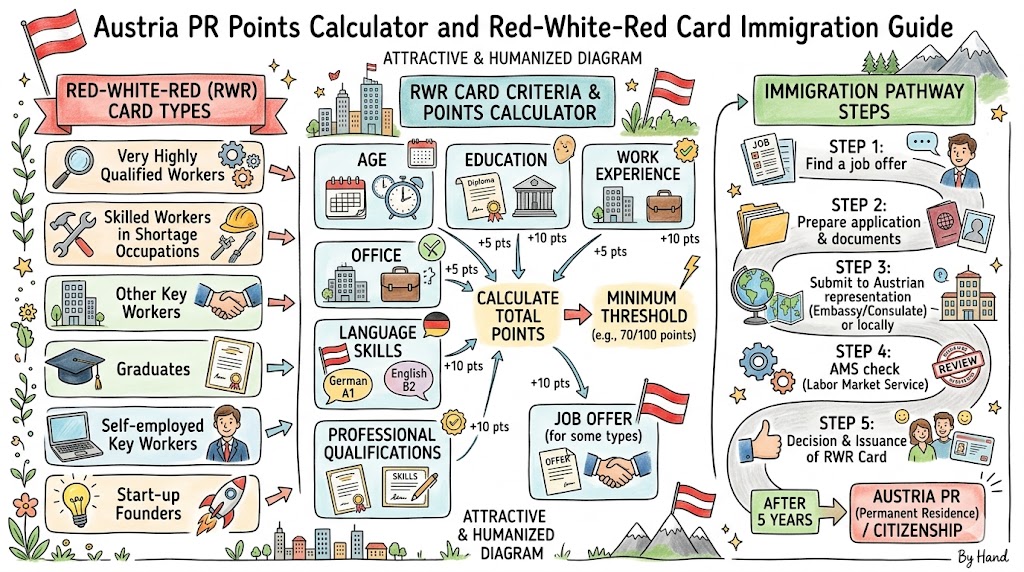
The points system is dynamic and varies slightly depending on which category of the Red-White-Red (RWR) Card you are applying for. However, most categories focus on the same core pillars of your professional profile.
Core Scoring Factors
- Education: Higher academic degrees—especially those from accredited universities—carry significant weight.
- Work Experience: Experience in your specific field of expertise is highly valued, with extra points awarded for experience gained within Austria.
- Age: Younger professionals generally receive more points, as they are expected to contribute to the labor market for a longer duration.
- Language Skills: Proficiency in German or English is a key indicator of integration potential. Even basic certifications can bridge the gap in your total score.
- Bonus Points: Certain categories offer bonuses for things like research activity, patents, or specific achievements in management.
Red-White-Red Card System Categories
The Red-White-Red Card isn’t a one-size-fits-all permit. It is tailored to specific professional pathways.
| Category | Best For | Requirement Highlights |
| Highly Qualified Workers | Scientists, experts, senior managers | No job offer required initially; 70-point minimum. |
| Skilled Workers (Shortage) | IT, engineering, healthcare professionals | Job offer required; 55-point minimum. |
| Other Key Workers | Specialized professionals with a contract | Job offer required; 55-point minimum. |
| Startup Founders | Entrepreneurs with innovative ideas | Business plan; financing; 50-point minimum. |
How Austria PR Points Are Calculated
To calculate your total, you must look at the specific point breakdown for your chosen category. Below is a simplified overview of how points are distributed across the most common pathways.
| Criteria | Maximum Points (Approx.) | Impact on Application |
| Qualifications | 30–40 | Determines your baseline professional value. |
| Work Experience | 20 | Recognizes your career history and expertise. |
| Language Skills | 25 | Reflects your ability to integrate into the workplace. |
| Age | 15–20 | Factor in your long-term career potential. |
Real-Life Sample Profile
Consider a 30-year-old software developer with a Master’s degree and 4 years of experience, holding an A2 German certificate. They would receive high points for their degree, solid points for experience, and additional points for their age and language, easily crossing the 55-point threshold for a Shortage Occupation application.
Step-by-Step Application Process
Securing your Red-White-Red Card is a sequential journey.
- Check Eligibility: Use the calculator to ensure you meet the minimum point threshold for your specific category.
- Collect Documentation: Compile your passport, degree transcripts, employment references, and language certificates.
- Secure a Job Offer: For most categories, having an employer in Austria is mandatory.
- Application Submission: You or your employer can file the application at the local authority in Austria or the nearest Austrian embassy.
- AMS Evaluation: The AMS conducts a labor market test to ensure that the position cannot be filled by a local worker.
- Approval & Entry: Once approved, you will receive your visa to enter Austria and collect your residence card.
Processing Time, Validity, and The Path to PR
The Red-White-Red Card is generally issued for 24 months and is tied to a specific employer. However, this is not the end of your journey. After 21 months of qualifying employment, you are eligible to transition to the Red-White-Red Card Plus. This status provides you with “free access” to the labor market, meaning you can change employers without needing a new permit. After 5 years of legal residency, you become eligible to apply for Permanent Residency (PR), and eventually, citizenship.
Strategies to Increase Your Points
If your initial assessment falls short, you have actionable ways to boost your score:
- Language Certification: Language is one of the few variables you can quickly influence. Enrolling in a German A1 or A2 course often provides the missing points.
- Credential Recognition: Ensure your foreign degrees are formally recognized or equivalent to Austrian standards.
- Focus on Shortage Occupations: Review the current national shortage list; your job title might be in high demand, which lowers the required point threshold.
- Get a Job Offer: If you are applying under the “Other Key Workers” category, a confirmed job offer is your strongest asset.
Common Mistakes to Avoid
- Category Mismatch: Applying as a “Highly Qualified” worker when your profile fits “Skilled Worker” better can lead to an immediate rejection.
- Outdated Documents: Ensure your police clearance and medical certificates are current and legally translated.
- Ignoring Collective Agreements: Your job offer must meet the legal minimum wage (collective bargaining agreement) for your position in Austria.
- Applying Without Proof: Never guess your points. If you claim 20 points for experience, you must provide written proof of that experience.
Real-Life Examples
The IT Specialist
- Profile: 35 years old, Bachelor’s degree in Computer Science, 6 years experience, English-speaking environment.
- Outcome: Highly likely to qualify under the “Skilled Workers in Shortage Occupations” category. Their points for experience and education provide a safe margin above the required 55 points.
The Recent Graduate
- Profile: 24 years old, Master’s degree from an Austrian university, no work experience.
- Outcome: As a graduate of an Austrian institution, they often have a fast-track route, allowing them to bypass some of the traditional experience-based point hurdles.
Frequently Asked Questions
- What is the Austria PR Points Calculator? An orientation tool for the Red-White-Red Card.
- Is German required for all visas? Not for all, but it is highly recommended for integration and extra points.
- How many points are needed? Typically 55 for skilled workers and 70 for highly qualified individuals.
- Can I apply without a job offer? Yes, only if you qualify as a “Highly Qualified Worker.”
- What is the RWR Plus Card? The next step after your initial RWR card, offering full job market flexibility.
- How long does processing take? Generally a few months; it varies by consulate.
- Is experience outside Austria counted? Yes, provided it is relevant to the job offer.
- Does my family move with me? Yes, the RWR card allows for family reunification under certain conditions.
- What if I don’t have a degree? You may still qualify under “Skilled Workers” if you have significant experience and vocational training.
- Can I change jobs? Only after obtaining the RWR Plus card or under specific circumstances.
Conclusion
The Austrian immigration system is a structured, merit-based pathway that rewards preparation and professional clarity. By utilizing the Austria PR Points Calculator, you have already taken a significant step toward transforming your career aspirations into a tangible reality. Moving to a new country is an ambitious undertaking, but the clarity provided by the Red-White-Red Card system ensures that if you have the skills, dedication, and right documentation, there is a clear path forward.
Remember, your score is not just a number—it is a reflection of your hard-earned experience and academic dedication. Don’t be discouraged if you aren’t yet at the maximum; focus on your language skills and seek out roles in high-demand sectors. Austria values global talent, and the steps you take today will build the foundation for your professional life in Europe. Stay diligent, keep your documents in order, and prepare for your move with confidence. Your future in Austria is waiting.
