Introduction
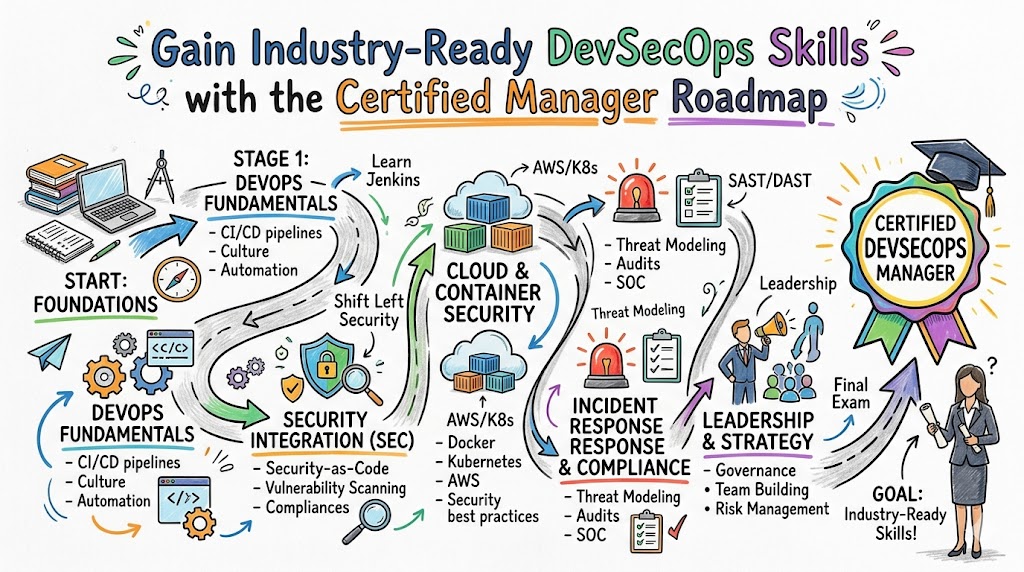
In the modern enterprise, the wall between security and delivery is crumbling. The Certified DevSecOps Manager program is built for those who understand that security is a feature, not a bottleneck. As cloud-native architectures become the standard, the ability to weave security directly into the fabric of your CI/CD pipeline has become the most sought-after skill in the industry. Whether you are leading a team of engineers or architecting complex cloud systems, this guide will help you navigate the landscape of devopsschool and align your technical journey with the growing demand for security-conscious leadership. If you are also interested in the intelligence-driven side of modern operations, explore aiopsschool to further expand your technical repertoire.
What is the Certified DevSecOps Manager?
The Certified DevSecOps Manager represents a commitment to bridge the gap between high-velocity development and rigorous security governance. It is not just about learning a security scanner; it is about learning how to design automated guardrails that empower developers to write secure code without sacrificing speed. This certification represents the shift from reactive, ticket-based security to proactive, integrated security-as-code. It is a benchmark for professionals who want to own the “secure delivery” mission within their organizations, ensuring that every deployment is reliable, compliant, and resilient against modern threats.
Who Should Pursue Certified DevSecOps Manager?
This program is tailored for experienced engineers and leaders who have already spent time in the trenches of DevOps or SRE. It is ideal for engineering managers who need to translate security mandates into team-level workflows, as well as lead engineers who want to move into program ownership. Cloud architects and security specialists who are tired of being “the department of no” will find the curriculum shifts their focus toward being “the enablers of speed.” Whether you are based in India’s booming tech hub or part of a global engineering organization, this certification provides the universal language of secure, automated software delivery.
Why Certified DevSecOps Manager
As companies face increasing pressure to adopt cloud-native technologies while meeting strict regulatory requirements, the demand for leaders who can handle both has skyrocketed. This certification remains valuable because it focuses on core principles—like threat modeling, automated governance, and cultural change—that outlast the latest tool trends. It provides a massive return on time by equipping you with the authority to influence architecture and the practical knowledge to implement it. Professionals who hold this credential are often the ones defining how their companies handle the next generation of software supply chain risks.
Certified DevSecOps Manager Certification Overview
The Certified DevSecOps Manager program, hosted on [devopsschool], is a practitioner-led curriculum designed to test your ability to manage complexity. It is structured around the reality of production environments, moving away from simple exam questions toward assessment-based project work. The certification demonstrates that you are not just capable of passing a test, but that you have the skills to implement real, lasting change in an enterprise environment, providing a clear signal of your technical seniority to stakeholders.
Certified DevSecOps Manager Certification Tracks & Levels
The tracks are built to accommodate different levels of involvement, from those managing day-to-day pipeline security to those building organizational-wide security strategies. Foundation tracks establish the baseline of security-as-code, while professional tracks force you to deal with compliance and large-scale pipeline governance. Advanced levels move into architecture and risk management, ensuring that you have a clear path from a hands-on engineer to a strategic decision-maker who can oversee security for entire product portfolios.
Complete Certified DevSecOps Manager Certification Table
| Track | Level | Who it’s for | Prerequisites | Skills Covered | Recommended Order |
| Security Operations | Foundation | Aspiring Security Champions | Basic CI/CD, Linux | Automated Security Basics | 1 |
| Pipeline Management | Professional | DevOps/SRE Leads | Professional Pipeline Experience | Governance & Scanning | 2 |
| Strategy & Design | Advanced | Engineering Managers | Architecture Experience | Compliance & Risk | 3 |
Detailed Guide for Each Certified DevSecOps Manager Certification
Certified DevSecOps Manager – Foundation Level
What it is
This certification validates the fundamental ability to integrate security tools into standard software development workflows.
Who should take it
It is designed for DevOps engineers and developers who are ready to take on security as a core responsibility.
Skills you’ll gain
- Understanding the shift-left security mindset.
- Basics of CI/CD pipeline hardening.
- Integration of SAST tools in pipelines.
Real-world projects you should be able to do
- Configure a pipeline that blocks code if vulnerabilities are found.
- Implement basic secret scanning to prevent credential leaks.
- Create a simple security dashboard for your project.
Preparation plan
- 14 days: Review the DevSecOps lifecycle and tool integration basics.
- 30 days: Hands-on lab practice implementing scanners in a sandbox environment.
- 60 days: Conduct a mock assessment and refine your pipeline designs.
Common mistakes
Focusing too much on the “security” part and ignoring the “dev” efficiency. Trying to automate everything at once without establishing a baseline.
Best next certification after this
- Same-track option: Professional Level Certification.
- Cross-track option: Cloud Security Specialist.
- Leadership option: Team Management Fundamentals.
Choose Your Learning Path
DevOps Path
The DevOps path teaches you how to streamline infrastructure, focusing on automation, container orchestration, and continuous delivery. You will become the bridge between development and operations, ensuring systems are both efficient and resilient, which serves as the bedrock for all other security integrations.
DevSecOps Path
The DevSecOps path is the specialization that brings security into the heart of your pipelines. You will learn to manage automated security gates, compliance, and threat intelligence as part of your day-to-day release process, turning security into a catalyst for faster, safer deployments.
SRE Path
The SRE path is dedicated to site reliability, focusing on observability, incident management, and error budgets. You will learn to use data-driven approaches to ensure system stability, helping you build systems that can withstand failures while remaining secure and performant under load.
AIOps Path
The AIOps path focuses on leveraging artificial intelligence for operational efficiency. You will learn to automate log analysis, predict system failures, and reduce “noise” in your monitoring tools, allowing your team to focus on proactive improvements rather than constant manual firefighting.
MLOps Path
The MLOps path is for those managing the machine learning lifecycle. You will learn to ensure model reproducibility, data integrity, and pipeline security, which is critical as AI models become core components of modern software architecture and need to be secured like any other code.
DataOps Path
The DataOps path focuses on data orchestration and pipeline quality. You will learn to manage large-scale data workflows, ensure data security and compliance at rest and in transit, and provide a stable foundation for analytics and data-driven decision-making across the enterprise.
FinOps Path
The FinOps path deals with cloud financial management. You will learn to monitor cloud usage, optimize costs, and align infrastructure spending with organizational value, ensuring that your technical decisions are not just architecturally sound, but also economically sustainable.
Role → Recommended Certified DevSecOps Manager Certifications
| Role | Recommended Certifications |
| DevOps Engineer | Professional Level |
| SRE | Professional Level |
| Platform Engineer | Advanced Level |
| Cloud Engineer | Foundation/Professional |
| Security Engineer | Advanced Level |
| Data Engineer | Foundation |
| FinOps Practitioner | Professional |
| Engineering Manager | Advanced Level |
Next Certifications to Take After Certified DevSecOps Manager
Same Track Progression
Deepen your knowledge by tackling advanced security architecture or specific cloud-native security certifications. This allows you to master the nuances of policy engines, service mesh security, and zero-trust networking, which are essential for large-scale enterprise environments.
Cross-Track Expansion
Expand your skill set into SRE or FinOps. A DevSecOps professional who also understands reliability and financial optimization is a triple-threat leader, capable of making architectural decisions that optimize for security, speed, stability, and cost all at once.
Leadership & Management Track
For those aiming at the C-suite or senior director roles, transition into governance and risk management certifications. These will provide you with the tools to handle the strategic side of security, such as legal compliance, crisis management, and the organizational politics of security adoption.
Training & Certification Support Providers for Certified DevSecOps Manager
DevOpsSchool provides a robust environment for learning, with deep-dive technical courses that help professionals master the practical aspects of DevSecOps.
Cotocus offers specialized, hands-on workshops that are ideal for teams looking to adopt DevSecOps and improve their internal security culture.
Scmgalaxy is a key provider for those focusing on the orchestration of complex CI/CD environments and the automation of delivery pipelines.
BestDevOps bridges the gap between traditional IT and modern cloud practices, providing high-quality training for diverse technical roles.
devsecopsschool stands out for its curriculum focused entirely on the intersection of security and development, ensuring deep topical expertise.
sreschool delivers training centered on system reliability and performance, providing the perfect counterpart to your DevSecOps training.
aiopsschool teaches the technical skills needed to integrate modern intelligence platforms into your existing IT operational workflows.
dataopsschool provides the necessary training for managing secure and reliable data delivery pipelines in modern, data-intensive enterprises.
finopsschool is the go-to resource for mastering the financial aspects of cloud, helping you manage budgets alongside your infrastructure.
Frequently Asked Questions (General)
- How does this certification compare to others?
This program is highly practical, focusing on the “managerial” and “design” aspects of security rather than just passing a theory-based test. - Is it suitable for a complete beginner?
It is not ideal for complete beginners; it is designed for those with some background in development, operations, or basic security. - How is the certification assessed?
Assessments are generally project-based or scenario-driven, focusing on your ability to apply concepts to real-world technical problems. - Will this help me get a raise or promotion?
In the current market, expertise in DevSecOps is highly valued and often correlates directly with higher salary tiers for senior roles. - Does the curriculum get updated?
Yes, the training is regularly updated to reflect new tools, emerging security threats, and shifting industry standards. - Are there any lab requirements?
Practical lab work is a central part of the program to ensure you have hands-on experience before completing your certification. - How do I manage the time for the training?
The training is designed with working professionals in mind, often offering flexible or self-paced options to fit your schedule. - Is this only for software engineers?
No, it is for anyone involved in the software delivery process, including SREs, cloud engineers, and technical managers. - How do I prove my skills to a potential employer?
The certification acts as a verified signal of your ability to handle complex DevSecOps environments and security implementation. - Can I use my existing company projects for the certification?
Many programs encourage applying course concepts to your actual job, which helps reinforce learning and adds immediate business value. - Do I need special hardware to take the labs?
Most labs run in the cloud or via virtualized environments, meaning you only need a stable internet connection and a laptop. - What if I get stuck during the training?
Mentorship and support are available through the platform, ensuring you can resolve technical blockers and keep your learning on track.
FAQs on Certified DevSecOps Manager
- How do I automate security without stopping production?
Focus on building “security gates” that run asynchronously or only block critical vulnerabilities, ensuring minimal friction for developers. - Is this certification about tool management?
No, it is about understanding how to integrate tools into an organizational process that maintains security throughout the entire lifecycle. - Does it cover Kubernetes security?
Yes, securing containerized workloads and Kubernetes clusters is a fundamental part of the professional and advanced modules. - How do I convince management to invest in DevSecOps?
Focus on the business benefits: risk mitigation, compliance, and reduced time-to-market by catching vulnerabilities early. - What role does threat modeling play?
It is a core pillar used to anticipate potential attack vectors before code is written, saving significant time during the development phase. - Can this help me manage security for third-party apps?
Yes, the program covers software supply chain security and how to manage the risks associated with external dependencies. - How do I measure DevSecOps success?
By tracking metrics like vulnerability remediation time, deployment frequency, and the percentage of automated tests passing. - Is there a focus on policy-as-code?
Yes, learning to define and enforce infrastructure policies automatically is a key learning outcome of the certification.
Final Thoughts: Is Certified DevSecOps Manager Worth It?
If you are a professional looking to distinguish yourself in a crowded market, this certification is one of the most effective ways to show you mean business. It is not just about gaining a credential; it is about adopting a mindset that will make you a more capable, strategic, and valuable asset to any engineering organization. If you are tired of the traditional “us versus them” mentality between security and engineering, this is your path to becoming the bridge that makes modern software delivery both possible and secure. Take the leap, build the skills, and start leading the change.
