Introduction
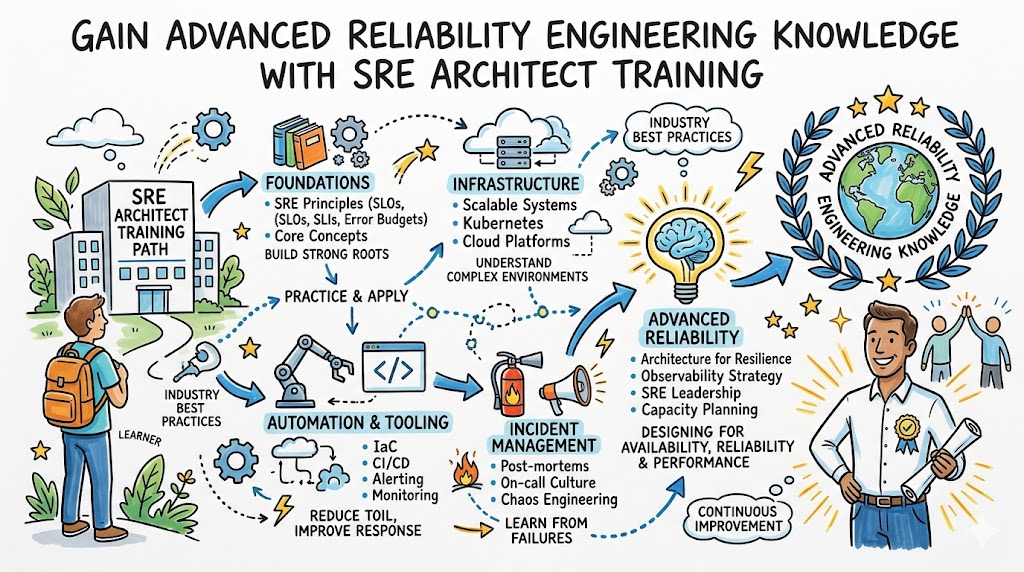
Operating enterprise-scale digital infrastructure requires a departure from traditional reactive administration toward proactive systemic design. This comprehensive blueprint is crafted for technology professionals navigating the modern complexities of high-availability systems, platform engineering, and automated cloud operations. Whether you are a hands-on systems engineer looking to codify your deployment experience or a director structuring an elite operations squad, this breakdown offers clear guidance. By analyzing the structured educational steps within the Certified Site Reliability Architect framework, technology practitioners can make informed architectural choices. Aligning these infrastructure paradigms with advanced automation frameworks found at aiopsschool allows organizations to deploy intelligent, autonomous, and self-repairing production ecosystems.
What is the Certified Site Reliability Architect?
The Certified Site Reliability Architect validation represents an advanced tier of professional expertise centered on systemic resilience and large-scale cloud operations. This curriculum exists to transform theoretical software design into scalable, concrete engineering realities capable of surviving real-world traffic anomalies. Instead of emphasizing passive text-based learning, the framework focuses heavily on practical operational exercises such as progressive rollouts, multi-region failovers, and telemetry design. It maps directly to modern enterprise engineering organizations by treating all operational infrastructure through an explicit software development lens.
Who Should Pursue Certified Site Reliability Architect?
This educational roadmap is structured specifically for infrastructure engineers, cloud developers, database administrators, and platform security specialists aiming to build unshakeable production foundations. It offers immediate value to senior engineering managers who require a standardized technical framework to measure team competency and operational readiness. For early-career professionals, it serves as an end-to-end master plan for building production systems correctly from day one. Globally, from the expanding technical enterprises across India to traditional corporate financial hubs, this program validates elite engineering capability.
Why Certified Site Reliability Architect
While software delivery tools, container runtimes, and cloud vendor features change frequently, the underlying laws governing distributed systems remain constant. This program provides engineers with foundational architectural patterns that survive tool migration cycles, keeping their technical skill sets highly valuable over long horizons. Modern enterprises consistently prioritize the reduction of expensive downtime, driving a massive corporate demand for qualified platform architects. The total dedication of time to this training yields significant returns by increasing an engineer’s systemic authority and organizational influence.
Certified Site Reliability Architect Certification Overview
The complete training and validation curriculum is delivered via interactive online learning portals and hosted directly on sreschool. The instructional path transitions logically from core telemetry tracking to complex, cross-region fault-tolerant infrastructure design. Candidates face rigorous, practical problem-solving evaluations that test active system troubleshooting capabilities rather than simple vocabulary recall. Achieving this professional credential proves that a specialist possesses the systemic vision and technical tactical skill needed to defend enterprise service level objectives.
Certified Site Reliability Architect Certification Tracks & Levels
The architectural educational pathway is divided into three distinct professional tiers: associate, expert, and principal mastery. Specialized curriculum tracks allow candidates to customize their training focus toward infrastructure automation, pipeline security, or deep financial resource optimization. The entry tier establishes unified engineering terminology, the intermediate tier tackles application design patterns, and the highest tier focuses on broad organizational platform strategy. This clear division allows individuals to systematically match their educational growth with their actual daily workplace responsibilities.
Complete Certified Site Reliability Architect Certification Table
| Track | Level | Who it’s for | Prerequisites | Skills Covered | Recommended Order |
| Operations | Foundation | Cloud Administrators | Basic Networking | Telemetry, Basic Incident Logs | First |
| Engineering | Professional | Systems Specialists | Operations Tier | Chaos Automation, Fallbacks | Second |
| Strategy | Advanced | Principal Architects | Engineering Tier | Cross-Region Design, Platform UX | Third |
Detailed Guide for Each Certified Site Reliability Architect Certification
Certified Site Reliability Architect – Foundation Level
What it is
This introductory credential certifies an engineer’s understanding of foundational service level engineering, basic alert structures, and standard post-incident documentation. It ensures that an individual can seamlessly integrate into standard infrastructure support systems and assist with ongoing operational health checks.
Who should take it
Software developers, fresh computer science graduates, technical support leads, and project coordinators who want to build a clean baseline understanding of modern systems engineering.
Skills you’ll gain
- Formulating measurable service level objectives based on real user behavior
- Configuring standard metrics dashboards using modern open-source telemetry tools
- Identifying recurring infrastructure toil and manual operational bottlenecks
- Participating constructively in corporate incident response workflows and reviews
Real-world projects you should be able to do
- Deploy a unified monitoring agent across a fleet of virtual instances to track localized system bottlenecks
- Create a structured, blameless post-mortem analysis for a simulated application performance degradation
Preparation plan
- 7 Days: Study core site reliability nomenclature, focusing on the specific math behind error budgets, service metrics, and data collection frequencies.
- 30 Days: Set up basic multi-tier applications in a local sandbox environment and configure real-time alert triggers based on traffic limits.
- 60 Days: This foundational validation layer does not require extended preparation cycles beyond a month of consistent, focused technical reading.
Common mistakes
- Setting too many irrelevant infrastructure alerts that cause immediate alert fatigue across engineering teams
- Treating post-incident reviews as a mechanism to assign blame rather than a technical learning opportunity
Best next certification after this
- Same-track option: Certified Site Reliability Architect – Professional Level
- Cross-track option: Certified DevSecOps Engineer – Associate
- Leadership option: Technical Team Lead Certification
Certified Site Reliability Architect – Professional Level
What it is
This intermediate tier validates an engineer’s capacity to architect, secure, and maintain complex microservice structures using advanced reliability strategies. It emphasizes active error budget management, progressive application rollouts, and defensive system coding practices.
Who should take it
Mid-career DevOps specialists, cloud migration engineers, and system administrators possessing a minimum of two years of hands-on infrastructure experience.
Skills you’ll gain
- Orchestrating progressive application delivery systems using automated canary patterns
- Integrating reliable circuit-breaking logic and request retry limits into distributed codebases
- Running controlled chaos injection experiments to locate hidden infrastructure dependencies
- Monitoring system boundaries utilizing deep distributed tracing technologies
Real-world projects you should be able to do
- Construct a deployment pipeline that automatically freezes code releases when service error budgets are violated
- Execute a targeted network partition test to observe database cluster replication and automatic election behaviors
Preparation plan
- 7 Days: Analyze detailed failure mode frameworks, microservice communication patterns, and advanced data persistence strategies.
- 30 Days: Write automated scripts to intercept infrastructure metrics and trigger auto-scaling events based on live performance data.
- 60 Days: Go through multiple real-world architectural failure case studies and complete full-length, scenario-based mock exams.
Common mistakes
- Implementing advanced chaos engineering tests before building basic infrastructure monitoring and observability frameworks
- Over-engineering applications with unnecessary microservices that introduce massive networking and debugging complexity
Best next certification after this
- Same-track option: Certified Site Reliability Architect – Advanced Level
- Cross-track option: Certified Cloud FinOps Specialist
- Leadership option: Systems Engineering Manager
Certified Site Reliability Architect – Advanced Level
What it is
This top-tier credential validates a professional’s mastery of global infrastructure design, large-scale technology transformations, and corporate platform engineering governance.
Who should take it
Principal engineers, chief technical architects, and enterprise infrastructure directors tasked with protecting the global availability of mission-critical systems.
Skills you’ll gain
- Designing globally distributed, active-active application architectures across multiple cloud zones
- Building internal developer platforms that maximize feature delivery speed while safeguarding system stability
- Creating company-wide disaster recovery policies and operational risk-mitigation guardrails
- Translating infrastructure availability achievements into concrete business performance metrics
Real-world projects you should be able to do
- Architect a zero-data-loss failover mechanism across distinct cloud providers to withstand total regional network outages
- Build a standardized, automated corporate platform blueprint that enforces architectural best practices across multiple teams
Preparation plan
- 7 Days: Review high-level global data consistency patterns, cloud compliance requirements, and macro-level financial modeling techniques.
- 30 Days: Critique and rewrite complex infrastructure design proposals to improve overall fault isolation and cost efficiency.
- 60 Days: Participate in peer-reviewed design defenses, review extensive cross-cloud enterprise case studies, and refine global incident response templates.
Common mistakes
- Crafting overly rigid technical compliance policies that severely hinder internal software developer delivery speeds
- Failing to align high-availability infrastructure spending with the actual financial value of the protected service
Best next certification after this
- Same-track option: Principal Infrastructure Fellow Designation
- Cross-track option: Executive AIOps Strategy Masterclass
- Leadership option: Enterprise Chief Technology Officer Track编
Choose Your Learning Path
DevOps Path
This pathway bridges the historical gap between rapid code feature development and stable infrastructure operations. Engineers master the art of injecting automated validation checks, code quality analysis, and reliability tracking directly into continuous integration pipelines. The training focuses on artifact tracking, automated release rollbacks, and blue-green environments to ensure software deployment carries minimal operational risk.
DevSecOps Path
This specialized methodology incorporates proactive security auditing directly into modern site reliability and infrastructure workflows. Professionals learn to build automated configuration scanning, image signing, and runtime security monitoring into their pipelines without slowing down standard delivery cadences. The focus is on establishing immutable infrastructure patterns and creating highly resilient defensive guardrails around sensitive data layers.
SRE Path
The core site reliability path focuses entirely on maximizing service uptime, optimizing compute performance, and eliminating systemic operational toil. Specialists learn to manage system risk mathematically through the strict application of error budgets and advanced telemetry analytics. The instructional journey moves from basic resource monitoring to building autonomous, software-driven infrastructure systems that heal themselves during production anomalies.
AIOps Path
This advanced curriculum introduces artificial intelligence models into standard infrastructure workflows to automate problem detection and remediation. Specialists learn to apply machine learning algorithms to millions of disparate telemetry streams, allowing for proactive anomaly identification before outages impact consumers. The path prepares engineers to oversee highly complex systems that are too vast for manual human monitoring.
MLOps Path
This track targets the distinct challenges associated with running complex machine learning workflows and model training clusters at scale. Engineers study the reliability of distributed data ingestion engines, model versioning pipelines, and high-throughput inference endpoints. The training adapts standard site reliability engineering methods to handle the heavy computational demands and data drift issues common in production AI ecosystems.
DataOps Path
Focused explicitly on guaranteeing the availability, accuracy, and flow of large-scale enterprise data processing pipelines. Practitioners master the orchestration of real-time streaming technologies, distributed database synchronization, and data lake storage reliability. The path demonstrates how to apply standard automation and monitoring tools to data pipelines, preventing costly data corruption and streaming delays.
FinOps Path
This track combines financial data analysis with cloud systems engineering to ensure maximum infrastructure budget efficiency. Engineers study right-sizing techniques, storage lifecycle automation, and cloud cost allocation models to eliminate waste. The training blends corporate financial tracking with system design choices, ensuring high performance is delivered at the lowest possible operational expense.
Role → Recommended Certified Site Reliability Architect Certifications
| Role | Recommended Certifications |
| DevOps Engineer | Foundation Level, Professional Engineering Track |
| SRE | Foundation Level, Professional, Advanced Strategy Track |
| Platform Engineer | Professional Engineering, Advanced Strategy Track |
| Cloud Engineer | Foundation Level, Professional Engineering Track |
| Security Engineer | Foundation Level, DevSecOps Specialization Track |
| Data Engineer | Foundation Level, DataOps Specialization Track |
| FinOps Practitioner | Foundation Level, FinOps Optimization Track |
| Engineering Manager | Foundation Level, Strategy and Leadership Track |
Next Certifications to Take After Certified Site Reliability Architect
Same Track Progression
Following the completion of the advanced tier, specialists should pursue deep technical focus within specific infrastructure sub-systems. This includes mastering low-level operating system kernel configurations, advanced software-defined networking design, or localized hardware optimization protocols. Engineers are encouraged to contribute to open-source platform tooling projects and participate in international technology working groups.
Cross-Track Expansion
To build a versatile engineering profile, validated architects should expand horizontally into neighboring tech specializations. Undertaking data engineering pathways allows an architect to apply reliability principles directly to enterprise analytical platforms. Similarly, pursuing financial engineering certifications allows a practitioner to design highly cost-efficient cloud architectures that please corporate financial stakeholders.
Leadership & Management Track
For senior practitioners planning a career shift away from direct command-line execution, moving toward formal engineering leadership is a logical choice. This involves undertaking specialized education in agile corporate management, strategic technology procurement, and team psychology frameworks. These validation paths prepare senior engineers to direct massive engineering departments and assume executive leadership responsibilities.
Training & Certification Support Providers for Certified Site Reliability Architect
DevOpsSchool provides extensive, instructor-led training programs built to advance systems administrators from basic script automation to high-level platform design. Their methodology utilizes extensive virtual laboratories structured around real-world application failure scenarios.
Cotocus specializes in delivering intensive technical bootcamps that focus heavily on modern container deployment and immutable system design. Their courses are adjusted frequently to stay aligned with current corporate infrastructure trends.
Scmgalaxy maintains an expansive library of configuration management documentation, deep-dive technical tutorials, and open-source automation scripts. It functions as a vital repository of practical answers for working system developers.
BestDevOps focuses on delivering structured, team-wide technical instruction paths to assist legacy enterprises with modern digital transformations. Their training bridges the gap between historical sysadmin operations and modern code-driven infrastructure.
devsecopsschool offers targeted educational tracks designed to bake security compliance monitoring directly into rapid software development lifecycles. Their training helps organizations treat security as an integral component of system uptime.
sreschool operates as the primary dedicated academy for site reliability engineering education, delivering specialized validation preparation courses. The platform focuses completely on service metrics, incident control, and distributed systems management.
aiopsschool provides specialized instruction centered on embedding predictive artificial intelligence algorithms into enterprise monitoring frameworks. Their training helps software teams move past simple reactive alert loops toward automated proactive mitigation.
dataopsschool focuses exclusively on structural training for managing massive distributed storage systems and high-throughput data processing networks. Their courses assist data teams in applying automated tracking mechanisms to complex data flows.
finopsschool delivers tailored instruction that merges cloud system design with disciplined corporate asset tracking and cost control strategies. Their materials help engineering teams optimize resource utilization without degrading system performance.
Frequently Asked Questions (General)
- How does site reliability architecture differ from classic systems administration?Systems administration frequently relies on manual server adjustments, individual troubleshooting, and reactive configuration management. Site reliability architecture uses a strict software engineering approach, applying code automation to scale systems, manage risk, and optimize availability.
- What is the standard preparation timeline for the professional tier exam?For an active operations specialist, a preparation time of four to six weeks is typical. This period allows sufficient time to master both the conceptual system design principles and the practical pipeline configuration requirements.
- Are there mandatory verification requirements before attempting the advanced tier exam?Yes, candidates must possess the professional level certification and verify significant real-world involvement with large-scale distributed architectures. The advanced evaluation expects complete familiarity with multi-region failure patterns.
- Is this architecture curriculum tied to a single cloud platform vendor?No, the educational program is intentionally built to be completely cloud-agnostic. The overarching architectural methodologies and failure isolation patterns are equally effective across any cloud infrastructure provider.
- Why is the concept of an error budget so critical in these training tracks?An error budget provides a clear mathematical balance between feature delivery speed and overall system stability goals. It removes emotional debates between development and operations teams by using clear data to guide release decisions.
- Can a traditional application developer find success following this career roadmap?Yes, developers can successfully transition by leveraging their existing coding skills to master infrastructure-as-code automation. This guide helps them expand their software knowledge out into networking, security, and systems engineering.
- How does the testing format measure an individual’s true hands-on capability?The evaluation uses live sandbox lab environments where students must actively debug broken services and repair misconfigured system components. This format ensures that passing candidates can handle real production emergencies.
- Why do these highly technical certifications include training on writing post-mortems?Technical outages are frequently caused or extended by human communication errors or broken internal processes. Mastering blameless post-mortems helps organizations uncover the systemic root causes of issues and prevent them from returning.
- What value does this training offer a team manager who no longer handles code?It provides management personnel with the frameworks needed to build balanced engineering structures, set realistic service goals, and gauge risk. This knowledge helps leaders align infrastructure spend with corporate targets.
- How regularly are the training paths and examination questions revised?The educational content receives continuous minor adjustments to track changing open-source tools, with major structural updates occurring regularly. This rhythm ensures that the training reflects the state of enterprise systems.
- Are there active professional communities available to assist students during their studies?Yes, students gain immediate access to dedicated communication channels and local tech groups hosted across the provider networks. These forums allow engineers to troubleshoot complex lab setups and share job leads.
- What are the long-term career prospects for validated site reliability architects?Prospects are outstanding, as enterprises globally scale their online presence and invest heavily in dedicated platform engineering squads. Organizations prioritize hiring certified architects to protect their core digital financial pipelines.
FAQs on Certified Site Reliability Architect
- How does the Certified Site Reliability Architect course teach teams to handle unexpected traffic spikes?The curriculum focuses heavily on setting up automated elastic scaling mechanisms, intelligent rate-limiting systems, and load-shedding architecture patterns. Engineers learn to design systems that degrade gracefully under extreme user demand rather than crashing completely. This tactical approach ensures that critical business transactions can continue processing even when global system infrastructure is heavily stressed.
- Does this program provide training for managing multi-tenant cloud application environments?Yes, the professional and advanced modules dive deeply into the isolation of multi-tenant infrastructure resources to prevent noisy-neighbor problems. Architects learn to configure structural resource quotas, separate network pathways, and secure data access across shared environments.
- What approach does the training take toward eliminating repetitive manual infrastructure tasks?The course enforces a strict software mindset that treats all recurring manual intervention as systemic operational toil that must be automated away. Students are taught to write robust infrastructure-as-code scripts and create automated configuration playbooks to handle routine systems adjustments.
- How are modern microservice tracing concepts tested during the practical lab evaluations?Candidates must configure unified distributed tracing agents across multiple independent services to map out complex request pathways. The testing check verifies if the student can accurately isolate the specific broken microservice within a simulated slow dependency chain.
- Is the Certified Site Reliability Architect path suitable for professionals working in highly regulated spaces?Yes, the course design actively incorporates governance frameworks, compliance tracking patterns, and secure audit logging standards. This makes the certification highly valuable for engineers operating within strict healthcare, government, or banking systems.
- How does this certification help organizations improve their standard incident response times?The program teaches standardized on-call scheduling rotations, automated alerting hierarchies, and explicit incident commander roles. By practicing these coordination frameworks, teams learn to eliminate confusion and drastically lower their mean time to system resolution.
- What type of database validation patterns are covered in the advanced architectural tracks?Architects analyze high-availability data topologies, including multi-region masterless replication, automated database failovers, and read-heavy caching layers. The lessons emphasize maintaining transactional data integrity during sudden underlying network splits.
- Why do global technology companies specifically seek out engineers with this certification?The program serves as an objective, verified proof that an engineer can handle the severe psychological and technical demands of major production outages. It assures hiring teams that the professional possesses a systematic approach to debugging complex distributed applications.
Final Thoughts: Is Certified Site Reliability Architect Worth It?
Choosing to pursue advanced architectural certification represents a substantial financial and personal time investment for any engineer. From a grounded mentorship perspective, the ultimate return on investment is found within the disciplined structural mindset you build throughout the training. This path challenges engineers to move beyond localized hotfixes and start building sustainable, automated cloud architectures that support massive long-term business expansion. If you aim to establish yourself as a definitive technical leader operating critical corporate systems, this structured path provides the exact operational blueprint required to excel.
