
Introduction
In today’s fast-paced digital economy, software delivery is the heartbeat of every enterprise. However, the path to achieving high-performance delivery is often blocked by architectural debt, cultural silos, and the overwhelming complexity of modern cloud ecosystems. Organizations frequently find that the jump from legacy operations to cloud-native agility requires more than just new tools—it requires a fundamental shift in how teams architect, deploy, and maintain their systems.
The demand for seasoned DevOps Consultant services and structured DevOps Corporate Training has reached an all-time high as businesses strive to maintain a competitive edge. Without proper mentorship, teams often get trapped in “tool-fatigue,” spending more time managing their pipelines than delivering value to their customers. For professionals and leaders looking to navigate this landscape, https://www.rajeshkumar.xyz/ serves as a vital resource, detailing how specialized mentorship and consulting can turn technical challenges into streamlined operational workflows. By integrating expert guidance, organizations can finally move from reactive troubleshooting to proactive platform engineering.
Why Organizations Need Experienced DevOps Trainers
The primary challenge in adopting modern practices is the friction between development speed and system reliability. Many enterprises attempt to implement DevOps frameworks based on documentation alone, leading to fragile pipelines and misunderstood architectural principles.
Experienced trainers bridge this gap by providing context-aware knowledge. A trainer does not just teach how a specific tool works; they explain why it should be used within the specific constraints of the company’s business model. From managing migration challenges to enabling cross-functional collaboration, a professional trainer acts as a catalyst for cultural transformation. This level of internal enablement ensures that teams are not merely adopting software, but building an enduring engineering culture that prioritizes automation and efficiency.
What Makes a Good DevOps Trainer
Technical proficiency is merely the baseline. A truly effective trainer brings years of “in-the-trenches” production experience. They understand the reality of system outages, the nuances of legacy integration, and the importance of maintainable architecture.
The best training programs are built on a methodology that blends theory with practical, enterprise-grade workshops. Instead of generic tutorials, an effective instructor provides architecture guidance that helps teams navigate their unique security and compliance requirements. This mentoring-first approach ensures that the knowledge transfer is sticky—allowing engineers to retain complex concepts and apply them immediately to solve real-world problems within their own environments.
Key Areas Covered by Modern DevOps Corporate Training
Today’s training landscape has shifted from basic automation to comprehensive platform-level expertise. To remain relevant, organizations must ensure their teams are fluent in the tools that power the modern cloud.
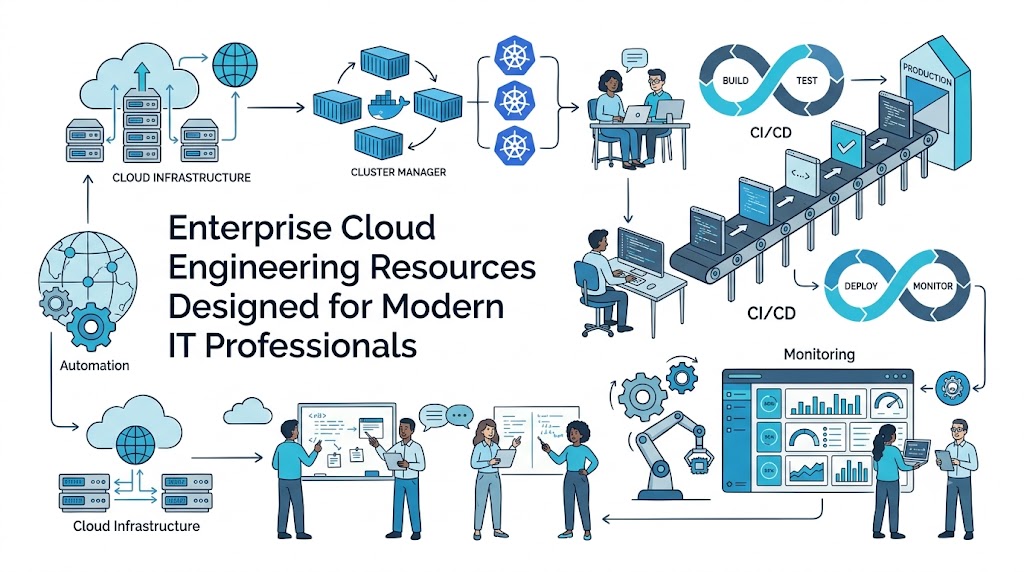
Effective DevOps Corporate Training now encompasses everything from CI/CD Pipeline Training to advanced Terraform Training for infrastructure provisioning. As containerization becomes ubiquitous, Docker Kubernetes Training is essential for maintaining production-ready environments. Furthermore, as teams move toward more automated governance, GitOps Training has become a cornerstone of reliable infrastructure management. By covering these critical domains, teams can build a unified, automated, and observable ecosystem that minimizes manual intervention.
Kubernetes Training for Enterprise Teams
Kubernetes is the standard for container orchestration, but its learning curve is steep. Without proper training, organizations often struggle with security vulnerabilities, inefficient resource allocation, and cluster downtime.
Enterprise-focused Kubernetes Corporate Training shifts the focus from simple pod deployment to cluster-level resilience. This includes mastering architectural patterns, scaling strategies, and troubleshooting techniques that are essential for high-availability production environments. By learning how to design for failure and implement rigorous security policies, teams can treat Kubernetes as a stable platform rather than a source of operational chaos.
Site Reliability Engineering Training
When a system reaches a certain scale, DevOps is no longer enough. This is where Site Reliability Engineering Training becomes a necessity. SRE bridges the gap between software development and IT operations by applying engineering discipline to operational problems.
Training focuses on the core tenets of reliability: defining and measuring SLIs and SLOs, managing error budgets, and automating incident responses. By teaching teams how to practice blameless post-mortems and proactive monitoring, an SRE Consultant helps organizations transform their operational mindset. The result is a system that is not only faster to deploy but significantly more resilient under pressure.
DevSecOps Training Benefits
Security can no longer be a final step in the software lifecycle; it must be an integrated, automated process. DevSecOps Training empowers teams to “shift-left” by embedding security checkpoints directly into the CI/CD pipeline.
Participants learn to implement secrets management, container security scanning, and policy-as-code. This approach reduces the risk of compliance failures and ensures that security is a continuous, automated attribute of the application itself. For modern enterprises, this is the only way to maintain the pace of innovation while adhering to stringent industry standards.
Platform Engineering Training
The industry is currently trending toward Platform Engineering—an evolution of DevOps that focuses on building an Internal Developer Platform (IDP). Platform Engineering Training guides teams in creating self-service portals that provide developers with “golden paths” for their applications.
By abstracting away the underlying infrastructure, platform engineers reduce the cognitive load on developers. This allows the organization to scale its engineering efforts without requiring every developer to become an expert in every underlying tool. A Platform Engineering Consultant helps organizations design these platforms with a focus on usability, governance, and long-term maintainability.
Consulting Services That Accelerate DevOps Adoption
Strategic consulting goes beyond individual training by providing a roadmap for the entire organization. A Cloud DevOps Consultant provides a bird’s-eye view of your architecture, identifying the bottlenecks that keep the organization from reaching its full potential.
These engagements are designed to be high-impact. Whether it is an AWS DevOps Consultant conducting an infrastructure audit or a professional advising on a complex cloud migration, the value lies in objective, experience-driven strategy. Through architecture reviews and long-term coaching, consultants ensure that the organization’s transition to modern delivery models is both efficient and sustainable.
Training Programs Best Suited for Different Roles
| Role | Recommended Training |
|---|---|
| Developer | CI/CD Pipeline Training, GitOps Training |
| Cloud Engineer | AWS DevOps Consultant-led workshops, Terraform Training |
| SRE | Site Reliability Engineering Training, Monitoring and Observability |
| Security Engineer | DevSecOps Corporate Training, Compliance as Code |
| Platform Engineer | Platform Engineering Training, Kubernetes Orchestration |
| Engineering Manager | DevOps Strategy, Reliability Engineering Management |
| CTO | Enterprise Cloud Strategy, Modernization Roadmap |
Why Enterprises Prefer Experienced Consultants
Engaging an external consultant is about de-risking the future. An expert consultant brings a wealth of knowledge from various industries and can predict where an organization might encounter resistance.
By leveraging a consultant’s expertise, enterprises avoid the “re-inventing the wheel” syndrome. Consultants provide the necessary guidance to align technical initiatives with business outcomes, ensuring that every automation project contributes to the bottom line. The ultimate goal of any consulting engagement is knowledge transfer—empowering internal teams to operate with the same expertise and confidence as the consultant who guided them.
Special Section for Modern Engineering Leaders
For those reading this, it is crucial to recognize that engineering excellence is a cumulative process. Whether you are seeking a DevOps Trainer in India to upskill your local teams or looking for an SRE Consultant to overhaul your incident management processes, the key is to prioritize hands-on, experience-driven mentorship.
The tools you choose today will form the foundation of your future infrastructure. By investing in professional guidance, you ensure that your teams are prepared for the challenges of tomorrow, turning complex technical hurdles into scalable, reliable, and secure workflows.
Frequently Asked Questions
- What does a DevOps Trainer do? A DevOps trainer simplifies complex workflows, provides hands-on mentorship, and aligns team practices with industry-standard automation and delivery models.
- How is DevOps Corporate Training different from self-learning? Corporate training is tailored to your unique architectural constraints and business objectives, providing practical, real-time guidance that online courses lack.
- Why should companies hire a Kubernetes Trainer? Kubernetes is highly sophisticated; expert trainers ensure your team understands security, scalability, and production-readiness, which prevents costly configuration errors.
- What skills are covered in Site Reliability Engineering Training? Training focuses on SLI/SLO implementation, incident management, automation of manual tasks, and building a culture of reliability through blameless practices.
- How long does Terraform Training usually take? Most foundational workshops span three to five days, covering everything from core provisioning to advanced state management and modular infrastructure design.
- Is GitOps useful for enterprise teams? Absolutely. GitOps ensures that your infrastructure is version-controlled, auditable, and easily reproducible, which is essential for enterprise-grade deployments.
- What industries benefit from DevSecOps? Any industry with data sensitivity or regulatory requirements—such as finance, healthcare, or e-commerce—gains immense security advantages through DevSecOps automation.
- What is Platform Engineering? It is the discipline of building an internal, self-service platform that provides developers with “golden paths,” thereby reducing complexity and increasing output.
- What makes a good DevOps Consultant? A strong consultant blends deep technical knowledge with the ability to mentor teams, facilitate organizational change, and design strategies that align with business goals.
- How do organizations measure DevOps success? Success is gauged through key performance indicators like deployment frequency, lead time for changes, MTTR, and the reduction of manual operational effort.
- Why is CI/CD Pipeline Training important? It ensures that software releases are predictable, high-quality, and fast, removing the human bottlenecks that frequently cause deployment failures.
- How can enterprises upskill engineering teams effectively? Effective upskilling relies on a combination of hands-on technical workshops, ongoing mentorship, and a clear alignment between learning paths and the company’s technical roadmap.
Final Thoughts
The transition to a high-performing DevOps and SRE culture is not an overnight success story—it is a continuous commitment to improvement. By prioritizing expert mentorship and structured training, organizations can bridge the gap between their current state and their operational goals. Investing in the right expertise today creates a lasting impact, ensuring that your teams are not only keeping up with technology but are equipped to drive the innovation that defines your organization’s future.
