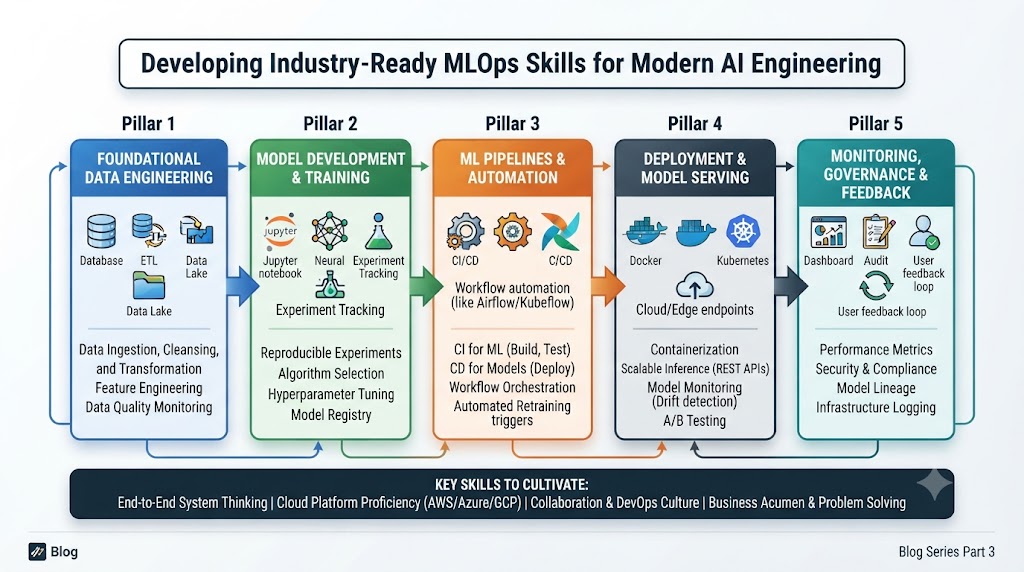
In today’s fast-paced tech world, moving from a model in a notebook to a robust production system is the ultimate hurdle. This is where the Certified MLOps Engineer credential comes into play. It is designed to turn engineers into masters of the production pipeline, bridging the gap between data science experimentation and reliable software operations. Whether you are a DevOps expert or a data specialist, this roadmap is your guide to mastering the systems that power modern artificial intelligence. By leveraging resources from aiopsschool, professionals can navigate their learning paths with clarity and purpose.
What is the Certified MLOps Engineer?
The Certified MLOps Engineer certification defines the intersection of machine learning, development, and operations. It is not just about understanding how to build a model; it is about knowing how to keep that model alive, accurate, and performant in a real-world environment. This certification exists to standardize the “production-first” mindset, moving away from theoretical studies toward the practical realities of continuous integration, model deployment, and observability. It aligns perfectly with enterprise-grade engineering workflows, ensuring that you understand how to manage the lifecycle of AI products with the same rigor you would apply to core infrastructure.
Who Should Pursue Certified MLOps Engineer?
This program is aimed at anyone who takes the reliability of AI systems seriously. It is a perfect fit for DevOps and SRE professionals who want to bring their automation expertise into the data domain. Likewise, data engineers and security professionals will find this path invaluable for understanding how to secure and scale complex ML architectures. Whether you are just starting your journey or you are an engineering manager aiming to upskill your team to meet global standards, this certification is highly relevant. In the Indian and global markets, the ability to operationalize AI is a key differentiator for any serious software professional.
Why Certified MLOps Engineer
As businesses rely more heavily on intelligent systems, the gap between “having a model” and “having an ML product” is widening. Professionals who earn this certification stay ahead of the curve because they focus on enduring principles: automation, version control, testing, and proactive monitoring. These skills are platform-agnostic, meaning you will stay relevant even as new tools emerge. Investing in this certification is essentially investing in your own technical longevity, ensuring you can deliver consistent results and manage complex systems in any enterprise setting.
Certified MLOps Engineer Certification Overview
This certification program is provided via the Certified MLOps Engineer curriculum and hosted on aiopsschool. The training is structured to be intensely practical, moving beyond simple quizzes to focus on hands-on competence. You will be evaluated on your ability to handle real-world challenges, such as maintaining uptime and managing data flow in production. The curriculum is curated by industry veterans who understand exactly what modern engineering teams are looking for when they hire for MLOps roles, ensuring the certification carries real weight in the job market.
Certified MLOps Engineer Certification Tracks & Levels
The learning journey is segmented into levels—Foundation, Professional, and Advanced—to ensure a logical progression. You start by mastering the basics of pipelining and environment management before moving into high-stakes topics like model drift, automated retraining, and infrastructure scaling. These tracks allow you to grow alongside your experience, providing a clear path from a junior practitioner to an expert who architects entire ML platforms. Every level is designed to build upon the last, cementing your knowledge and ensuring you have the confidence to tackle more complex roles as you advance.
Complete Certified MLOps Engineer Certification Table
| Track | Level | Who it’s for | Prerequisites | Skills Covered | Recommended Order |
| MLOps Essentials | Foundation | Entry Level | Basic Coding | Pipeline Basics | 1 |
| MLOps Production | Professional | Mid-Level | Foundation Cert | CI/CD & Testing | 2 |
| MLOps Enterprise | Advanced | Expert | Professional Cert | Scaling & Strategy | 3 |
Detailed Guide for Each Certified MLOps Engineer Certification
Certified MLOps Engineer – Foundation Level
What it is
This introductory level introduces the essential workflow of transforming a raw ML experiment into a reproducible, scriptable, and automated process.
Who should take it
Aspiring MLOps engineers and developers who want to understand the foundational lifecycle of machine learning models.
Skills you’ll gain
- Configuring basic ML environments.
- Mastering Git for model versioning.
- Writing clean, modular data pipelines.
Real-world projects you should be able to do
- Create an automated script to retrain a model.
- Containerize a simple ML model using Docker.
- Set up a basic data ingestion pipeline.
Preparation plan
- 7–14 days: Focus on understanding the core MLOps lifecycle.
- 30 days: Complete the hands-on lab projects to solidify skills.
- 60 days: Practice assessment scenarios to ensure readiness.
Common mistakes
Overlooking the importance of version control for data and environment configurations.
Best next certification after this
- Same-track: Certified MLOps Engineer – Professional
- Cross-track: DevOps Foundation
- Leadership: Team Lead Fundamentals
Certified MLOps Engineer – Professional Level
What it is
This level focuses on the rigorous standards required to deploy models into production environments where reliability and stability are non-negotiable.
Who should take it
DevOps, SRE, or Data engineers with solid experience who are ready to specialize in the operational side of AI.
Skills you’ll gain
- Advanced CI/CD pipeline orchestration.
- Real-time monitoring and alerting for models.
- Automated testing and validation of data quality.
Real-world projects you should be able to do
- Implement a robust CI/CD pipeline for an ML model.
- Build a dashboard for model performance tracking.
- Execute a full end-to-end model deployment in a test environment.
Preparation plan
- 7–14 days: Study production architecture and CI/CD patterns.
- 30 days: Build and test a full production-grade ML pipeline.
- 60 days: Solve advanced lab challenges and review production failure modes.
Common mistakes
Focusing solely on deployment and neglecting the critical need for continuous monitoring and data validation.
Best next certification after this
- Same-track: Certified MLOps Engineer – Advanced
- Cross-track: SRE Professional
- Leadership: Senior Engineering Lead
Choose Your Learning Path
DevOps Path
This path is the foundation for all modern engineering. It emphasizes the “culture of automation,” infrastructure as code, and continuous delivery. If you want to manage stable systems and streamline software delivery, this is where you start.
DevSecOps Path
Security is not an afterthought. This path shows you how to integrate security controls directly into your automated pipelines. You will learn to perform automated vulnerability scans and ensure your deployments meet strict compliance requirements.
SRE Path
Reliability is the core of this path. You will focus on measuring system health, defining service level objectives, and mastering the art of incident response. It is perfect for those who want to build systems that scale gracefully.
AIOps Path
Explore how to apply machine learning to your own operations. This path covers how to use AI to analyze logs, detect anomalies in infrastructure, and automate the resolution of recurring technical issues in large-scale environments.
MLOps Path
This path is your gateway to becoming a specialist in machine learning operations. It covers the entire lifecycle of an ML project, from data sourcing and feature engineering to deployment, monitoring, and automated retraining at scale.
DataOps Path
Data is the fuel for AI. This path focuses on the quality, flow, and reliability of data. You will learn how to orchestrate data pipelines, test for quality at every stage, and ensure data is always ready for model consumption.
FinOps Path
Every bit of infrastructure has a cost. This path teaches you how to keep cloud and infrastructure costs under control without sacrificing performance, focusing on financial accountability within your technical teams.
Role → Recommended Certified MLOps Engineer Certifications
| Role | Recommended Certifications |
| DevOps Engineer | DevOps Foundation, MLOps Foundation |
| SRE | SRE Foundation, MLOps Professional |
| Platform Engineer | MLOps Foundation, Professional |
| Cloud Engineer | Cloud Architect, MLOps Foundation |
| Security Engineer | DevSecOps, MLOps Security |
| Data Engineer | DataOps, MLOps Foundation |
| FinOps Practitioner | FinOps, MLOps Professional |
| Engineering Manager | All Professional Tracks |
Next Certifications to Take After Certified MLOps Engineer
Same Track Progression
Consistency is key. Moving from Foundation to Professional or Advanced demonstrates a deep commitment to the field. This progression shows employers that you possess both the breadth of knowledge and the depth of expertise required for senior roles.
Cross-Track Expansion
The best engineers are well-rounded. Pairing your MLOps expertise with SRE or DataOps credentials will make you an indispensable asset, capable of solving problems that touch every part of the modern engineering lifecycle.
Leadership & Management Track
For those aiming to lead, focus on certifications that emphasize team strategy, project lifecycle management, and architectural decision-making. Transitioning to leadership is about enabling teams to execute efficiently while maintaining high standards of engineering excellence.
Training & Certification Support Providers for Certified MLOps Engineer
DevOpsSchool is a highly regarded provider, offering hands-on, deeply technical workshops that guide engineers through the complexities of automation, CI/CD, and infrastructure management.
Cotocus excels in delivering training on cutting-edge technologies, focusing on bridging the gap between emerging tools and the practical demands of modern enterprise environments.
Scmgalaxy offers comprehensive training on configuration management and version control, which are foundational skills for any engineer dealing with codebases and model versions.
BestDevOps provides curated learning paths and best-practice guidance, helping professionals adopt standard toolsets that improve overall efficiency and pipeline reliability.
devsecopsschool specializes in security-centric training, showing you how to bake compliance, vulnerability management, and threat prevention into the very heart of your software development pipelines.
sreschool delivers training focused on system stability and high availability, teaching you the essential metrics and strategies for keeping distributed, complex systems running smoothly.
aiopsschool is your go-to source for the official certification curriculum, acting as the central hub for learning resources, assessment preparation, and mastery of MLOps principles.
dataopsschool focuses on operational excellence in data management, providing the training you need to ensure that data flows seamlessly, reliably, and accurately into your production models.
finopsschool is the authority on cloud financial management, offering insights and training on how to optimize your infrastructure costs while maintaining high-performance production environments.
Frequently Asked Questions (General)
- What makes this certification challenging?The challenge lies in its focus on production-grade outcomes, requiring you to think through infrastructure stability and not just code.
- How much study time is realistic?Most successful candidates dedicate several hours a week over a two-month period to absorb the depth of the material.
- Are there prerequisites for the entry-level track?A functional understanding of programming and basic system operations is generally recommended to get the most out of the training.
- Is there a long-term return on this investment?Yes, as demand for AI-literate operations engineers continues to rise, this certification serves as a clear validation of your expertise.
- Does the curriculum stay current?The subject matter experts behind the program ensure that the training is updated regularly to reflect real-world industry shifts and tool developments.
- Can I complete the certification remotely?Yes, the program is fully accessible online, allowing you to study and take assessments at your own pace from anywhere.
- How does this help my daily job?You will learn to troubleshoot issues faster and automate manual tasks, directly contributing to more stable and efficient deployments.
- What is the procedure for retaking an exam?The provider offers clear support and guidance to help you identify areas for improvement before attempting the exam again.
- Does the certification expire?Certifications are typically active for a specific duration, after which you may need to demonstrate continuing education to stay updated.
- Is there a network for certified professionals?Graduates often gain access to community forums, allowing you to connect with other practitioners and stay informed about industry trends.
- How is the exam assessment conducted?It features a blend of scenario-based questions that test your ability to apply MLOps principles to real-world technical problems.
- Are these credentials respected globally?The program’s focus on universal engineering principles ensures that your skills are highly valued by tech companies across the globe.
FAQs on Certified MLOps Engineer
- What is the central goal of this certification?The goal is to teach you how to automate, deploy, and maintain machine learning models in a reliable production environment.
- Do I need to be a data scientist?No, this is for engineers. You need to know how to deploy models, not necessarily how to invent the mathematical algorithms behind them.
- How does it differ from DevOps?It applies the same principles of automation and CI/CD, but specifically to the unique challenges of data, model training, and drift.
- Is cloud knowledge required?A basic familiarity with cloud services is very helpful, as most modern MLOps pipelines are hosted on cloud infrastructure.
- Will I learn about data monitoring?Yes, detecting issues like data drift is a critical part of the curriculum and essential for maintaining model performance.
- Can this help me pivot my career?Absolutely, it provides the bridge between general operations and the high-growth field of AI infrastructure.
- How does it help engineering managers?It helps them understand the lifecycle of AI projects so they can better plan resources and guide their technical teams.
- Are there lab components?Yes, the training is designed to be hands-on, ensuring you actually do the work rather than just reading about it.
Final Thoughts: Is Certified MLOps Engineer Worth It?
Ultimately, this certification is for the professional who wants to stop guessing and start building with intent. If you want to move away from the chaos of manual deployments and understand how to build resilient systems that power the next generation of AI, this path is for you. It isn’t a shortcut; it is a serious commitment to learning the mechanics of operational excellence. My advice is to approach this with a mindset of continuous improvement. The industry doesn’t just need more people; it needs more people who understand how to make technology work consistently, reliably, and at scale.
