Introduction
The landscape of modern IT operations is undergoing a massive shift as artificial intelligence integrates with traditional infrastructure. This guide is designed for systems engineers, Site Reliability Engineers (SREs), and platform architects who want to transition from reactive monitoring to proactive, AI-driven automation. By breaking down the core capabilities of algorithmic IT operations, this comprehensive analysis helps professionals make informed decisions about engineering validation. Organizations globally require engineers who can implement machine learning models to analyze telemetry data, detect anomalies, and automate incident response at scale. Navigating these validation pathways allows technical leaders and engineering practitioners to align their skills with contemporary enterprise demands.
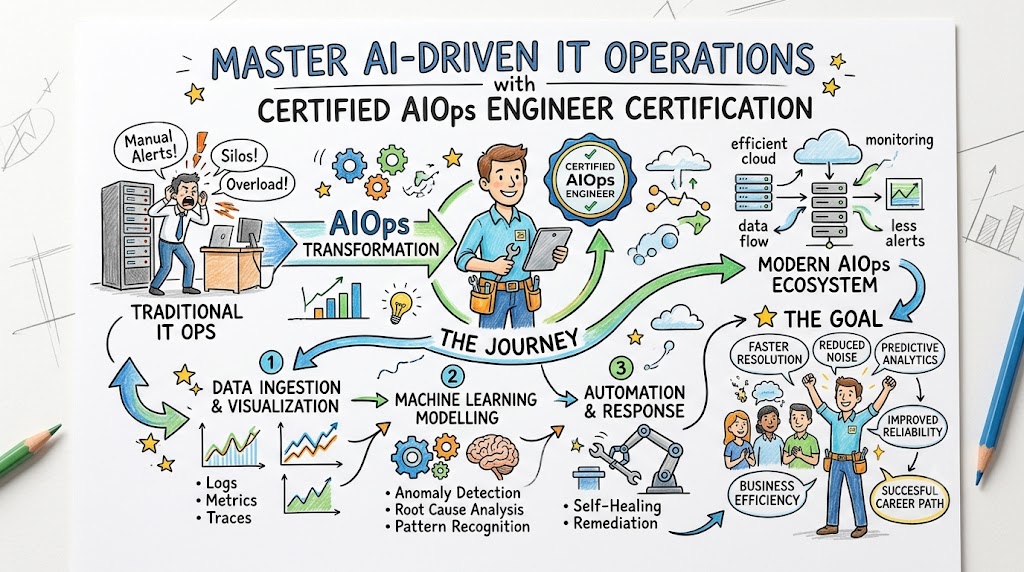
The industry recognizes this specific educational path through the formal Certified AIOps Engineer program provided directly by the specialized training platform known as aiopsschool. This professional framework establishes a structured approach to learning the complexities of event correlation, automated root cause analysis, and predictive infrastructure management.
What is the Certified AIOps Engineer?
The Certified AIOps Engineer designation represents a technical framework that validates an engineer’s capability to deploy machine learning algorithms within production environments. It exists to bridge the gap between traditional systems administration and automated, data-driven infrastructure management. Rather than focusing purely on theoretical data science, this validation emphasizes the practical application of anomaly detection, log clustering, and automated incident remediation.
Modern enterprise environments generate terabytes of telemetry data across distributed microservices architectures, making human observation insufficient. This program ensures that engineers understand how to build pipelines that ingest, parse, and analyze metrics, traces, and logs in real time. It aligns directly with cloud-native architectures, giving teams the ability to minimize Mean Time to Resolution (MTTR) through algorithmic intelligence.
Who Should Pursue Certified AIOps Engineer?
This validation path is engineered for infrastructure professionals, software developers, and operations managers who are responsible for system availability and performance. SREs and DevOps professionals benefit significantly by learning how to replace static thresholds with dynamic, machine-learning-based alerting mechanisms. Security operations and data engineering teams also find value in mastering the ingestion models used to correlate disparate infrastructure events.
The framework accommodates various career stages, offering entry points for mid-level engineers looking to specialize, as well as senior architects designing self-healing systems. Managers and technical leads leverage this knowledge to oversee complex infrastructure transformations and justify automation budgets. Globally, and specifically within major technology hubs like India, the demand for engineers who possess both operational experience and data analytics capabilities continues to expand rapidly.
Why Certified AIOps Engineer
Enterprise technology environments are growing too complex for traditional manual oversight, making automated data analysis a core operational requirement. This certification remains highly valuable because it focuses on foundational algorithmic principles and data pipelines rather than a single proprietary software suite. Engineers who master these concepts can adapt to any enterprise tooling ecosystem, ensuring long-term career resilience as specific platforms evolve.
The return on time investment is demonstrated by the immediate impact an engineer can bring to an organization by reducing alert fatigue and operational overhead. By shifting from reactive firefighting to predictive capacity planning, certified professionals elevate their strategic value within their engineering organizations. This technical expertise protects professionals against automation displacement by positioning them as the builders of the intelligent systems themselves.
Certified AIOps Engineer Certification Overview
The structured program is delivered via official educational channels and hosted entirely on the specialized technical platform known as aiopsschool. The validation path is divided into progressive tiers that test both theoretical comprehension and hands-on implementation capabilities through simulated production scenarios. It moves away from simple multiple-choice formats, requiring candidates to demonstrate actual proficiency in data management and algorithmic configuration.
The assessment methodology ensures that candidates possess the practical troubleshooting skills required to handle large-scale system incidents using automated tools. Ownership of the certification curriculum is maintained by industry experts who regularly update the objectives to reflect changes in cloud-native ecosystems and data science frameworks. This rigorous structure ensures that the credential carries authentic weight among engineering directors and enterprise recruiters.
Certified AIOps Engineer Certification Tracks & Levels
The curriculum is organized into three distinct operational tiers designed to match the professional growth of a systems engineer. The foundation level introduces core telemetry concepts, basic statistical analysis, and data ingestion architectures necessary for modern monitoring. This entry tier establishes the baseline vocabulary and mathematical concepts required to interact with more advanced analytical systems.
The professional and advanced tracks shift focus toward complex machine learning implementations, multi-source event correlation, and autonomous remediation workflows. Specialized paths allow engineers to align their studies with specific domains such as cloud financial management, site reliability, or secure operations. This multi-tiered structure allows professionals to steadily accumulate knowledge while receiving clear validation milestones at each stage of their career progression.
Complete Certified AIOps Engineer Certification Table
| Track | Level | Who it’s for | Prerequisites | Skills Covered | Recommended Order |
| Operations | Foundation | Associate Systems Engineers | Basic Linux & Python | Telemetry Ingestion, Dynamic Thresholds | First |
| Automation | Professional | Mid-Level SREs & DevOps | Systems Monitoring | Event Correlation, Root Cause Analysis | Second |
| Architecture | Advanced | Principal Engineers & Leads | Advanced Data Pipelines | Autonomous Remediation, Pattern Mining | Third |
Detailed Guide for Each Certified AIOps Engineer Certification
Certified AIOps Engineer – Associate Level
What it is
This baseline certification validates an engineer’s foundational knowledge of telemetry data ingestion, basic data pipelines, and the limitations of traditional static threshold alerting.
Who should take it
Systems administrators, junior DevOps practitioners, and helpdesk engineers looking to move into modern platform operations and automated monitoring teams.
Skills you’ll gain
- Configuration of open-source data collectors and log shippers.
- Understanding the difference between structured, semi-structured, and unstructured telemetry.
- Application of basic statistical models to system metric streams.
- Setting up real-time dashboard visualizations for distributed applications.
Real-world projects you should be able to do
- Construct a functional data ingestion pipeline that collects logs from a multi-node web cluster.
- Implement basic anomaly detection based on standard deviations over rolling historical time windows.
Preparation plan
- 7–14 Days: Focus on understanding the core pillars of observability—metrics, logs, and distributed traces—along with basic data formats like JSON and CSV.
- 30 Days: Build sample lab environments using open-source log aggregators to practice parsing real-time system events and setting up data forwarding rules.
- 60 Days: Review sample exam blueprints, study basic statistical math concepts, and complete mock assessments to verify theoretical comprehension.
Common mistakes
Candidates often fail because they skip learning basic data manipulation or underestimate the statistical math concepts required to understand dynamic thresholding.
Best next certification after this
- Same-track option: Certified AIOps Engineer – Professional Level
- Cross-track option: Cloud Infrastructure Specialist
- Leadership option: Systems Operations Team Lead
Certified AIOps Engineer – Professional Level
What it is
This intermediate validation certifies a professional’s capability to implement automated event correlation, deduplication, and algorithmic root cause analysis across complex microservices.
Who should take it
Experienced SREs, DevOps engineers, and cloud architects responsible for minimizing application downtime and managing complex alerting matrices in enterprise environments.
Skills you’ll gain
- Implementation of noise reduction algorithms on high-volume event streams.
- Application of clustering techniques to group related system logs together automatically.
- Configuring topology-based root cause analysis engines across dynamic cloud infrastructure.
- Constructing machine learning pipelines optimized for time-series forecasting.
Real-world projects you should be able to do
- Deploy an event management pipeline that reduces infrastructure alert noise by at least seventy percent using deduplication algorithms.
- Create a predictive forecasting model that accurately identifies upcoming storage exhaustion three days before it occurs.
Preparation plan
- 7–14 Days: Deep dive into time-series analysis techniques, mathematical clustering concepts, and the structural architecture of distributed microservices.
- 30 Days: Set up a live Kubernetes cluster, inject artificial faults, and train analytical engines to isolate the root cause automatically.
- 60 Days: Document performance metrics from testing labs, refine model hyperparameters, and focus heavily on scenario-based architectural questions.
Common mistakes
Many candidates focus too much on specific software vendor interfaces rather than mastering the underlying algorithmic logic and data correlation principles.
Best next certification after this
- Same-track option: Certified AIOps Engineer – Advanced Level
- Cross-track option: Security Operations Automation Engineer
- Leadership option: Technical Infrastructure Program Manager
Certified AIOps Engineer – Advanced Level
What it is
The highest tier of validation proving an engineer’s ability to design, build, and maintain autonomous self-healing infrastructure systems driven entirely by machine learning.
Who should take it
Principal engineers, enterprise infrastructure architects, and technical directors responsible for the global availability and operational efficiency of massive platform deployments.
Skills you’ll gain
- Designing closed-loop autonomous remediation systems that fix production incidents without human intervention.
- Implementing advanced natural language processing models for automated incident post-mortem generation.
- Architecting scalable, highly available data fabrics designed for real-time stream processing.
- Governing algorithmic bias and ensuring transparency in automated operational decision-making pipelines.
Real-world projects you should be able to do
- Engineer an autonomous recovery system that detects a localized memory leak, reroutes traffic, captures diagnostics, and restarts services safely.
- Design an enterprise-grade streaming infrastructure capable of processing millions of operational data points per second with minimal latency.
Preparation plan
- 7–14 Days: Review advanced stream processing paradigms, distributed systems consensus protocols, and complex machine learning deployment workflows.
- 30 Days: Construct complex, multi-tiered failure scenarios in a staging environment to validate the safety and reliability of autonomous remediation scripts.
- 60 Days: Focus on architectural design reviews, high-availability data storage structures, and optimizing model retraining schedules for changing system baselines.
Common mistakes
Failing to implement safety guardrails in automated remediation exercises, resulting in runaway automation loops that worsen simulated infrastructure outages during assessments.
Best next certification after this
- Same-track option: Enterprise Operations Strategy Fellow
- Cross-track option: Principal MLOps Architect
- Leadership option: Director of Platform Engineering / Vice President of Infrastructure
Choose Your Learning Path
DevOps Path
This educational track concentrates heavily on integrating intelligent telemetry validation steps directly into continuous deployment pipelines. Engineers learn to use predictive analytics to analyze code changes and forecast potential production performance impacts before software is fully released. By mastering automated quality gates, professionals can stop problematic deployments autonomously based on algorithmic risk scores. The path bridges the gap between fast application delivery cycles and operational system stability.
DevSecOps Path
Security-focused practitioners utilize this methodology to apply behavioral anomaly detection to security log streams, identifying sophisticated threats that bypass rules-based firewalls. The learning curve focuses on correlating system performance deviations with network traffic anomalies to catch data exfiltration or malicious access attempts. Professionals learn to build automated mitigation loops that isolate compromised infrastructure instantly based on statistical threat confidence scores. It transforms standard security auditing into a continuous, machine-led defense mechanism.
SRE Path
Site Reliability Engineers adopt this framework to transition from rigid, manual Service Level Objective (SLO) tracking to automated error budget forecasting. The curriculum prioritizes advanced event correlation and root cause isolation, giving engineers the ability to pinpoint components failing within highly distributed systems. Participants learn to construct automated runbooks that trigger targeted self-healing workflows, drastically reducing systemic downtime. This path minimizes cognitive load during major incidents by removing alert noise and presenting clear, actionable diagnostics.
AIOps Path
This dedicated specialization focuses deeply on the lifecycle management of operational machine learning models, from initial ingestion tuning to continuous retraining. Engineers explore the technical mechanics of processing massive, high-velocity infrastructure telemetry streams using advanced mathematical frameworks. The focus centers on maintaining model accuracy as underlying corporate network layouts and user application behaviors shift over time. It represents the pure engineering discipline required to run robust, industrial-scale operational intelligence platforms.
MLOps Path
This pipeline-centric framework teaches engineers how to apply continuous integration and automated deployment patterns directly to data science models within production frameworks. Practitioners master the automation of training datasets, model validation checks, and the performance monitoring of algorithms deployed at the enterprise edge. The path ensures that data science assets are delivered reliably, safely, and transparently across cloud platforms. It acts as the operational backbone that standardizes how artificial intelligence products are maintained.
DataOps Path
Data management specialists utilize this curriculum to ensure the absolute integrity, cleanliness, and availability of the telemetry streams feeding analytical engines. The training covers scalable pipeline architectures, real-time stream transformation techniques, and the mitigation of data quality degradation. Professionals learn to build resilient storage systems that handle the extreme write loads generated by thousands of microservices. This track provides the foundational data reliability that prevents analytical engines from making decisions based on corrupted metrics.
FinOps Path
Cloud financial analysts and infrastructure planners use algorithmic pattern mining to discover hidden waste and optimize resource utilization across multi-cloud deployments. This discipline covers predictive capacity planning, allowing organizations to forecast cloud expenditure anomalies weeks before they impact the monthly corporate budget. Engineers learn to automate resource downsizing workflows based on historical utilization profiles without threatening application performance. It replaces reactive cloud spend reporting with autonomous, efficiency-driven infrastructure optimization.
Role → Recommended Certified AIOps Engineer Certifications
| Role | Recommended Certifications |
| DevOps Engineer | Certified AIOps Engineer – Associate & Professional Level |
| SRE | Certified AIOps Engineer – Professional & Advanced Level |
| Platform Engineer | Certified AIOps Engineer – Advanced Level |
| Cloud Engineer | Certified AIOps Engineer – Associate Level |
| Security Engineer | Certified AIOps Engineer – Professional Level (Security Focus) |
| Data Engineer | Certified AIOps Engineer – Professional Level (Data Focus) |
| FinOps Practitioner | Certified AIOps Engineer – Associate Level (FinOps Focus) |
| Engineering Manager | Certified AIOps Engineer – Associate Level |
Next Certifications to Take After Certified AIOps Engineer
Same Track Progression
Upon mastering the advanced tier of this framework, engineers should pursue deep specializations in distributed system tracing and highly scaled streaming data fabrics. True mastery involves moving past basic platform configurations and moving toward contributing directly to open-source algorithmic monitoring projects. This stage focuses on refining custom mathematical models tailored to unique enterprise scale requirements.
Cross-Track Expansion
Professionals looking to broaden their industrial capabilities should couple their algorithmic operations knowledge with advanced cloud security architecture or large-scale data engineering validations. Understanding how to manage massive distributed data engines enhances an engineer’s capability to design highly performant data pipelines. This cross-training establishes a highly versatile technical profile capable of leading complex multi-disciplinary platform initiatives.
Leadership & Management Track
For senior practitioners transitioning away from daily keyboard configurations, shifting toward strategic technology management frameworks is recommended. Pursuing validations in IT governance, enterprise digital transformation strategy, and organizational change management helps translate technical automation metrics into business financial outcomes. This education prepares engineers to step into executive roles like Chief Technology Officer or VP of Infrastructure.
Training & Certification Support Providers for Certified AIOps Engineer
DevOpsSchool provides extensive, instructor-led training programs focused on establishing strong fundamental systems administration and continuous delivery skills required before advancing into algorithmic operations.
Cotocus specializes in delivering immersive, laboratory-driven bootcamps designed to give infrastructure engineers hands-on experience setting up complex multi-cloud deployments and enterprise telemetry pipelines.
Scmgalaxy offers a deep repository of community knowledge, configuration blueprints, and technical documentation assisting engineers with real-world tool integrations and troubleshooting scenarios.
BestDevOps focuses on delivering highly tailored enterprise team training solutions designed to accelerate the adoption of automated infrastructure workflows and modern cloud-native operational standards.
devsecopsschool delivers specialized education centered on integrating continuous security scanning, threat modeling, and automated compliance protocols directly into modern software delivery pipelines.
sreschool provides targeted curricula dealing with site reliability principles, focusing on error budget management, incident response frameworks, and high-availability systems architecture design.
aiopsschool serves as the primary technical hosting platform and primary curriculum creator for the official automated operations validation and learning pathways.
dataopsschool focuses exclusively on educating data pipeline developers on maintaining high-quality, highly resilient telemetry streams required to fuel modern analytical systems.
finopsschool delivers specialized financial engineering training designed to help professionals master cloud cost optimization, predictive forecasting, and automated resource utilization modeling.
Frequently Asked Questions (General)
- What are the primary prerequisites for entering this engineering program? Candidates should possess a functional understanding of Linux systems administration, standard networking protocols, and basic scripting proficiency using languages like Python or Go.
- How long does it typically take to prepare for the professional level assessment? An engineer with pre-existing operations experience generally requires thirty to sixty days of structured study and laboratory practice to master the exam objectives.
- Does this training program focus on one specific software platform? No, the curriculum is intentionally designed to be framework-agnostic, focusing on universal data patterns, algorithms, and architectures usable across any toolset.
- What formatting styles are utilized during the official examination phases? The validation process combines theoretical multiple-choice inquiries with practical, hands-on lab challenges that require fixing real infrastructure simulations.
- Why is algorithmic automation preferred over standard threshold alerting methods? Static thresholds generate immense alert noise and fail to capture complex, multi-variable performance anomalies that machine learning models identify easily.
- Can a technical manager benefit from completing the initial associate tier? Yes, the foundational level provides engineering managers with the technical vocabulary and structural overview needed to lead automation projects effectively.
- How frequently are the certification curriculum blueprints revised by the board? The exam objectives undergo comprehensive updates annually to incorporate shifting cloud-native patterns and modern data processing methodologies.
- What strategy is recommended for completing the advanced tier projects? Candidates should prioritize building secure, closed-loop automation labs that focus on system recovery safety and precise metric boundary validations.
- Is a background in advanced data science mandatory to succeed here? No, the program focuses on the practical engineering application of pre-built algorithms and data pipelines rather than pure theoretical model creation.
- How does this credential impact an engineer’s profile in competitive job markets? It clearly distinguishes candidates by verifying they possess modern, proactive optimization skills rather than just legacy reactive systems troubleshooting experience.
- What types of telemetry data are covered during the course of study? The curriculum provides exhaustive training across all three primary pillars of modern observability: metrics, unstructured log messages, and distributed execution traces.
- Are re-certification assessments required to maintain active credential status? Yes, professionals complete brief update assessments every two years to verify their alignment with contemporary enterprise architectural standards.
FAQs on Certified AIOps Engineer
- How does Certified AIOps Engineer address the growing problem of enterprise alert fatigue? The framework provides exhaustive training on event deduplication and multi-source clustering algorithms. Engineers learn how to transform thousands of isolated infrastructure alerts into a single, cohesive incident context ticket. This drastic reduction in operational noise allows on-call response teams to focus their critical cognitive energy on solving actual systemic faults rather than sorting through repetitive notification streams.
- Can the skills learned in Certified AIOps Engineer be applied within legacy on-premises environments? Yes, the underlying architectural concepts of telemetry ingestion, log parsing, and statistical pattern analysis function identically regardless of host location. Whether a company runs workloads on physical bare-metal hardware or modern serverless clouds, the algorithmic logic used to spot anomalies remains stable. The program teaches engineers how to normalize data from any source prior to running analytical pipelines.
- What is the significance of closed-loop autonomous remediation within this curriculum? Closed-loop remediation represents the advanced operational capability where a system detects a failure, determines the root cause, and applies a fix without human intervention. The training ensures engineers understand how to design these automated responses safely, incorporating strict operational guardrails to prevent runaway automation loops from accidentally taking entire platforms offline during incidents.
- How does this program prepare engineers to manage non-linear infrastructure scaling challenges? Traditional monitoring fails when systems scale rapidly, as static thresholds cannot adapt to highly dynamic microservice footprints. This certification teaches professionals how to implement mathematical forecasting models that analyze historical usage trends alongside real-time traffic indicators. This allows systems to dynamically adjust capacity allocations before performance degradation visible to end-users can manifest.
- Where does natural language processing fit into the Certified AIOps Engineer toolset? Natural language processing is leveraged to ingest and analyze human-generated text data, such as developer chat rooms, deployment logs, and historical incident post-mortems. The curriculum explores how to correlate these unstructured text streams with traditional time-series metrics, allowing systems to recognize if an incident matches a past outage profile based on written descriptions.
- How does the curriculum ensure the security and compliance of ingested telemetry data? Data security is integrated into all pipeline architecture objectives, teaching engineers how to construct automated masking rules that strip out sensitive personal information at the edge. This ensures that log metrics can be safely analyzed by centralized ML models without risking compliance violations under major global data privacy frameworks.
- What role does topology mapping play in algorithmic root cause analysis? Topology mapping provides the analytical engine with a clear structural model of how different microservices depend on one another. The program trains engineers to feed these live dependency maps directly into correlation engines, allowing the software to trace the path of a failure upstream to find the exact component causing the issue.
- How should an engineer approach hyperparameter tuning for operational infrastructure models? The certification emphasizes practical, stable configurations optimized for infrastructure environments rather than hyper-dense mathematical perfection. Engineers learn to tune models to minimize false negatives, ensuring critical system anomalies are never missed, while keeping false positives low enough to prevent the return of operational alert fatigue.
Final Thoughts: Is Certified AIOps Engineer Worth It?
Moving toward an algorithmically driven infrastructure strategy is no longer a luxury reserved for massive hyperscale technology firms. As enterprise software architectures continue to increase in complexity, companies require engineering professionals who can implement automated, data-driven operational frameworks. This validation program provides an exceptionally structured, unbiased path toward mastering these essential platform capabilities without getting bogged down in marketing hype.
For the individual practitioner, investing time into this curriculum delivers clear professional returns by upgrading legacy monitoring skills into modern observability engineering. It shifts your daily work paradigm from high-stress firefighting to the deliberate architecture of self-healing systems. If your long-term career goal involves leading scale-resilient platform engineering teams, obtaining this formal validation is an incredibly sound, future-proof decision.
