Introduction
In the modern landscape of software engineering, security cannot be an afterthought; it must be integrated directly into the delivery pipeline. As organizations transition toward cloud-native architectures, the need for professionals who can bridge the gap between development, security, and operations has never been greater. This guide serves to Certified DevSecOps Professional aspirants, offering a roadmap to navigate the complexities of secure software delivery. Whether you are aiming to aiopsschool or looking to solidify your platform engineering foundations, understanding these certifications is vital. This comprehensive overview is designed to help engineers, security specialists, and managers make informed career decisions in an increasingly interconnected and threat-conscious technology ecosystem.
What is the Certified DevSecOps Professional?
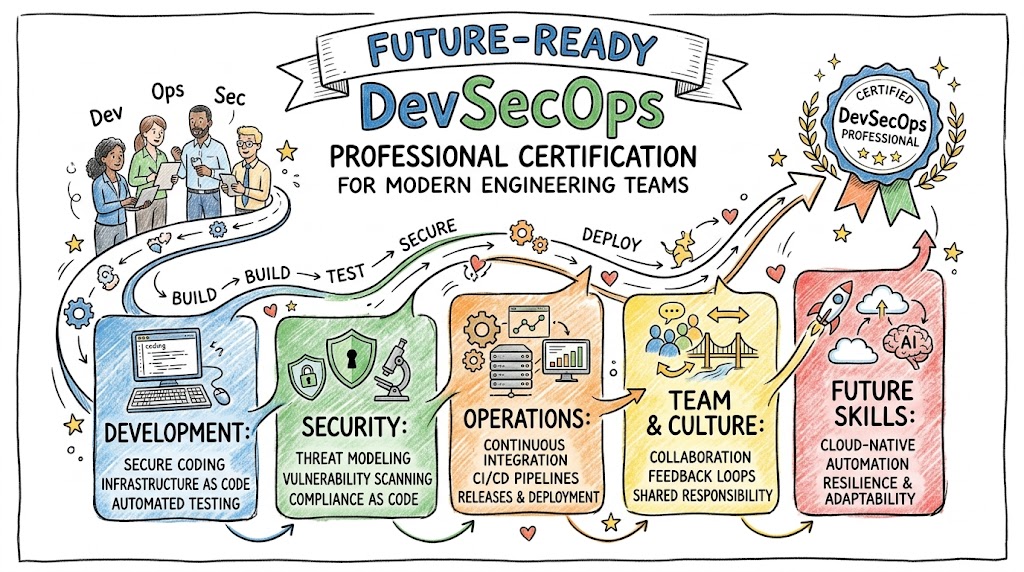
The Certified DevSecOps Professional program represents a standardized approach to mastering the intersection of software development, security, and infrastructure automation. It exists to formalize the skills required to implement security-as-code within automated delivery pipelines. Rather than focusing on abstract theory, this program emphasizes hands-on, production-grade techniques that address real-world vulnerabilities and compliance requirements. It aligns directly with the shift-left philosophy, ensuring that security assessments and hardening occur early in the development lifecycle. By adopting this framework, engineers demonstrate their ability to manage enterprise-grade risks while maintaining the velocity required by modern DevOps workflows.
Who Should Pursue Certified DevSecOps Professional?
This certification is designed for a broad spectrum of technical professionals tasked with building, securing, or managing modern software delivery systems. Software engineers who want to specialize in secure coding, DevOps engineers aiming to harden their CI/CD pipelines, and Site Reliability Engineers focused on infrastructure resilience will find immediate value here. Additionally, security analysts looking to move into automated security engineering and platform engineers building secure internal developer platforms will benefit significantly. Managers and technical leads overseeing digital transformation initiatives in India and globally also gain the necessary insights to steer their teams toward secure, high-performance outcomes.
Why Certified DevSecOps Professional
In an era where cyber threats are becoming increasingly sophisticated, the demand for professionals who can systematically secure infrastructure is surging. This certification provides a sustainable career advantage because it focuses on core principles—like identity management, automated testing, and compliance—that transcend specific tool fads. It offers a high return on investment by validating your expertise to employers who are struggling to find candidates capable of balancing speed and safety. Professionals holding this certification remain relevant because they understand the structural integrity of a secure pipeline, allowing them to adapt quickly as new tools and technologies emerge in the market.
Certified DevSecOps Professional Certification Overview
The Certified DevSecOps Professional program is delivered via and is hosted on the devopsschool platform. The certification follows a practical, assessment-based approach designed to mirror the challenges faced in actual production environments. Ownership of the certification lies with the certifying body, which ensures that the curriculum stays updated with evolving industry standards. The structure is designed to be accessible to those with varying levels of experience, provided they have a solid foundational understanding of Linux, basic networking, and modern CI/CD concepts. It serves as a benchmark for competency in an increasingly security-critical job market.
Certified DevSecOps Professional Certification Tracks & Levels
The certification structure is tiered to accommodate different stages of a professional’s career, ranging from fundamental awareness to advanced expert mastery. The foundation level focuses on core concepts and basic pipeline security, while the professional level dives into complex architectural challenges, compliance, and threat modeling. Advanced levels are reserved for those architecting multi-cloud security strategies or managing enterprise-wide DevSecOps transformations. Specialization tracks allow candidates to pivot their skills toward SRE, FinOps, or specialized security roles, ensuring that the certification path aligns perfectly with individual career progression goals.
Complete Certified DevSecOps Professional Certification Table
| Track | Level | Who it’s for | Prerequisites | Skills Covered | Recommended Order |
|---|---|---|---|---|---|
| Security | Foundation | Beginners | Basic IT knowledge | Basic security concepts | 1 |
| Security | Professional | Working Engineers | Understanding of CI/CD | Pipeline hardening | 2 |
| Security | Advanced | Lead Engineers | Professional Cert | Architecture design | 3 |
Detailed Guide for Each Certified DevSecOps Professional Certification
Certified DevSecOps Professional – Professional Level
What it is This certification validates a candidate’s ability to integrate security tools and practices into an existing CI/CD pipeline, ensuring automated vulnerability detection and remediation.
Who should take it DevOps engineers, security practitioners, and software developers with experience in a collaborative delivery environment.
Skills you’ll gain
- Implementing static and dynamic application security testing (SAST/DAST).
- Managing container security and vulnerability scanning.
- Integrating compliance checks into automated deployment workflows.
- Managing secrets and sensitive configuration data.
Real-world projects you should be able to do
- Building a hardened, automated CI/CD pipeline from scratch.
- Conducting a full vulnerability assessment on a containerized application.
- Deploying an infrastructure-as-code template that passes automated compliance audits.
Preparation plan
- 7–14 days: Review fundamental security concepts and DevOps pipeline architecture, focusing on the core principles of shift-left security.
- 30 days: Engage in hands-on lab exercises, setting up security tooling within local or cloud environments to gain practical muscle memory.
- 60 days: Conduct mock security audits, troubleshoot common pipeline failures, and refine your approach to handling security incidents during deployments.
Common mistakes
- Focusing purely on theory without practicing command-line tools.
- Neglecting to understand the underlying infrastructure components.
- Failing to connect security outcomes to business delivery goals.
Best next certification after this
- Same-track: Advanced DevSecOps Professional
- Cross-track: Certified SRE Professional
- Leadership: DevOps Engineering Manager
Choose Your Learning Path
DevOps Path
The DevOps path focuses on automating the entire software delivery lifecycle while ensuring consistency and speed. Professionals on this path learn to manage infrastructure, application deployments, and orchestration tools effectively. Mastering this track is essential for building scalable systems and maintaining high availability across different environments.
DevSecOps Path
This path prioritizes embedding security into every phase of the development and delivery lifecycle. Engineers learn to automate threat modeling, vulnerability scanning, and compliance audits to prevent security bottlenecks. It is the premier choice for those looking to protect enterprise assets in a fast-paced environment.
SRE Path
The SRE path is centered on reliability, performance, and operational excellence through engineering solutions. Candidates learn to define Service Level Objectives, manage incident response, and automate manual operational tasks. This path is perfect for those who enjoy solving complex, large-scale system problems.
AIOps Path
The AIOps path explores the integration of artificial intelligence and machine learning into IT operations. Professionals learn to use data-driven insights to predict system issues, automate root cause analysis, and optimize performance. It is a forward-thinking track for engineers interested in autonomous operations.
MLOps Path
The MLOps path addresses the unique challenges of deploying and managing machine learning models in production. Engineers learn to handle data pipelines, model versioning, and continuous delivery for AI applications. This specialization is critical for bridging the gap between data science and production engineering.
DataOps Path
The DataOps path focuses on creating robust, repeatable, and automated data pipelines. Professionals learn to manage data quality, integration, and security while ensuring data remains accessible for analytics. This track is designed for those managing high-volume data environments and complex information ecosystems.
FinOps Path
The FinOps path centers on the financial accountability of cloud infrastructure spending. Engineers learn to monitor usage, optimize resources, and align cloud costs with business value. This path is increasingly important for organizations aiming to manage cloud expenses while maintaining operational efficiency.
Role → Recommended Certified DevSecOps Professional Certifications
| Role | Recommended Certifications |
|---|---|
| DevOps Engineer | Professional DevSecOps |
| SRE | Professional DevSecOps, SRE Fundamentals |
| Platform Engineer | Professional DevSecOps, Advanced Architecture |
| Cloud Engineer | Professional DevSecOps, Cloud Security |
| Security Engineer | Advanced DevSecOps |
| Data Engineer | DataOps + DevSecOps |
| FinOps Practitioner | FinOps + DevSecOps |
| Engineering Manager | Management Leadership in DevSecOps |
Next Certifications to Take After Certified DevSecOps Professional
Same Track Progression
Once you have mastered the professional level, the logical next step is to pursue advanced certifications that focus on complex architecture and enterprise-level strategy. This involves deep diving into multi-cloud security frameworks, advanced container orchestration security, and large-scale incident management. These certifications validate your ability to lead high-level technical decisions.
Cross-Track Expansion
Broadening your skill set by adding certifications in related areas such as FinOps or AIOps creates a well-rounded engineering profile. For instance, combining DevSecOps expertise with FinOps allows you to optimize cloud costs without sacrificing security, making you a highly versatile asset to any engineering organization.
Leadership & Management Track
For those interested in the managerial side, transitioning toward leadership certifications provides the tools to manage teams and drive cultural change. This involves learning how to foster collaboration between silos, implement security-first mindsets in teams, and manage stakeholders in complex technical environments.
Training & Certification Support Providers for Certified DevSecOps Professional
DevOpsSchool is a premier provider offering comprehensive curriculum and hands-on labs for modern engineering disciplines, focusing on industry-standard practices and practical, project-based learning to ensure candidates are job-ready.
Cotocus delivers specialized training focused on deep technical proficiency, helping engineers navigate complex infrastructure and security landscapes with a strong emphasis on real-world applications and enterprise-grade performance.
Scmgalaxy provides expert-led instruction for professionals aiming to master source control and automation practices, ensuring a deep understanding of the mechanics behind modern software delivery pipelines and operational efficiency.
BestDevOps offers curated learning paths that emphasize the latest tools and methodologies, helping practitioners stay ahead of industry trends and build robust, high-performance systems in competitive markets.
devsecopsschool serves as a focused hub for all things related to security in the pipeline, providing intensive training and certification programs specifically designed to create high-level security engineers.
sreschool provides comprehensive training for Site Reliability Engineering, focusing on system resilience, automation, and observability to prepare candidates for managing massive-scale, mission-critical infrastructure environments.
aiopsschool teaches the integration of intelligent automation into operations, helping engineers learn to leverage data, machine learning, and predictive analytics to maintain system health and optimize performance.
dataopsschool focuses on the engineering side of data management, providing essential skills for building scalable, reliable, and automated data processing pipelines that support modern analytics and decision-making.
finopsschool specializes in cloud financial management, helping professionals master the art of balancing performance and cost to drive maximum business value from their cloud investments and operations.
Frequently Asked Questions (General – 12 questions)
- How difficult is it to earn the Certified DevSecOps Professional? The difficulty depends on your experience, but it requires a solid understanding of both security and development. If you are comfortable with CI/CD and basic security principles, you will find it manageable with consistent study.
- How long should I prepare for this certification? Most professionals find that 30 to 60 days of dedicated practice is sufficient, provided they have regular hands-on interaction with the tools and concepts taught.
- What are the prerequisites for these certifications? Typically, you need a foundational understanding of Linux, command-line interfaces, and general software development life cycle concepts.
- Is this certification recognized globally? Yes, the certification is designed to align with universal industry standards, making it relevant for roles in India and international markets.
- How does this certification improve my career prospects? It provides objective proof of your skills, which often leads to higher salary potential and access to more specialized roles in high-demand environments.
- Are there any maintenance requirements for the certificate? Certifications usually require periodic renewal or proof of continuous learning to ensure your skills stay aligned with the latest technological developments.
- Can beginners pursue this track? Yes, provided they start at the foundation level and are willing to invest the time to build their practical skills through hands-on labs.
- How is the exam structured? The exam is typically practical and assessment-based, requiring candidates to demonstrate their ability to complete real-world tasks in a simulated environment.
- Will this certification help me if I am in a management role? Absolutely, it helps managers better understand the technical challenges their teams face and enables them to make informed decisions about security investments.
- What if I fail the exam on my first attempt? Most providers offer a path to retake the exam after a cooling-off period, allowing you to review your weaknesses and prepare more effectively.
- Are the skills learned transferable? Yes, the concepts taught, such as automated testing, threat modeling, and secure configuration, are universal and apply to almost any modern software stack.
- Is it better to get a broad certification or a specialized one? A broad foundation is necessary, but specializing in a high-demand area like DevSecOps often provides a clearer path to seniority and higher compensation.
FAQs on Certified DevSecOps Professional
- What specifically does the certification cover? It covers automated security integration, pipeline hardening, and compliance.
- Is coding required? Yes, basic scripting skills for automation are essential.
- Does it focus on specific tools? It focuses on principles, though popular tools are used in labs.
- Is it for cloud security? Yes, it includes significant cloud-native security practices.
- How do I get hands-on experience? Use the recommended labs provided by the training platform.
- Are there lab-based exams? Yes, the exam tests practical implementation.
- Does this cover AI security? It touches on security in automated workflows.
- Is this updated frequently? Yes, content is refreshed to keep pace with industry shifts.
Final Thoughts: Is Certified DevSecOps Professional Worth It?
Earning this certification is an investment in your technical longevity. In an industry defined by constant change, holding a verified set of skills in DevSecOps distinguishes you from the crowd and provides a solid foundation for more advanced roles. It is not a shortcut, nor is it a magic badge that replaces experience. However, when combined with a commitment to continuous learning and real-world application, it becomes a powerful tool in your career arsenal. Treat the certification process as a dedicated period of professional development, and you will find that the knowledge gained is far more valuable than the certificate itself.
