
Introduction
Moving to Canada is a transformative journey that promises new horizons, career growth, and the stability of a G7 nation. For millions, this dream begins with a single, crucial step: understanding the Canada PR Points Calculator.
Navigating the immigration landscape can feel like a labyrinth, but it is fundamentally a merit-based system designed to attract the world’s best talent. Whether you are an IT professional, a skilled trade worker, or a healthcare expert, understanding your score is the difference between waiting in the dark and proactively shaping your future. This guide is your roadmap to mastering the Express Entry system in 2026.
What Is the Canada PR Points Calculator?
The Canada PR Points Calculator is a simulation tool used to estimate your Comprehensive Ranking System (CRS) score. The CRS is the official point-based grid IRCC (Immigration, Refugees and Citizenship Canada) uses to rank candidates in the Express Entry pool.
Why Does Canada Use a Points System?
Canada’s immigration policy is driven by economic needs. The government prioritizes candidates who are most likely to integrate quickly and contribute to the Canadian economy. By using a points-based system, Canada ensures that its selection process is objective, transparent, and fair.
Eligibility Score vs. CRS Invitation Score
It is essential to distinguish between these two benchmarks:
- Eligibility Score: This is the minimum threshold required to qualify for programs like the Federal Skilled Worker Program. Simply meeting this does not guarantee an invitation.
- CRS Invitation Score: This is the “cutoff” score for a specific draw. Only those who rank above this number receive an Invitation to Apply (ITA) for Permanent Residency.
How the Canada PR Points System Works
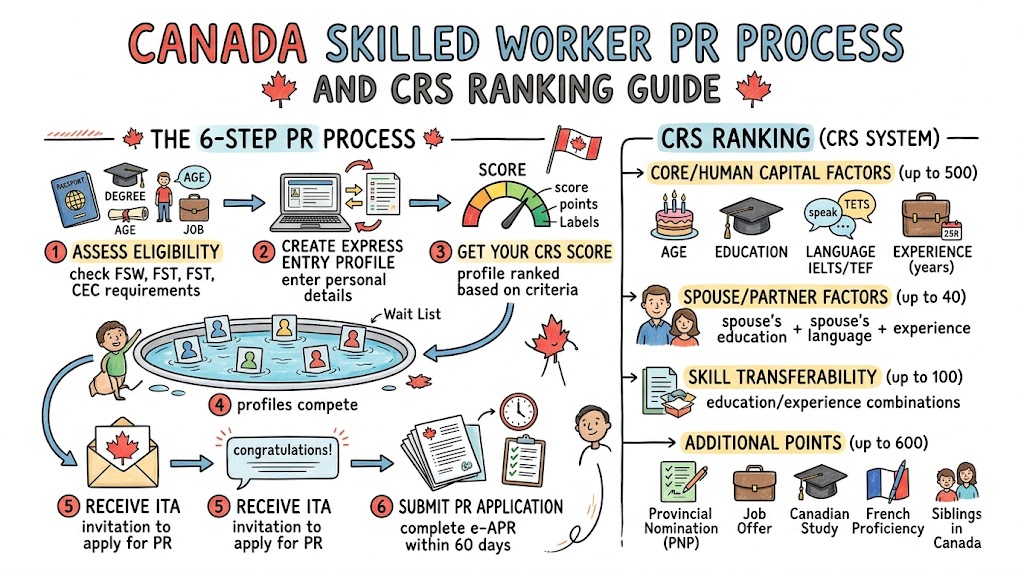
Your CRS score is categorized into four main sections. Understanding these is the first step toward optimizing your profile.
The Four Pillars of Your CRS Score
| Category | Maximum Points (Single Applicant) | What it Evaluates |
| Core Human Capital | 500 Points | Age, Education, Language, & Work Experience |
| Spouse Factors | 40 Points | Spouse’s Language, Education, & Work Experience |
| Skills Transferability | 100 Points | Combinations of Education, Language, & Experience |
| Additional Points | 600 Points | Provincial Nominations, Job Offers, & Siblings in Canada |
Note: If you are applying as a single candidate, the points allocated for a spouse are automatically redistributed to your Core Human Capital factors.
The Express Entry System: Pathways to PR
Express Entry is the digital management system for Canadian immigration. It houses several streams, each with unique requirements.
Primary Express Entry Programs
- Federal Skilled Worker Program (FSWP): Designed for professionals with foreign work experience and strong academic credentials.
- Canadian Experience Class (CEC): Tailored for those who have already gained skilled work experience within Canada.
- Federal Skilled Trades Program (FSTP): For qualified tradespeople in fields like construction, manufacturing, or specialized maintenance.
- Provincial Nominee Program (PNP): Perhaps the most powerful tool, where provinces nominate you based on specific local labor shortages.
Strategic CRS Score Breakdown
In 2026, IRCC is focusing heavily on category-based draws. This means your specific occupation (NOC code) and language skills are now as critical as your total score.
Factors That Maximize Your Score
- Age: The “prime” window for maximum points (110) is ages 20–29. Points begin to decrease gradually after age 30, reaching zero at age 45.
- Education: A Master’s or PhD yields the highest returns. Always ensure you have a valid Educational Credential Assessment (ECA) for your foreign degrees.
- Language: Your proficiency in English (IELTS/CELPIP) or French is the most “controllable” variable. Moving from CLB 7 to CLB 9 can boost your score by over 50 points.
Step-by-Step Example Calculation
Let’s look at how a typical candidate’s score adds up:
Profile: 29-year-old software engineer, Master’s degree holder, IELTS CLB 9, 3 years of experience.
- Age (29): 110 points.
- Education (Master’s): 135 points.
- Language (CLB 9): ~124 points.
- Work Experience (3 years): 64 points.
- Skills Transferability (Education + Language): 50 points.Total Estimated CRS: ~483 points.
How to Boost Your CRS Score in 2026
If your calculated score is slightly below the recent draw averages, you have several effective strategies:
- The French Advantage: Learning French to a NCLC 7 level can grant you an extra 50 points and opens the door to frequent, lower-cutoff French-language proficiency draws.
- Provincial Nomination (The Golden Ticket): A nomination from a province (like Ontario or British Columbia) adds 600 points to your profile, effectively guaranteeing an ITA in the next draw.
- Target Category-Based Draws: If you work in Healthcare, STEM, or Trades, monitor the specific category-based draws. These often have significantly lower cutoffs than general draws.
- Retake Language Tests: If you are at a CLB 7 or 8, a few months of focused study to reach CLB 9 can result in one of the largest single jumps in your CRS score.
Common Mistakes to Avoid
| Mistake | Consequence |
| Incorrect NOC Selection | Your work experience may be disqualified, leading to rejection. |
| Expired IELTS/ECA | Your profile will be invalidated during the document verification stage. |
| Inaccurate Self-Scoring | Overestimating points creates a false sense of security and delays your strategy. |
| Ignoring PNP Streams | Many candidates focus only on Federal draws, missing the easier Provincial routes. |
Real-Life Case Studies
Case 1: The IT Professional
A 27-year-old developer had a CRS of 420. By focusing solely on their writing and speaking skills for the IELTS, they moved from CLB 7 to CLB 9. Their score jumped to 470, helping them qualify for a targeted tech-based draw.
Case 2: The Married Duo
A couple had a low score due to the primary applicant’s age (36). By switching the “Principal Applicant” to the 30-year-old spouse (who also had a Master’s degree), their CRS increased by 45 points, allowing them to cross the 500-point threshold.
Case 3: The Healthcare Worker
A nurse had a modest score of 440. By applying for the Ontario Immigrant Nominee Program (OINP) Healthcare stream, they secured a provincial nomination, gained 600 points, and received their invitation within two months.
Frequently Asked Questions (FAQ)
- What is a “good” CRS score? In 2026, scores between 480 and 510 are generally competitive, but this fluctuates based on the draw type.
- Is a job offer mandatory? No, but it can provide 50 or 200 bonus points depending on the position.
- Does age hurt my chances? Age points decline after 30, but you can compensate with higher language scores or provincial nominations.
- Can I apply without an ECA? No, you must have an ECA for foreign education to claim education points.
- Is IELTS the only test? No, CELPIP (for English) or TEF/TCF (for French) are also accepted.
- Can a sibling in Canada help? Yes, having a sibling who is a Canadian citizen or PR earns you 15 bonus points.
- What if I improve my score after applying? You can and should update your profile immediately to reflect new scores or credentials.
- Are volunteer hours counted? No, only paid, skilled work experience counts.
- How long is the Express Entry profile valid? Your profile remains in the pool for 12 months.
- Do I need a huge bank balance? You must show “Proof of Funds” unless you have a valid job offer or are currently authorized to work in Canada.
- Which province is easiest? Saskatchewan, Alberta, and Nova Scotia often have accessible streams for specific skill sets.
- What is a COPR? It is the Confirmation of Permanent Residence document you receive once your final application is approved.
Conclusion: Your Path Forward
Mastering the Canada PR Points Calculator is more than just a numbers game—it is the cornerstone of your immigration strategy. In 2026, the system has become more nuanced, favoring those who take a proactive approach by aligning their skills with the current economic priorities of Canada. Whether you are aiming for a high CRS score through language refinement or seeking the 600-point boost of a provincial nomination, your success depends on informed planning and meticulous execution.
Do not be discouraged by fluctuations in draw cutoffs. The immigration landscape is vast, and there is almost always a pathway for those who are prepared, adaptable, and persistent. Your dream of living in Canada is within reach—start by calculating your score, identifying your unique strengths, and taking the necessary steps to make your profile stand out. The journey of a thousand miles begins with a single, calculated step.
