Introduction
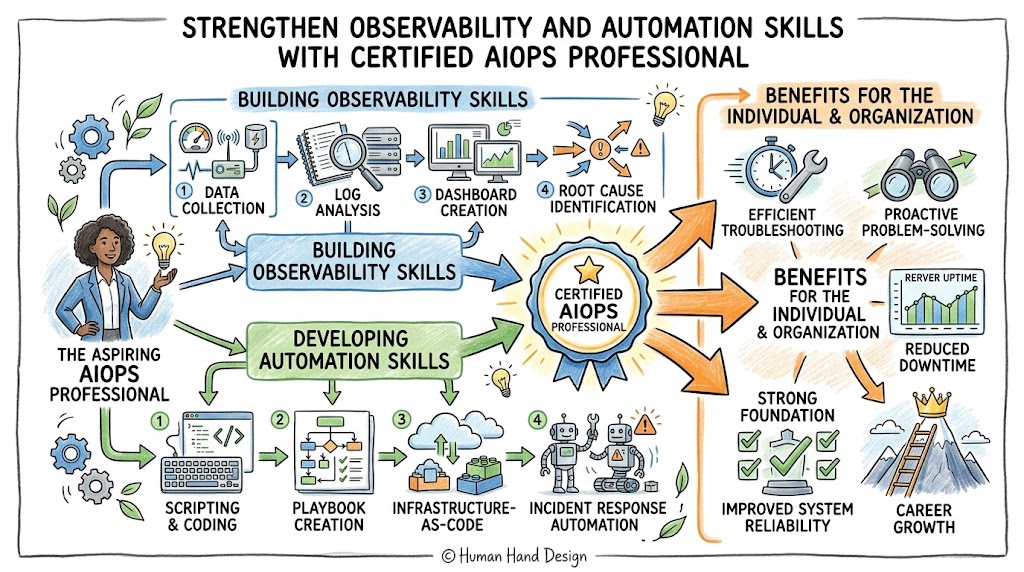
In the current era of hyper-scale infrastructure, the Certified AIOps Architect certification stands as the gold standard for engineers seeking to transform raw telemetry into automated decision-making. As modern stacks grow increasingly volatile, the traditional reactive approach to troubleshooting is no longer viable. This guide is curated for high-performing SREs, DevOps engineers, and technical architects who need to navigate the complexities of machine learning integration within IT operations. By leveraging the resources at aiopsschool, professionals can systematically build the skills required to reduce operational toil, proving their expertise in an increasingly automated world.
What is the Certified AIOps Architect?
The Certified AIOps Architect represents the convergence of data science, observability, and infrastructure engineering. It exists to provide a framework for designing systems that do not just monitor, but actively analyze and remediate operational issues in real-time. Unlike generic certification programs that focus on product features, this path emphasizes the architectural logic behind intelligent operations. It aligns with the reality of production-grade workflows where human intervention must be minimized, and predictive modeling is used to maintain high system availability.
Who Should Pursue Certified AIOps Architect?
This path is intended for those who have moved beyond “getting things running” and are now focused on “keeping things optimized at scale.” It is essential for SREs and Platform Engineers who handle massive datasets and need better ways to manage incident noise. Security engineers will find value in the anomaly detection aspects, while technical leaders and managers will benefit from the strategic vision required to implement organizational-wide AIOps standards. Whether you are scaling infrastructure in India’s rapid digital ecosystem or maintaining global cloud architectures, this certification provides the necessary expertise to remain competitive.
Why Certified AIOps Architect
The demand for professionals who can bridge the gap between AI/ML capabilities and IT infrastructure is skyrocketing. This certification ensures you are not just familiar with current tools, but are fundamentally grounded in the architectural patterns that drive intelligent operations. As toolsets shift and platforms evolve, these core principles of data-driven reliability remain constant, ensuring your career longevity. The return on your investment is clear: the ability to design self-healing systems that reduce MTTR (Mean Time to Repair) and drastically decrease operational costs.
Certified AIOps Architect Certification Overview
The program is structured through the Certified AIOps Architect portal and managed via [aiopsschool]. It is not a test of memory, but a test of applied logic. The certification is segmented into logical layers, covering data ingestion, ML model deployment, and the final automated execution layer. Ownership of the certification requires a clear demonstration that you can design a robust pipeline that treats operational data as a first-class citizen in your infrastructure design.
Certified AIOps Architect Certification Tracks & Levels
The certification levels are designed to mirror a natural career progression from implementation to architectural leadership. Foundation levels establish your baseline for observability and data hygiene. Professional levels force you to grapple with model training, noise reduction, and integration. Advanced levels, meanwhile, focus on policy, governance, and the orchestration of large-scale, automated environments. This modular approach allows you to step into the domain regardless of your current seniority.
Complete Certified AIOps Architect Certification Table
| Track | Level | Who it’s for | Prerequisites | Skills Covered |
| Foundation | Entry | Junior Ops Engineers | Basic Shell/Scripting | Data Observability |
| Professional | Mid-Level | Senior DevOps/SRE | Foundation Level | ML Model Pipelines |
| Advanced | Architect | Leads/Principal | Professional Level | Policy & Governance |
Detailed Guide for Each Certified AIOps Architect Certification
Certified AIOps Architect – Professional Level
What it is
A high-level certification focused on the architectural design of automated incident response systems and proactive infrastructure health monitoring.
Who should take it
Senior engineers with practical experience in large-scale production environments who want to formalize their knowledge of intelligent automation.
Skills you’ll gain
- Designing scalable data ingestion pipelines.
- Implementing noise reduction patterns for alert fatigue.
- Orchestrating automated remediation scripts based on ML outputs.
Real-world projects you should be able to do
- Architecture of a system that correlates logs and metrics to identify root cause.
- Building a predictive capacity planner that triggers auto-scaling before breaches occur.
- Developing a feedback loop where post-incident data improves model accuracy.
Preparation plan
- 7–14 days: Deep dive into the fundamentals of observability and time-series data storage.
- 30 days: Hands-on implementation of a small AIOps prototype using standard industry tooling.
- 60 days: Review and optimization of your architectural design, focusing on scalability and security.
Common mistakes
Over-engineering the ML models instead of focusing on data quality. Failing to consider the operational maintenance of the automation pipelines.
Best next certification after this
- Same-track: Advanced Strategy AIOps
- Cross-track: MLOps Specialist
- Leadership option: Platform Engineering Management
Choose Your Learning Path
DevOps Path
This path integrates intelligence into the CI/CD pipeline. By learning to analyze deployment metrics automatically, you can prevent faulty code from reaching production, effectively raising the quality bar for every release.
DevSecOps Path
The focus here is on identifying malicious intent through behavioral analysis. You will learn to architect systems that recognize abnormal traffic patterns, enabling automated containment of security breaches.
SRE Path
This path prioritizes the elimination of manual toil. By using AIOps to automate repetitive troubleshooting tasks, you can ensure that your service level objectives (SLOs) are maintained without constant human oversight.
AIOps / MLOps Path
This specialized track bridges the gap between the operational data and the machine learning model lifecycle. It covers how to maintain, retrain, and version your models so they remain effective in a changing production environment.
DataOps Path
The focus is on the pipeline itself. You will learn how to ensure the data flowing into your AIOps architecture is accurate, consistent, and available in real-time for immediate decision-making.
FinOps Path
This path utilizes intelligent operational data to perform cost optimization. By predicting usage spikes and identifying idle resources, you can automate your cloud expenditure to maximize value.
Role → Recommended Certified AIOps Architect Certifications
| Role | Recommended Certifications |
| DevOps Engineer | Foundation |
| SRE | Professional |
| Platform Engineer | Professional |
| Cloud Engineer | Foundation |
| Security Engineer | Professional |
| Data Engineer | Professional |
| FinOps Practitioner | Foundation |
| Engineering Manager | Advanced |
Next Certifications to Take After Certified AIOps Architect
Same Track Progression
Deepen your expertise by tackling advanced governance and enterprise-scale orchestration, focusing on multi-cloud implementations and complex data strategies.
Cross-Track Expansion
Expand your reach into MLOps or DataOps to gain a holistic view of the data lifecycle, from initial collection to final model serving and inference monitoring.
Leadership & Management Track
Transition into leadership roles by focusing on the business and organizational impacts of AIOps, including team restructuring, budget forecasting, and enterprise change management.
Training & Certification Support Providers for Certified AIOps Architect
DevOpsSchool offers rigorous training programs aimed at bridging the gap between theoretical DevOps knowledge and real-world implementation expertise.
Cotocus delivers intensive, project-heavy coaching that ensures you can apply architectural patterns to complex, distributed production systems.
Scmgalaxy focuses on the structural elements of automation, providing deep insights into version control and configuration management best practices.
BestDevOps specializes in current industry trends, helping engineers stay aligned with the latest toolsets and standard operating procedures.
devsecopsschool provides a specialized curriculum that integrates security into the operational lifecycle, ensuring your architecture is both resilient and secure.
sreschool concentrates on the core tenets of site reliability, providing the methodologies needed to manage high-uptime environments at scale.
aiopsschool acts as the primary authority for specialized training in operational intelligence and the implementation of self-healing infrastructures.
dataopsschool focuses on the engineering of data pipelines, which are the backbone of any robust and effective AIOps deployment.
finopsschool offers insights into cloud financial management, helping professionals use operational data to control and optimize infrastructure costs.
Frequently Asked Questions (General – 12 questions)
- What is the primary objective of this certification?The objective is to validate the architect’s ability to design, implement, and maintain intelligent systems that automate IT operations.
- Is this program suitable for beginners?While anyone can start, it is designed for those who already have a functional understanding of DevOps or SRE principles.
- How does this certification increase my professional value?It proves you possess high-level architectural skills that are in demand for modern, large-scale, automated environments.
- Can I manage my studies alongside a full-time job?The program is designed for working professionals, with flexible study modules to accommodate busy career schedules.
- Is the exam based on specific tools?The certification focuses on architectural principles that are platform-agnostic, though labs often use common industry-standard tools.
- What is the expected ROI for this certification?The ROI comes from career advancement, the ability to solve complex problems faster, and increased efficiency in your current role.
- How are the assessments conducted?Assessments are conducted through a mix of theoretical understanding and practical, scenario-based application.
- Are there any required hardware specs for the labs?Most labs are cloud-based, so a standard laptop with reliable internet access is all you need to get started.
- Can I update my skills after getting certified?Yes, the certification path encourages continuous learning through access to workshops and updated training material.
- How long does it take to complete the program?Completion time varies based on your existing knowledge, but typically ranges from one to three months of dedicated study.
- Do I need a background in data science?No, you need to understand how to apply data insights to operational problems, not build complex ML algorithms from scratch.
- Is this certification recognized internationally?The principles of AIOps are global standards, making this certification highly relevant for international engineering roles.
FAQs on Certified AIOps Architect (8 Focused Q&A)
- How do I deal with “alert noise”?Architect a system that uses ML to aggregate and suppress related alerts, ensuring only high-impact issues reach the human operators.
- Is AIOps only for massive systems?While most beneficial at scale, the patterns of observability and intelligent response are valuable in any non-trivial production setup.
- How does this impact the SRE team?It enables the SRE team to focus on high-value architectural improvements rather than repetitive, manual incident response.
- Can I automate root cause analysis?Yes, by using correlation engines that map incidents to specific deployment events or configuration changes automatically.
- What is the role of data quality?Data quality is paramount; if the telemetry data is garbage, the AI-driven output will also be garbage, leading to incorrect responses.
- Does this replace human engineers?No, it augments them, removing toil so they can focus on higher-order engineering problems that require human creativity.
- Is it difficult to integrate with existing tools?Modern AIOps architectures are designed to be plug-and-play with existing observability and ticketing platforms.
- How does this affect my architectural decisions?It forces you to design with “observability-first” in mind, ensuring your systems are self-documenting and self-diagnostic.
Final Thoughts: Is Certified AIOps Architect Worth It?
In my two decades of experience, I have seen many trends come and go, but the move toward intelligent, automated operations is a fundamental shift in how we build and maintain technology. Pursuing the Certified AIOps Architect is not about adding a line to your resume; it is about equipping yourself with the mindset and technical framework to handle the challenges of modern infrastructure. It is a rigorous path that demands a commitment to continuous improvement. If you are serious about advancing your career and making a tangible impact on the reliability and efficiency of your organization’s systems, this is a path that delivers long-term results.
