Introduction
The Certified Site Reliability Manager program is designed to elevate professionals in the DevOps, cloud-native, and platform engineering domains. This guide targets engineers, SREs, cloud professionals, security and data practitioners, and technical managers who want to unlock practical, production-ready SRE skills. With complex systems increasingly driving business operations, mastering site reliability ensures minimal downtime, scalable systems, and operational excellence. By following this guide, professionals can make informed decisions about the right certification path, understand career implications, and identify which skills directly impact real-world performance.
What is the Certified Site Reliability Manager?
The Certified Site Reliability Manager represents a practical, production-focused approach to mastering SRE principles. It emphasizes hands-on learning over theoretical concepts, enabling participants to implement observability, incident management, and automation workflows in enterprise-grade systems. The certification aligns with modern engineering practices, including cloud infrastructure, microservices, and DevOps pipelines, preparing candidates to drive reliability, efficiency, and operational resilience in live environments.
Who Should Pursue Certified Site Reliability Manager?
This certification is ideal for software engineers, SREs, cloud engineers, platform engineers, security analysts, data engineers, and technical managers seeking structured SRE knowledge. Beginners can acquire foundational skills, while experienced professionals can validate advanced operational competencies. Globally and in India, organizations increasingly prioritize SRE expertise for scalable infrastructure, making this certification valuable across industries and career levels.
Why Certified Site Reliability Manager
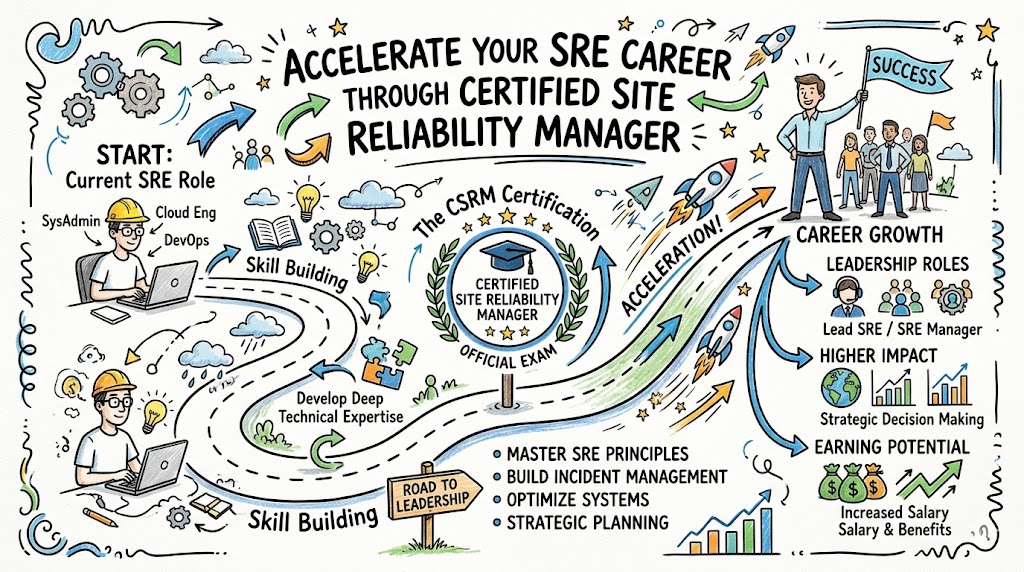
The Certified Site Reliability Manager certification equips professionals with skills that remain relevant despite rapid tool evolution. By focusing on observable system metrics, automation, and incident response, certified practitioners can significantly reduce downtime and operational costs. Employers recognize this certification as proof of mastery in real-world SRE practices, ensuring a strong return on time investment and accelerating career growth in engineering, platform, and operational leadership roles.
Certified Site Reliability Manager Certification Overview
The program is delivered via Certified Site Reliability Manager – Official URL and hosted on sreschool. It covers foundation, professional, and advanced levels, with a mix of assessments, hands-on labs, and real-world project exercises. Candidates maintain ownership of their learning path, progressing through modules that reinforce operational workflows, reliability engineering principles, and incident management.
Certified Site Reliability Manager Certification Tracks & Levels
The certification is structured into three main levels: foundation, professional, and advanced. Each level builds on the previous, gradually expanding knowledge from core reliability principles to complex automation, observability, and leadership skills. Specialized tracks include DevOps, SRE, FinOps, and cross-functional operational practices, aligning the certification with career progression from engineer to team lead or platform architect.
Complete Certified Site Reliability Manager Certification Table
| Track | Level | Who it’s for | Prerequisites | Skills Covered | Recommended Order |
|---|---|---|---|---|---|
| SRE | Foundation | Beginners in DevOps/SRE | Basic Linux & Cloud | Reliability fundamentals, monitoring basics | 1 |
| SRE | Professional | Mid-level engineers | Foundation level or equivalent experience | Observability, alerting, incident response | 2 |
| SRE | Advanced | Experienced SREs, Team Leads | Professional SRE | Advanced automation, chaos engineering, reliability design | 3 |
| DevOps | Foundation | DevOps practitioners | Basic DevOps knowledge | CI/CD pipelines, infrastructure reliability | 1 |
| DevOps | Professional | Engineers & Platform DevOps | Foundation DevOps | Automation, deployment strategies, monitoring | 2 |
| FinOps | Professional | Cloud Finance engineers | Cloud experience | Cost observability, optimization, budgeting | 1 |
| AIOps | Professional | AI platform engineers | Python & cloud familiarity | AI-driven monitoring, anomaly detection | 1 |
| MLOps | Professional | Data engineers & ML Ops | Data pipelines experience | Model reliability, monitoring, deployment | 1 |
| Leadership | Advanced | Managers & Architects | Professional SRE | Reliability governance, team management | 1 |
Detailed Guide for Each Certified Site Reliability Manager Certification
Certified Site Reliability Manager – Foundation
What it is
Validates fundamental SRE knowledge including monitoring, SLIs/SLOs, and reliability best practices.
Who should take it
Entry-level engineers, junior SREs, DevOps beginners seeking practical reliability skills.
Skills you’ll gain
- Understanding SLIs, SLOs, and SLAs
- Basic monitoring and alerting setup
- Incident response fundamentals
- Intro to automation in operational tasks
Real-world projects you should be able to do
- Setup monitoring for a cloud service
- Define and track service-level objectives
- Create a simple alerting workflow
- Document incident response processes
Preparation plan
- 7–14 days: Review monitoring tools and SRE principles
- 30 days: Hands-on labs with cloud services and alerting
- 60 days: Simulate incidents and practice response
Common mistakes
- Ignoring observability metrics
- Overlooking error budgets
- Focusing only on theory
Best next certification after this
- Same-track: Professional SRE
- Cross-track: DevOps Professional
- Leadership: Advanced SRE Leadership
Certified Site Reliability Manager – Professional
What it is
Validates applied SRE skills in enterprise environments, emphasizing automation, observability, and incident handling.
Who should take it
Mid-level engineers, platform specialists, or SREs looking to formalize operational practices.
Skills you’ll gain
- Advanced monitoring & logging
- Incident management and postmortem analysis
- Reliability automation & CI/CD integration
- Capacity planning and scaling
Real-world projects you should be able to do
- Automate incident response workflows
- Implement chaos engineering tests
- Optimize system performance
- Maintain production-grade SLIs/SLOs
Preparation plan
- 7–14 days: Review professional SRE case studies
- 30 days: Practice automation & observability tasks
- 60 days: Lead mock incident simulations
Common mistakes
- Over-automation without monitoring
- Skipping postmortem reviews
- Ignoring upstream/downstream dependencies
Best next certification after this
- Same-track: Advanced SRE
- Cross-track: DevOps Professional
- Leadership: SRE Management
Certified Site Reliability Manager – Advanced
What it is
Demonstrates mastery of enterprise-scale SRE, automation, and cross-team leadership.
Who should take it
Experienced SREs, platform leads, and engineering managers driving reliability across services.
Skills you’ll gain
- Chaos engineering implementation
- Advanced reliability design
- Strategic incident management
- Governance and policy creation
Real-world projects you should be able to do
- Design fault-tolerant infrastructure
- Lead multi-team incident response
- Implement enterprise monitoring strategy
- Optimize global system reliability
Preparation plan
- 7–14 days: Review leadership case studies
- 30 days: Execute advanced production simulations
- 60 days: Lead live reliability projects
Common mistakes
- Neglecting documentation and knowledge sharing
- Ignoring cross-team communication
- Overlooking scaling constraints
Best next certification after this
- Same-track: Deep SRE specialization
- Cross-track: FinOps / DevOps Advanced
- Leadership: Executive Engineering Management
Choose Your Learning Path
DevOps Path
Accelerates reliability expertise for DevOps practitioners by combining SRE and automation skills. You’ll gain practical knowledge in CI/CD pipelines, observability, and service management, preparing for platform engineering or senior DevOps roles.
DevSecOps Path
Integrates security into reliability practices. Focus on secure automation, incident response, and monitoring vulnerabilities. Ideal for professionals bridging operational and security responsibilities.
SRE Path
Deep dive into core SRE principles, reliability design, and system observability. Prepares engineers to manage production systems efficiently and lead reliability initiatives in enterprise settings.
AIOps / MLOps Path
Focuses on AI-driven operations, anomaly detection, and model reliability. Professionals learn to automate incident detection, optimize model performance, and integrate machine learning observability into production pipelines.
DataOps Path
Covers data pipeline reliability, monitoring, and governance. Data engineers and analytics teams gain skills to ensure end-to-end reliability for ETL, streaming, and analytics platforms.
FinOps Path
Emphasizes cost observability, cloud spend optimization, and financial governance. Ideal for cloud finance teams seeking reliability in cost monitoring and resource efficiency.
Role → Recommended Certified Site Reliability Manager Certifications
| Role | Recommended Certifications |
|---|---|
| DevOps Engineer | Foundation, Professional SRE |
| SRE | Professional, Advanced SRE |
| Platform Engineer | Professional SRE, DevOps Professional |
| Cloud Engineer | Professional SRE, DevOps Professional |
| Security Engineer | DevSecOps SRE, Professional SRE |
| Data Engineer | DataOps Professional SRE |
| FinOps Practitioner | FinOps Professional SRE |
| Engineering Manager | Advanced SRE Leadership |
Next Certifications to Take After Certified Site Reliability Manager
Same Track Progression
Deepen expertise with advanced SRE principles, fault-tolerant design, and enterprise automation.
Cross-Track Expansion
Gain broader operational understanding in DevOps, FinOps, or DataOps to improve system reliability and team collaboration.
Leadership & Management Track
Transition to leading reliability teams, defining enterprise practices, and driving cross-functional reliability initiatives.
Training & Certification Support Providers for Certified Site Reliability Manager
DevOpsSchool
Offers hands-on labs and mentorship, focusing on real-world SRE challenges and platform reliability practices.
Cotocus
Provides structured training paths emphasizing incident response, automation, and observability in production environments.
Scmgalaxy
Specializes in practical SRE exercises, CI/CD integration, and enterprise reliability workflows.
BestDevOps
Guides candidates through applied DevOps and SRE skills, including monitoring, alerting, and postmortem analysis.
devsecopsschool
Focuses on integrating security with SRE practices, helping professionals manage secure and reliable systems.
sreschool
Hosts the full Certified Site Reliability Manager program, offering practical labs, certification tracks, and enterprise-aligned SRE training.
aiopsschool
Provides advanced AI-driven observability and anomaly detection training for production-grade monitoring.
dataopsschool
Covers reliability in data pipelines, streaming, and analytics platforms for data engineering teams.
finopsschool
Trains professionals on cloud cost reliability, financial observability, and operational budgeting.
Frequently Asked Questions (General)
- What is the difficulty level of the Certified Site Reliability Manager?
It ranges from moderate for foundation learners to advanced for leadership-level SREs, depending on prior experience. - How much time is required to prepare for each level?
Foundation: 2–4 weeks; Professional: 4–6 weeks; Advanced: 6–8 weeks, including hands-on labs. - Are there prerequisites for taking the certification?
Foundation requires basic Linux/cloud knowledge; Professional and Advanced need prior SRE or DevOps experience. - Is the certification globally recognized?
Yes, it is acknowledged by enterprises across India, APAC, and international organizations. - Does it offer real-world projects?
All levels include hands-on labs, production simulations, and incident response exercises. - What is the ROI of earning this certification?
High, as it enhances career prospects, operational skills, and leadership readiness. - Can beginners take the program?
Yes, foundation-level tracks cater to beginners with no prior SRE experience. - Which tools and platforms are covered?
Covers cloud platforms, CI/CD pipelines, monitoring stacks, and incident management tools. - Is there a leadership track?
Yes, the advanced level includes leadership, governance, and management-oriented modules. - How are assessments conducted?
Through hands-on labs, project simulations, and multiple-choice theoretical tests. - Can this certification help in cross-functional roles?
Absolutely, it prepares candidates for DevOps, DataOps, FinOps, and cloud reliability responsibilities. - Is mentorship available?
Yes, providers like sreschool and DevOpsSchool offer mentorship and guidance throughout the program.
FAQs on Certified Site Reliability Manager
- What practical skills will I gain from the certification?
You’ll gain observability setup, incident response, automation workflows, chaos testing, and SLA/SLO management, all applicable in production systems. - Can this certification accelerate my career in SRE?
Yes, it validates applied skills, making you eligible for higher-level SRE, platform, or DevOps roles. - How intensive is the Advanced SRE track?
It requires deep understanding of automation, monitoring, and enterprise-grade incident management; preparation involves 60 days of structured practice. - Do the programs focus on real-world projects?
Yes, every track includes hands-on exercises, simulated incidents, and practical operational workflows. - Is prior DevOps experience mandatory?
For foundation track, minimal experience suffices; professional and advanced tracks require prior exposure to DevOps/SRE principles. - What’s the best sequence of certifications?
Start with foundation, progress to professional, then advance to leadership/advanced SRE modules for complete mastery. - How does it differ from general DevOps certifications?
Focuses on reliability, observability, incident management, and production readiness rather than general DevOps practices. - Will it help in global career opportunities?
Yes, the certification aligns with international SRE standards, recognized across enterprises worldwide.
Final Thoughts: Is Certified Site Reliability Manager Worth It?
The Certified Site Reliability Manager certification is highly valuable for professionals aiming to excel in reliability, platform engineering, and operational leadership. It provides hands-on, production-focused skills that directly improve system uptime, scalability, and efficiency. By following structured tracks from foundation to advanced levels, candidates can unlock career acceleration, broaden expertise across DevOps, DataOps, and FinOps, and prepare for leadership roles. For anyone serious about mastering SRE principles and driving measurable outcomes in complex environments, this certification is a practical and career-enhancing choice. Strategic preparation, real-world application, and continued skill-building ensure the certification pays long-term dividends.
