
Introduction
In today’s fast-moving tech environment, companies rely heavily on software to drive growth, serve customers, and handle daily transactions. Yet, the pressure to release new features quickly often pushes security to the background. When vulnerabilities are spotted only after an application goes live, fixing them becomes an expensive and stressful hurdle. DevSecOps fixes this disconnect by weaving security seamlessly into every phase of development and operations from day one. Many organizations turn to professional expertise to bridge the gap between rapid delivery and robust protection. Through strategic planning, careful assessments, hands-on implementation, team training, and managed support, businesses can establish a resilient defense for their applications and cloud workloads. Platforms like DevSecOpsNow.com help teams navigate this journey with practical solutions and expert guidance tailored to real-world operational needs.
Understanding the Shift Toward Modern DevSecOps
DevSecOps represents a cultural and technical shift that makes security a shared duty for everyone involved in building software. Historically, development teams wrote the code, operations deployed it, and a separate security team acted as a final checkpoint. This traditional setup frequently created friction, caused project delays, and left developers frustrated by last-minute roadblocks.
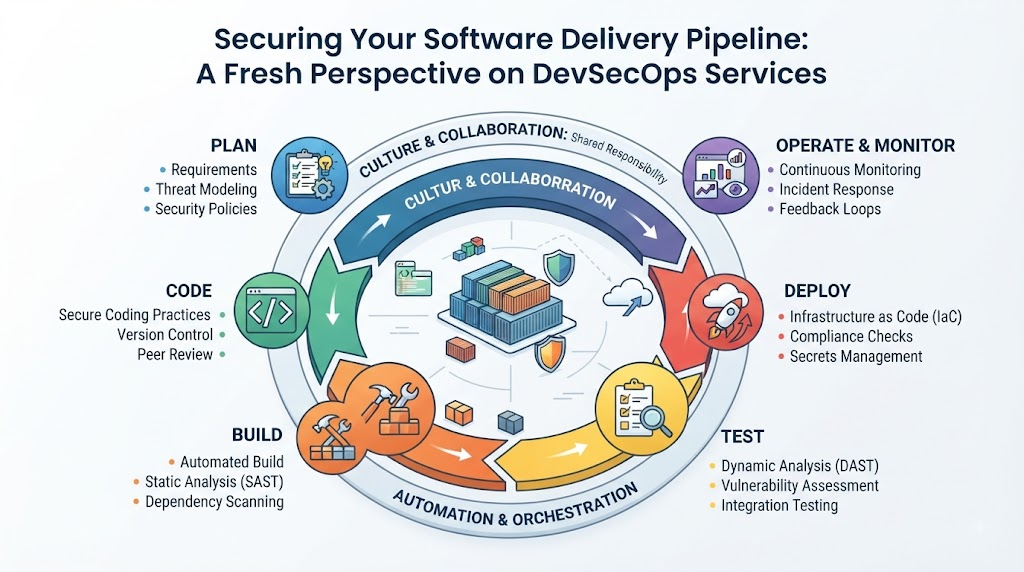
DevSecOps rethinks this workflow by shifting security forward, ensuring checks occur continuously as code is written. Automation handles the heavy lifting, scanning code and checking configurations instantly without stalling the pipeline. Collaboration is equally crucial, bringing developers, ops staff, and security professionals together to resolve issues early. By making safety an ongoing practice rather than a one-time event, organizations keep their products secure without sacrificing speed.
DevSecOps Consulting Services for Strategic Clarity
Designing a secure delivery workflow requires a clear roadmap, as a generic security checklist rarely fits every organization’s unique stack and team structure.
DevSecOps Consulting Services provide expert direction to help businesses plan, structure, and refine their security strategy. Consultants analyze your current development environment, spot workflow bottlenecks, and recommend tools that integrate smoothly with your existing systems. They assist in designing secure architectures, planning automated tests within your CI/CD pipelines, and establishing practical governance policies. This strategic partnership empowers leadership to make confident decisions, align security goals with business expansion, and minimize risk effectively.
DevSecOps Assessment Services for Finding Hidden Gaps
Jumping into major security changes without knowing your baseline can lead to wasted effort and misdirected resources.
DevSecOps Assessment Services deliver a comprehensive review of your current development pipelines, cloud setups, and security controls. Specialists examine how your team writes code, handles secrets, manages access permissions, and tests applications prior to release. This evaluation uncovers blind spots, misconfigurations, and workflow friction that automated scans might overlook. With a clear picture of your maturity level, your organization receives a prioritized action plan detailing exactly which areas need attention first.
DevSecOps Implementation Services for Smooth Integration
Transitioning from legacy development methods to an automated, secure workflow requires careful planning and precise execution. Trying to overhaul everything at once often overwhelms internal engineers.
DevSecOps Implementation Services help organizations build security directly into their daily operations in manageable phases. Implementation engineers work alongside your staff to embed automated testing tools into pipelines, configure vulnerability management systems, and secure cloud environments. They ensure that security checks fit naturally into developer workflows so fixing bugs feels intuitive. This structured rollout keeps software delivery fast, reliable, and secure from initial commit to production.
DevSecOps Managed Services for Round-the-Clock Protection
Maintaining security tools and monitoring pipelines requires constant attention—something busy internal teams often struggle to juggle alongside feature development.
DevSecOps Managed Services offer continuous oversight and operational support for businesses that want reliable security without expanding their internal headcount. Managed providers keep a watchful eye on CI/CD pipelines, track emerging vulnerabilities, manage security tooling, and deliver regular health reports. They also assist with alert triage and incident response when unexpected events occur. This continuous support lifts the operational burden from your internal engineers, letting them focus on building great products.
DevSecOps Training for Building Internal Expertise
Even the most advanced security automation will fail if the people operating the systems lack foundational security awareness. Technology alone cannot protect a business; educated teams are essential.
DevSecOps Training bridges the gap between development, operations, and security by teaching staff how to write secure code and spot common vulnerabilities early. Participants learn how to interpret automated scan results, apply pipeline best practices, and collaborate more effectively. Investing in team education fosters a culture where security is seen as a shared responsibility rather than an external chore.
Corporate DevSecOps Training for Enterprise Alignment
Larger organizations face unique hurdles when trying to synchronize multiple engineering departments and leadership units around a single security standard.
Corporate DevSecOps Training upskills entire enterprise technology groups simultaneously, ensuring consistent practices across all business units. These comprehensive programs cover secure coding, cloud infrastructure hardening, container safety, and automated compliance. Featuring practical, hands-on exercises tailored to your technology stack, corporate training breaks down traditional silos. By educating developers, DevOps specialists, and managers together, enterprises build a cohesive, security-first mindset across the board.
Cloud Security Consulting Services for Scalable Infrastructure
Modern applications rely heavily on cloud platforms to scale effortlessly and serve global users. However, managing these environments introduces complex security risks if configurations are mismanaged.
Cloud Security Consulting Services help businesses protect their cloud infrastructure against unauthorized access, data leaks, and configuration errors. Consultants review identity management settings, network policies, storage permissions, and Infrastructure-as-Code files. They help implement robust secrets management and set up continuous monitoring to catch suspicious activity early. This targeted guidance ensures your cloud environment remains resilient, compliant, and agile.
Kubernetes Security Consulting Services for Containerized Apps
Container platforms like Kubernetes offer incredible flexibility and speed for modern application delivery, but they also introduce distinct security challenges that standard tools miss.
Kubernetes Security Consulting Services help organizations protect their containerized workloads across the entire lifecycle. Experts review cluster settings, role-based access controls, network segmentation, and image registries to find potential weaknesses. They help establish admission controls, runtime monitoring, and secure secrets handling. This proactive approach ensures your cloud-native applications run safely without compromising deployment speed.
Software Supply Chain Security Services
Today’s applications rely heavily on open-source packages, third-party libraries, and pre-built container images. While this accelerates development, it exposes projects to risks hidden inside external dependencies.
Software Supply Chain Security Services provide deep visibility and control over every component entering your software builds. Experts help organizations track dependencies, scan packages for known vulnerabilities, verify code integrity, and generate accurate Software Bills of Materials. By securing build systems and artifact repositories, these services protect businesses from malicious code injection and supply chain threats.
Penetration Testing Services for Rigorous Security Validation
While automated tools catch routine bugs, sophisticated attackers look for complex logic flaws that require human intuition and real-world simulation.
Penetration Testing Services evaluate your web apps, APIs, cloud environments, and internal networks by mimicking actual cyber attacks in a controlled setting. Ethical hackers uncover exploitable weaknesses, verify whether existing defenses hold up, and provide actionable remediation advice. While automated tools provide everyday baseline defense, penetration testing offers a vital periodic check that validates your overall security posture against advanced threats.
How DevSecOps Services Work Together
A truly secure delivery framework relies on a connected sequence of services where each stage reinforces the next:
The process generally starts with a DevSecOps Assessment to identify existing gaps and measure maturity. Next, DevSecOps Consulting Services establish the ideal strategy and toolchain architecture. With a solid plan in place, DevSecOps Implementation Services integrate security checks directly into development pipelines.
To maintain momentum, DevSecOps Training equips internal teams with the skills needed to write secure code. For ongoing defense, DevSecOps Managed Services provide continuous monitoring and operational backup. Finally, periodic Penetration Testing Services validate defenses against advanced threats, feeding insights back into the improvement cycle.
DevSecOps Service Comparison Table
| Service | Main Focus | Business Benefit |
| DevSecOps Consulting Services | Security strategy and planning | Better security decisions |
| DevSecOps Assessment Services | Finding security and process gaps | Clear improvement roadmap |
| DevSecOps Implementation Services | Integrating security into delivery | More secure software releases |
| DevSecOps Managed Services | Ongoing security support | Reduced operational workload |
| DevSecOps Training | Building team skills | Stronger security awareness |
| Cloud Security Consulting Services | Securing cloud environments | Reduced cloud security risks |
| Kubernetes Security Consulting Services | Securing container platforms | Safer cloud-native applications |
| Software Supply Chain Security Services | Protecting software components | Reduced supply chain risk |
| Penetration Testing Services | Finding exploitable weaknesses | Stronger security validation |
Common DevSecOps Challenges Businesses Face
Organizations transitioning to modern software delivery often encounter predictable hurdles that can slow down progress:
- Late Security Checks: Discovering vulnerabilities after code completion results in costly delays and team frustration.
- Tool Fatigue: Juggling disconnected security products creates endless alerts and confusion for developers.
- High False Positive Rates: Sifting through inaccurate alerts wastes engineering hours and erodes trust in automated tools.
- Skill Gaps: Development teams often want to write secure code but lack training in modern threat prevention.
- Pipeline Friction: Security checks that disrupt normal development workflows tempt teams to bypass controls.
- Cloud Misconfigurations: Complex cloud and container environments frequently suffer from accidental exposure and loose permissions.
A structured DevSecOps approach resolves these issues by introducing smart automation, clear processes, and collaborative workflows.
Benefits of Professional DevSecOps Services
- Early Vulnerability Detection: Catch and resolve security flaws during early design and coding phases before production release.
- Rapid Issue Remediation: Fix security problems faster with automated alerts and developer-friendly guidance.
- Confident Software Releases: Push updates with peace of mind knowing automated checks have verified your code.
- Robust Infrastructure Protection: Secure cloud environments, infrastructure code, and container clusters against accidental exposure.
- Minimized Supply Chain Risk: Gain complete visibility over open-source packages and dependencies to prevent upstream attacks.
- Stronger Team Collaboration: Eliminate silos between developers, operators, and security professionals for smoother operations.
How DevSecOpsNow.com Helps Organizations
Navigating the complexities of modern software security can challenge businesses of any size. DevSecOpsNow.com offers practical guidance, expert consulting, and structured services designed to make security adoption straightforward. Teams can access professional support across assessments, pipeline implementation, managed monitoring, and corporate training. Whether you need assistance securing cloud infrastructure, hardening Kubernetes clusters, managing supply chains, or performing penetration tests, the platform delivers actionable solutions tailored to real-world needs. By emphasizing practical engineering and collaboration, DevSecOpsNow.com helps companies build resilient software without sacrificing innovation speed.
How to Choose the Right DevSecOps Service Provider
Selecting the right partner to guide your security evolution is a critical choice for your engineering organization. Leaders should evaluate potential providers using several key criteria:
- Practical Experience: Look for proven, hands-on experience across diverse development stacks and cloud ecosystems.
- Comprehensive Offerings: Ensure the provider offers a balanced mix of consulting, implementation, training, and managed support.
- Infrastructure Depth: Verify their technical expertise in securing modern cloud environments and container platforms.
- Collaboration Focus: A strong partner should empower your internal teams to work together effectively rather than just installing software.
- Business Alignment: Choose a team that understands your commercial objectives and tailors security solutions to fit your delivery pace.
DevSecOps Service Comparison: Consulting vs Implementation vs Managed Services
| Service Type | Best For | Main Purpose |
| Consulting | Organizations planning DevSecOps | Strategy and guidance |
| Assessment | Organizations identifying security gaps | Finding weaknesses |
| Implementation | Organizations adopting DevSecOps | Building security into workflows |
| Managed Services | Organizations needing ongoing support | Continuous security management |
| Training | Teams building security skills | Knowledge and awareness |
Future of DevSecOps
The software development and cybersecurity landscape continues to evolve rapidly, shaped by emerging technologies and shifting threat models. Artificial intelligence is increasingly utilized to assist security teams, flagging anomalies and suggesting code fixes with greater speed. Cloud-native architectures and container platforms remain dominant, making specialized container security and policy-as-code essential for modern engineering groups. Meanwhile, Software Bills of Materials and continuous compliance are becoming standard practices as supply chain transparency takes priority. Organizations that adopt these trends and build a solid DevSecOps foundation today will easily adapt to tomorrow’s technological shifts.
Frequently Asked Questions
1. What are DevSecOps Consulting Services?
Answer: DevSecOps Consulting Services provide expert advice to help organizations plan, design, and optimize their security strategy and CI/CD pipelines.
2. Why are DevSecOps Assessment Services important?
Answer: Assessment services evaluate your current workflows and security controls to uncover hidden vulnerabilities, giving you a clear roadmap for improvement.
3. How do DevSecOps Implementation Services help businesses?
Answer: Implementation services deliver hands-on support to weave automated security testing and policies smoothly into your existing development routines.
4. What are DevSecOps Managed Services?
Answer: Managed services offer continuous security monitoring, vulnerability tracking, and operational backing to keep pipelines secure without overloading internal teams.
5. Why is DevSecOps Training important for technical teams?
Answer: Training builds essential knowledge across development and operations staff, teaching them secure coding practices and effective tool usage.
6. What is the value of Corporate DevSecOps Training?
Answer: Corporate training aligns entire enterprise technology departments around unified security standards, building a company-wide culture of shared responsibility.
7. Why do businesses need Cloud Security Consulting Services?
Answer: Cloud security consulting helps organizations protect modern cloud infrastructure from misconfigurations, unauthorized access, and data leaks.
8. Why are Kubernetes Security Consulting Services important?
Answer: These services secure containerized applications and cluster setups throughout their operational lifecycle, preventing runtime threats.
9. What are Software Supply Chain Security Services?
Answer: Supply chain security services provide visibility over third-party packages and open-source dependencies, protecting builds from malicious injection.
10. How do Penetration Testing Services support DevSecOps?
Answer: Penetration testing simulates real-world attacks to uncover complex flaws that automated scanners miss, validating your overall security posture.
Final Thoughts
Building secure software is an absolute necessity in today’s connected digital ecosystem. Waiting until the end of a project to check for vulnerabilities introduces unnecessary stress, project delays, and financial exposure. By weaving security into every phase of delivery through DevSecOps, organizations can release reliable applications with confidence. Whether through strategic advisory, thorough assessments, seamless implementation, team training, or managed monitoring, professional support makes security manageable. Embracing cloud, container, and supply chain protection ensures your technology stack stays resilient against emerging threats. With the right practices and a capable partner like DevSecOpsNow.com, businesses can achieve sustainable growth, robust protection, and long-term success.
