
Introduction
As machine learning models shift from experimental notebooks to core production systems, bridging the gap between data science and operational reliability has become paramount. The Certified MLOps Manager is an advanced professional credential designed for technical leaders and engineers striving to govern, scale, and automate modern machine learning pipelines. Delivered through aiopsschool, this program addresses the critical need for robust lifecycle management, model monitoring, and continuous delivery in enterprise environments. Within DevOps, cloud-native, and platform engineering careers, mastering machine learning operations ensures that data-driven solutions are delivered securely, efficiently, and at scale. This comprehensive guide helps professionals evaluate the curriculum, understand the learning tracks, and make informed career decisions to elevate their technical expertise.
What is the Certified MLOps Manager?
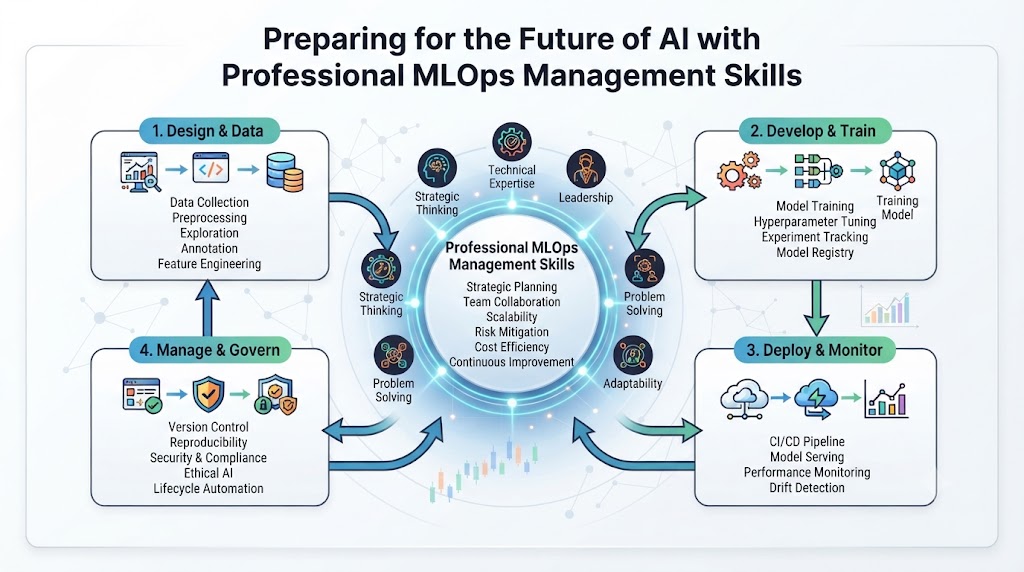
The Certified MLOps Manager represents a rigorous standard of excellence in orchestrating machine learning infrastructure, model deployment, and automated monitoring. It exists to replace theoretical knowledge with battle-tested, production-focused engineering methodologies that address real-world deployment bottlenecks. The program aligns with modern cloud-native workflows, infrastructure as code, and enterprise governance practices to ensure seamless collaboration between data scientists and infrastructure engineers. By focusing on reproducibility, automated testing, and scalable serving architectures, it equips practitioners to handle complex enterprise machine learning lifecycles. Professionals learn to design resilient architectures that minimize drift, optimize compute costs, and maintain strict security compliance across all model deployments.
Who Should Pursue Certified MLOps Manager?
This certification benefits a wide spectrum of technical professionals, including software engineers, infrastructure specialists, and data practitioners moving into leadership or platform roles. Site reliability engineers, cloud architects, and security professionals will find immense value in learning how to secure and scale machine learning workloads reliably. Beginners gain a structured entry into production machine learning workflows, while experienced engineers and technical managers validate their ability to lead enterprise-grade automation initiatives. The curriculum holds strong global and regional relevance, particularly for practitioners across India and international markets driving large-scale digital transformations. Ultimately, anyone responsible for the uptime, performance, and governance of machine learning models in production will find this credential essential.
Why Certified MLOps Manager
Enterprise adoption of artificial intelligence continues to surge, creating an unprecedented demand for leaders who can successfully operationalize machine learning at scale. The Certified MLOps Manager credential offers exceptional career longevity by focusing on foundational architectural principles rather than fleeting tool-specific trends. As organizations increasingly realize that model creation is only a fraction of the journey, professionals skilled in operationalizing these systems become indispensable. The certification delivers a remarkable return on time and career investment by preparing leaders to tackle complex deployment challenges and drive organizational efficiency. Staying relevant in modern platform engineering requires mastering these integration workflows, making this credential a powerful differentiator in the job market.
Certified MLOps Manager Certification Overview
The program is delivered via the official Certified MLOps Manager page and hosted on aiopsschool. Certification levels are structured progressively to validate both foundational comprehension and advanced architectural execution through rigorous practical assessments. Ownership of the credential signifies a verified ability to manage end-to-end model lifecycles, enforce governance policies, and optimize resource utilization. The assessment approach combines theoretical evaluations with practical scenario-based problem-solving to test real-world readiness. This structured path ensures that candidates emerge not just with theoretical awareness, but with actionable skills ready for immediate deployment in enterprise environments.
Certified MLOps Manager Certification Tracks & Levels
The certification framework encompasses foundation, professional, and advanced tiers tailored to different stages of professional growth and technical responsibility. Specialization tracks branch into core operational areas including infrastructure automation, model reliability, cost management, and secure deployment pipelines. Foundation levels establish core concepts of model tracking, data versioning, and basic pipeline orchestration for emerging practitioners. Professional and advanced levels dive deep into multi-cloud deployments, automated retraining loops, advanced drift detection, and enterprise governance frameworks. This progressive architecture ensures seamless alignment with career advancement, guiding engineers smoothly from individual contributors to strategic technical leaders.
Complete Certified MLOps Manager Certification Table
| Track | Level | Who it’s for | Prerequisites | Skills Covered | Recommended Order |
| MLOps Foundation | Foundation | Junior Engineers, Data Scientists | Basic Python and Git | Version control, tracking, basic deployment | 1 |
| MLOps Professional | Professional | DevOps Engineers, ML Engineers | Foundation certification | CI/CD for ML, monitoring, orchestration | 2 |
| MLOps Advanced | Advanced | Technical Leads, Architects | Professional certification | Governance, multi-cloud scaling, security | 3 |
Detailed Guide for Each Certified MLOps Manager Certification
Certified MLOps Manager – Foundation Level
What it is
This certification validates core understanding of machine learning lifecycle management, version control principles, and basic pipeline orchestration. It establishes the fundamental mindset required to bridge data science experiments with reliable software engineering practices.
Who should take it
Junior software engineers, data scientists, and aspiring platform specialists looking to understand how machine learning models move beyond local development environments.
Skills you’ll gain
- Implementing data and model version control using industry-standard repositories.
- Setting up basic tracking mechanisms for model training experiments.
- Understanding containerization principles for reproducible machine learning environments.
- Establishing simple automated testing for data quality and model outputs.
Real-world projects you should be able to do
- Package a Python-based machine learning training script inside a reproducible Docker container.
- Track experiment parameters, metrics, and artifacts using an open-source metadata store.
- Build a basic continuous integration script that validates input data schemas before training.
Preparation plan
- 7–14 days: Focus intensively on core concepts, reading foundational documentation, and understanding the terminology of pipeline automation.
- 30 days: Build out small-scale local pipelines, experiment with containerization, and practice basic experiment tracking workflows.
- 60 days: Thoroughly review foundational case studies, participate in community discussions, and complete practice assessments to solidify knowledge.
Common mistakes
- Treating machine learning code the same as traditional software without accounting for data dependencies.
- Ignoring the importance of consistent environment management across development and staging.
- Focusing too heavily on complex orchestration tools before mastering basic version control.
Best next certification after this
- Same-track option: Certified MLOps Manager Professional Level.
- Cross-track option: DevOps Foundation Certification.
- Leadership option: Agile Engineering Management Credential.
Certified MLOps Manager – Professional Level
What it is
This certification validates advanced competence in designing, automating, and scaling end-to-end machine learning pipelines in production environments. It focuses heavily on continuous integration, continuous delivery, and comprehensive monitoring strategies.
Who should take it
Experienced DevOps engineers, machine learning engineers, and site reliability professionals responsible for maintaining production model uptime and performance.
Skills you’ll gain
- Designing robust CI/CD pipelines specifically tailored for machine learning code and models.
- Implementing automated model monitoring to detect data drift and concept drift.
- Configuring scalable model serving endpoints using container orchestration platforms.
- Integrating security scanning into the model packaging and deployment lifecycle.
Real-world projects you should be able to do
- Deploy a fully automated training and inference pipeline using modern orchestration frameworks on Kubernetes.
- Set up automated alerts and dashboards to track inference latency, resource consumption, and prediction drift.
- Implement a secure model registry with role-based access control and vulnerability scanning.
Preparation plan
- 7–14 days: Review advanced orchestration architectures and study enterprise case studies on failure recovery.
- 30 days: Hands-on lab practice deploying models to clustered environments and configuring telemetry tools.
- 60 days: Dedicate time to troubleshooting complex pipeline failures, optimizing serving performance, and reviewing official documentation.
Common mistakes
- Neglecting to set up proactive monitoring for data drift after a model goes live.
- Over-engineering the deployment pipeline before establishing clear baseline performance metrics.
- Failing to align infrastructure scaling policies with fluctuating inference request loads.
Best next certification after this
- Same-track option: Certified MLOps Manager Advanced Level.
- Cross-track option: Certified SRE Professional.
- Leadership option: Enterprise Cloud Architecture Lead.
Certified MLOps Manager – Advanced Level
What it is
This certification validates elite mastery of enterprise machine learning governance, multi-region scaling, and strategic platform design. It emphasizes organizational leadership, cost optimization, and compliance across complex hybrid cloud ecosystems.
Who should take it
Senior platform architects, engineering managers, and technical leaders driving organization-wide artificial intelligence and machine learning strategies.
Skills you’ll gain
- Architecting multi-cloud and hybrid machine learning platforms with high availability.
- Implementing enterprise-grade governance, lineage tracking, and regulatory compliance frameworks.
- Optimizing compute costs across heavy GPU workloads and distributed training clusters.
- Leading cross-functional teams to align machine learning operations with business objectives.
Real-world projects you should be able to do
- Design an enterprise-wide machine learning platform architecture adhering to strict data privacy regulations.
- Implement automated cost-governance policies that shut down idle training clusters and optimize GPU usage.
- Establish a centralized model inventory with comprehensive lineage tracking and audit logging.
Preparation plan
- 7–14 days: Study enterprise architecture patterns, security compliance standards, and multi-tenant cluster management.
- 30 days: Design theoretical multi-region disaster recovery plans and review cost-optimization strategies.
- 60 days: Engage in peer reviews, analyze complex enterprise case studies, and synthesize governance frameworks.
Common mistakes
- Overcomplicating governance structures so that they hinder developer agility and innovation.
- Overlooking the total cost of ownership when scaling distributed training infrastructure.
- Failing to establish clear communication channels between data science teams and executive leadership.
Best next certification after this
- Same-track option: Principal AI Infrastructure Strategist.
- Cross-track option: Certified FinOps Expert.
- Leadership option: Director of Platform Engineering.
Choose Your Learning Path
DevOps Path
The DevOps path focuses on bridging traditional software delivery pipelines with the unique requirements of machine learning systems. Practitioners learn to apply infrastructure as code, automated testing, and robust deployment strategies to model artifacts. This route ensures that underlying compute resources, storage layers, and networking components scale reliably alongside changing model demands. Professionals following this path become adept at managing the infrastructure bedrock upon which all successful machine learning initiatives rely.
DevSecOps Path
The DevSecOps path embeds security, compliance, and vulnerability management directly into every stage of the machine learning lifecycle. Learners explore secure model registries, credential management, adversarial attack mitigation, and strict data privacy compliance frameworks. This specialized journey ensures that intellectual property and sensitive customer data remain protected against emerging cyber threats throughout training and inference. Graduates are equipped to safeguard enterprise artificial intelligence assets without compromising operational velocity or developer productivity.
SRE Path
The SRE path emphasizes reliability, observability, automated remediation, and rigorous service level objectives for production machine learning services. Engineers master latency tracking, fallback mechanisms, traffic routing, and capacity planning to ensure uninterrupted inference availability. This focus is critical for mission-critical applications where model downtime directly translates to severe business disruption. Practitioners learn to build self-healing architectures that gracefully handle infrastructure failures and unexpected request surges.
AIOps / MLOps Path
The AIOps / MLOps path dives deep into the specialized orchestration of data pipelines, experiment tracking, automated retraining, and model performance evaluation. Learners master the complete lifecycle from raw data ingestion to automated model retirement and deprecation workflows. This core path provides the ultimate technical toolkit for engineering teams dedicated to maximizing model accuracy and deployment speed. Graduates excel at eliminating friction between data scientists and infrastructure administrators through standardized automation.
DataOps Path
The DataOps path focuses on the robust collection, cleansing, transformation, and delivery of high-quality data feeding modern machine learning models. Professionals learn to build automated data quality checks, resilient streaming pipelines, and efficient feature stores. Because model performance relies entirely on data integrity, this path is foundational for organizational artificial intelligence success. Practitioners ensure that pipelines deliver pristine, versioned datasets consistently and securely to training environments.
FinOps Path
The FinOps path addresses the critical challenge of managing and optimizing cloud expenditure associated with heavy machine learning workloads. Learners explore cost allocation, GPU utilization monitoring, spot instance strategies, and automated budget governance frameworks. This financial discipline ensures that engineering teams can innovate rapidly without incurring unexpected cloud infrastructure expenses. Graduates empower organizations to balance performance and scalability with strict financial accountability.
Role → Recommended Certified MLOps Manager Certifications
| Role | Recommended Certifications |
| DevOps Engineer | Certified MLOps Manager Professional Level |
| SRE | Certified MLOps Manager Professional Level |
| Platform Engineer | Certified MLOps Manager Advanced Level |
| Cloud Engineer | Certified MLOps Manager Professional Level |
| Security Engineer | Certified MLOps Manager Advanced Level |
| Data Engineer | Certified MLOps Manager Foundation Level |
| FinOps Practitioner | Certified MLOps Manager Advanced Level |
| Engineering Manager | Certified MLOps Manager Advanced Level |
Next Certifications to Take After Certified MLOps Manager
Same Track Progression
Advancing within the same track involves moving from professional operational roles to principal architecture and strategic oversight positions. Professionals dive deeper into multi-region federated learning, advanced model compression techniques, and automated machine learning infrastructure design. This deep specialization establishes industry authority and prepares leaders to spearhead cutting-edge enterprise artificial intelligence initiatives.
Cross-Track Expansion
Broadening skill sets through cross-track expansion allows practitioners to integrate site reliability, financial governance, and security seamlessly into their workflows. Pairing machine learning operations expertise with security or site reliability credentials creates versatile, high-impact engineers. This multidisciplinary approach makes technical professionals exceptionally valuable in modern, agile enterprise environments.
Leadership and Management Track
Transitioning to leadership involves shifting focus from hands-on pipeline configuration to organizational strategy, team building, and budget governance. Leaders learn to align technical roadmaps with executive business goals, mentor cross-functional engineering teams, and drive cultural transformation. This progression unlocks executive opportunities such as Director of Engineering or Chief Technology Officer.
Training & Certification Support Providers for Certified MLOps Manager
DevOpsSchool is a globally recognized platform offering comprehensive training and certification programs designed to bridge the gap between theory and practical industry execution. Their expert-led bootcamps focus heavily on real-world engineering challenges, ensuring professionals acquire immediately applicable skills for modern enterprise environments.
Cotocus delivers specialized technology consulting and corporate training services, helping organizations adopt cutting-edge cloud-native and automation methodologies. Their structured learning paths empower engineering teams to master complex operational workflows and achieve industry-recognized certifications efficiently.
Scmgalaxy serves as a vibrant community hub and premier learning resource for software configuration management, DevOps, and modern infrastructure engineering. They provide extensive tutorials, expert guidance, and structured training programs tailored to keep professionals ahead of rapid technological advancements.
BestDevOps offers curated learning experiences and rigorous training programs designed to help engineers master continuous delivery, cloud architecture, and platform engineering. Their practical curriculum emphasizes hands-on mastery and prepares candidates thoroughly for top-tier industry credentials.
devsecopsschool specializes in security-first engineering education, integrating robust vulnerability management and compliance practices into software and machine learning pipelines. Their targeted courses ensure practitioners understand how to build resilient, secure architectures from the ground up.
sreschool focuses exclusively on site reliability engineering principles, teaching professionals how to build highly available, observable, and fault-tolerant production systems. Their expert instructors provide deep practical insights into incident management, automation, and reliability metrics.
aiopsschool provides cutting-edge education and certification pathways dedicated to operationalizing artificial intelligence and machine learning at enterprise scale. Through rigorous, production-focused curricula, they empower engineers and leaders to master modern intelligent system lifecycles.
dataopsschool offers specialized training centered on data engineering, pipeline automation, and data quality management for modern analytical workflows. Their programs equip practitioners with the skills needed to build reliable, scalable data foundations for enterprise applications.
finopsschool delivers expert instruction on cloud financial management, cost optimization, and resource governance for modern engineering organizations. Their training helps leaders maximize return on investment while maintaining rigorous budgetary control over heavy cloud workloads.
Frequently Asked Questions (General)
1. What is the difficulty level of these certifications?
The difficulty ranges from approachable foundation tiers for beginners to rigorous, scenario-based evaluations at the advanced level requiring extensive hands-on experience.
2. How much time should I dedicate to preparation daily?
Most candidates find success by dedicating one to two hours daily over a four-to-six-week preparation window depending on their existing background.
3. Are there strict prerequisites for taking the professional exams?
While foundation exams have minimal entry barriers, professional and advanced levels recommend prior foundational knowledge or equivalent practical work experience.
4. What is the typical return on investment for these credentials?
Certified professionals frequently report accelerated career progression, enhanced technical confidence, and increased marketability in high-demand technical roles.
5. What is the recommended sequencing for multiple certifications?
Starting with foundation tracks before progressing to professional operations and finally advanced architecture ensures a smooth and sustainable learning journey.
6. How do these certifications add value in enterprise environments?
They validate standardized operational practices, reducing deployment friction and improving collaboration between data science and infrastructure teams.
7. Are the assessments purely theoretical or practical?
Examinations incorporate practical scenario-based problem-solving alongside theoretical questions to ensure genuine real-world readiness.
8. Can beginners without engineering backgrounds succeed?
Beginners can succeed by starting at the foundation level and investing adequate time into supplementary hands-on coding and infrastructure practice.
9. How do these programs help in remote work environments?
They provide standardized frameworks and common operational language that streamline remote collaboration across distributed engineering teams.
10. What kind of ongoing support is provided during training?
Learners typically receive access to expert mentorship, community forums, hands-on labs, and comprehensive official documentation throughout their studies.
11. How often is the curriculum updated?
Curriculums undergo regular reviews to incorporate the latest industry tools, emerging architectural patterns, and evolving enterprise security standards.
12. Do these credentials hold global recognition?
Certifications from these specialized schools are respected internationally by top-tier technology companies seeking verified production-grade expertise.
FAQs on Certified MLOps Manager
1. What core competencies does Certified MLOps Manager validate?
It validates end-to-end model lifecycle orchestration, automated monitoring, infrastructure scaling, and governance practices for enterprise machine learning deployments.
2. Who should prioritize taking this specific certification?
DevOps engineers, machine learning specialists, platform architects, and technical leaders managing production artificial intelligence systems will benefit most.
3. How does this credential differ from standard data science courses?
Unlike data science courses focused on model training, this certification emphasizes production reliability, CI/CD pipelines, monitoring, and operational scale.
4. What hands-on projects are essential for exam preparation?
Candidates should practice building automated training pipelines, setting up drift monitoring dashboards, and configuring secure containerized serving endpoints.
5. How does the certification address model drift and monitoring?
It covers advanced telemetry strategies, automated statistical testing for data quality, and proactive alerting mechanisms to catch degradation early.
6. What is the recommended study timeline for working professionals?
A structured four-week preparation plan utilizing hands-on labs and official study materials is ideal for busy working professionals.
7. How does this certification impact career growth in India and globally?
It positions professionals as specialized leaders capable of bridging the critical gap between data science experimentation and enterprise production reliability.
8. Are cloud-specific skills covered in the curriculum?
Yes, the program addresses multi-cloud strategies, container orchestration platforms, and cost-governance frameworks essential for modern enterprise deployments.
Final Thoughts: Is Certified MLOps Manager Worth It?
Achieving operational maturity in machine learning is one of the defining challenges for modern engineering organizations. The Certified MLOps Manager credential cuts through theoretical noise, offering a structured, practical roadmap for professionals committed to production excellence. If you are serious about leading infrastructure automation, ensuring model reliability, and scaling artificial intelligence systems effectively, this program provides undeniable value. Approach your preparation with a hands-on mindset, embrace the architectural principles, and use this credential to elevate your career to the next level.
