
Introduction
Welcome to the definitive handbook on the Certified FinOps Architect. This piece is crafted to help tech practitioners grasp the direct influence of cloud financial controls on today’s business environments. As infrastructure expenditures spiral out of boundary for countless firms, the demand for builders who can construct budget-conscious systems has surged tremendously.
This guide serves infrastructure engineers, operations specialists, and technical leads who aim to unite technical execution with corporate finance. We will dissect what this credential entails, how it supports your career path, and why top-tier corporations value it immensely. The program receives official backing and delivery via FinOpsSchool, a recognized hub for focused cloud economics education.
By reading through this article, you will gain a straightforward, execution-ready plan to boost your profession. We will strip away corporate jargon and concentrate entirely on the everyday, real-world value of mastering cloud financial architecture.
What is the Certified FinOps Architect?
The Certified FinOps Architect stands as a specialized credential proving an expert’s competence in designing, building, and operating cost-optimized cloud platforms. It goes far beyond passive cost dashboards, focusing instead on embedding financial discipline directly into software delivery pipelines. This certification exists because traditional tech roles often ignore expenses until a massive monthly invoice arrives, creating unnecessary tension between technical and finance departments.
This program leans heavily into hands-on, production-level learning rather than textbook financial concepts. It expects candidates to understand unit metrics, automated waste cleanup, smart alerting, and granular tagging practices. You must know how to right-size infrastructure programmatically and apply spot capacity safely without harming uptime.
Furthermore, it meshes smoothly with modern engineering methods like Infrastructure as Code and automated delivery pipelines. Modern enterprises treat infrastructure cost as a critical non-functional requirement right alongside security and latency. The Certified FinOps Architect credential proves your capability to design systems that remain fast, secure, and financially viable over time.
Who Should Pursue Certified FinOps Architect?
This certification brings massive value to hands-on software developers, DevOps practitioners, and reliability engineers managing cloud fleets at scale. If you manage container orchestrators, set up auto-scaling groups, or provision large data stores, you directly impact corporate profitability. Acquiring these skills allows you to demonstrate your value to leadership using clear financial metrics.
Platform specialists, security operators, and data engineers also stand to gain significantly from this learning track. Data platforms often generate unpredictable, runaway cloud bills, making FinOps expertise essential for modern data teams. Security professionals use these principles to ensure that compliance logging and auditing tools do not quietly drain the engineering budget.
It suits professionals across all career stages, from mid-level engineers wanting distinction to seasoned managers steering entire technical divisions. In major tech and service hubs like India, this background is rapidly becoming a standard expectation for senior positions. Globally, organizations actively hunt for architects who can refine existing infrastructure instead of always writing new code from scratch.
Why Certified FinOps Architect
The promise of cloud computing was lower expenses, but without strict operational governance, it often produced the exact opposite outcome. There is a persistent, high-volume market for engineers who can eliminate cloud sprawl and manage operational expenditure efficiently. This market need is permanent; as long as businesses rely on utility-priced cloud resources, FinOps remains an essential discipline.
This certification maintains long-term relevance because it centers on enduring principles of cloud economics rather than temporary command-line tools. Whether you utilize native cloud vendor utilities, open-source utilities, or multi-cloud platforms, the core architectural rules of cost control remain identical. This ensures your knowledge stays evergreen even as the underlying cloud ecosystem transforms.
Corporate adoption of FinOps has shifted from experimental pilots to core mandatory policy, especially within finance, healthcare, and retail sectors. The return on the time you invest learning these concepts appears almost immediately and catches the eye of executive leadership. Trimming thousands of dollars in monthly waste represents one of the fastest paths to recognition and career advancement.
Certified FinOps Architect Certification Overview
The Certified FinOps Architect curriculum runs through the official FinOpsSchool framework, built to challenge genuine engineering capabilities. The exam format tests candidates against realistic scenarios, forcing them to balance strict budgets against performance and reliability needs. It avoids simple multiple-choice memorization in favor of practical evaluation.
The testing model emphasizes scenario-driven troubleshooting, architecture reviews, and data-backed decisions. Candidates must prove they can review intricate billing files, isolate architectural bottlenecks, and deploy automated fixes. The entire framework centers on building long-term, scalable cost strategies rather than quick, temporary fixes.
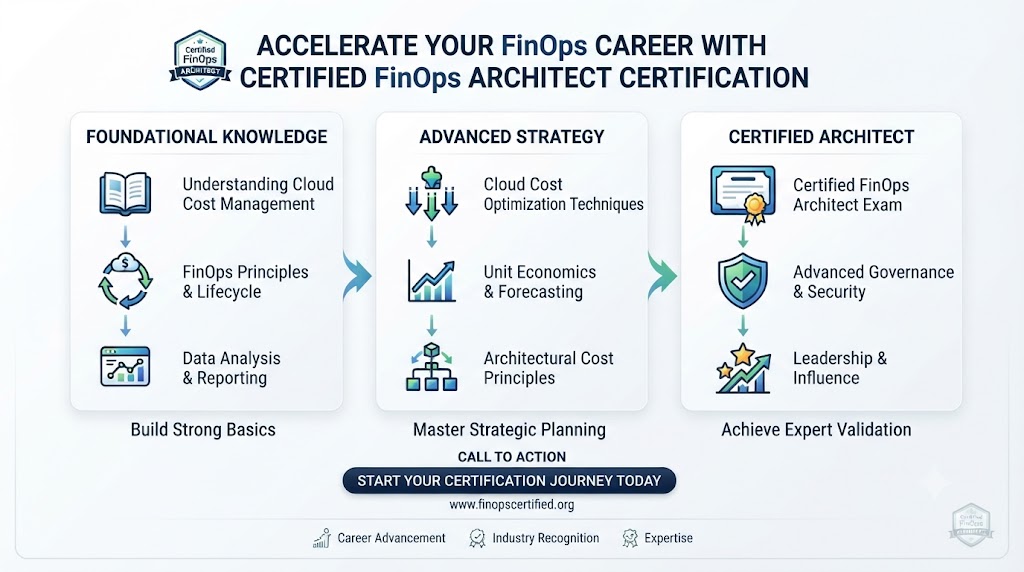
Earning this credential highlights a mature, business-aware approach to systems engineering. The curriculum builds incrementally, guiding you from basic billing visibility up to advanced automated governance routines. This structured approach guarantees that your acquired skills apply directly to your daily work.
Certified FinOps Architect Certification Tracks & Levels
The certification layout uses distinct tiers to match your professional growth, beginning with the Foundation tier. The Foundation tier establishes a common vocabulary between engineering and finance units, covering basic allocation, tagging rules, and reporting views. It serves as an ideal entry point for engineers stepping into cloud economics for the first time.
The Professional tier transitions into the direct engineering of cost controls. It covers automated instance right-sizing, commitment discount governance, and embedding cost validation inside CI/CD workflows. This tier targets senior practitioners who design and maintain production environments daily.
The Advanced tier targets technical directors, principal architects, and dedicated FinOps leaders managing enterprise budgets. It covers intricate unit economics, multi-cloud financial operations, and building custom internal tooling. Specialized tracks within the ecosystem also adapt these core concepts to DevOps, SRE, and DataOps workflows.
Complete Certified FinOps Architect Certification Table
| Track | Level | Who it’s for | Prerequisites | Skills Covered | Recommended Order |
| Core FinOps | Foundation | Cloud Engineers, Finance | Basic Cloud Knowledge | Cost Visibility, Tagging, Basic Reporting | 1 |
| Core FinOps | Professional | DevOps, SREs, Architects | Foundation Level | Automation, CI/CD Integration, Rightsizing | 2 |
| Core FinOps | Advanced | Principal Engineers, Managers | Professional Level | Unit Economics, Multi-cloud, Custom Tooling | 3 |
| SRE FinOps | Specialization | Reliability Engineers | Professional Level | Reliability vs Cost Trade-offs, Spot Automation | 4 |
| DataOps FinOps | Specialization | Data Engineers | Professional Level | Big Data Cost Optimization, Pipeline Efficiency | 5 |
Detailed Guide for Each Certified FinOps Architect Certification
Certified FinOps Architect – Foundation
What it is
The Foundation certification validates a basic understanding of cloud financial management principles and terminologies. It proves you understand how cloud billing works and how to achieve basic cost visibility.
Who should take it
This is ideal for junior to mid-level engineers, finance analysts, and technical project managers. It is the perfect starting point for anyone who wants to understand cloud billing mechanics.
Skills you’ll gain
- Understanding cloud pricing models and utility billing.
- Implementing effective resource tagging and allocation.
- Setting up basic billing alerts and anomaly detection.
- Reading and interpreting complex cloud invoices.
Real-world projects you should be able to do
- Design a comprehensive resource tagging strategy for an enterprise.
- Build custom cost dashboards for different engineering teams.
- Implement automated billing alerts to prevent budget overruns.
Preparation plan
- 7-14 Days: Focus heavily on understanding the terminology and reading official whitepapers on cloud pricing models.
- 30 Days: Practice in a sandbox environment by deploying resources and analyzing the resulting billing data.
- 60 Days: Not typically required for the Foundation level unless you have zero prior cloud experience.
Common mistakes
- Ignoring the importance of a strict, standardized tagging policy.
- Failing to understand the difference between amortized and unamortized costs.
- Treating FinOps purely as a finance function rather than an engineering one.
Best next certification after this
- Same-track option: Certified FinOps Architect – Professional.
- Cross-track option: Certified Kubernetes Administrator to understand container workloads.
- Leadership option: Agile Project Management to help drive FinOps cultural adoption.
Certified FinOps Architect – Professional
What it is
The Professional certification tests your ability to engineer cost-saving mechanisms directly into cloud architecture. It bridges the gap between identifying waste and actively engineering systems to prevent it.
Who should take it
Senior DevOps engineers, platform architects, and infrastructure leads should pursue this level. It requires a solid technical background in cloud provisioning and automation.
Skills you’ll gain
- Automating infrastructure rightsizing using code.
- Integrating cost-estimation tools into CI/CD pipelines.
- Managing and optimizing compute savings plans and reserved instances.
- Architecting spot instance fleets for stateless workloads.
Real-world projects you should be able to do
- Inject open-source cost estimation tools into Terraform workflows.
- Architect a highly available application using exclusively interruptible spot instances.
- Automate the cleanup of unattached storage volumes and idle load balancers.
Preparation plan
- 7-14 Days: Review advanced automation techniques and CI/CD integrations for infrastructure.
- 30 Days: Build and test automated remediation scripts in a test cloud environment.
- 60 Days: Deep dive into architectural trade-offs, focusing on balancing high availability with strict budget constraints.
Common mistakes
- Focusing only on manual cost reductions instead of building automated guardrails.
- Over-committing to reserved instances before properly rightsizing the infrastructure.
- Implementing cost blocks in CI/CD without providing engineers a way to override during emergencies.
Best next certification after this
- Same-track option: Certified FinOps Architect – Advanced.
- Cross-track option: Certified DevSecOps Professional to combine security with cost architecture.
- Leadership option: Engineering Management Certification.
Certified FinOps Architect – Advanced
What it is
The Advanced certification is the pinnacle of the program, focusing on massive scale and deep organizational transformation. It validates your ability to run complex cloud financial operations across multi-cloud environments.
Who should take it
Principal engineers, directors of cloud infrastructure, and dedicated FinOps leads. This is for professionals making strategic architectural decisions for the entire company.
Skills you’ll gain
- Defining and tracking complex unit economics for software products.
- Architecting seamless multi-cloud financial operations and visibility.
- Building custom internal developer platforms with built-in FinOps telemetry.
- Forecasting complex cloud spend based on business growth metrics.
Real-world projects you should be able to do
- Build a system that calculates cloud cost per customer transaction in real time.
- Design a multi-cloud cost aggregator using serverless data pipelines.
- Lead a company-wide architectural overhaul to reduce cloud footprint by thirty percent.
Preparation plan
- 7-14 Days: Study advanced unit economics and business forecasting models.
- 30 Days: Work on designing complex, multi-account, multi-cloud cost architectures on a whiteboard.
- 60 Days: Implement custom cost tracking metrics using advanced monitoring tools like Datadog or Prometheus.
Common mistakes
- Failing to tie cloud metrics back to actual business KPIs (unit economics).
- Building overly complex multi-cloud solutions when a single cloud strategy is more cost-effective.
- Forgetting the human element and failing to build a culture of cost accountability.
Best next certification after this
- Same-track option: None, this is the terminal certification in this track.
- Cross-track option: Enterprise Architecture certifications.
- Leadership option: Executive Technology Leadership programs.
Choose Your Learning Path
DevOps Path
The DevOps path weaves cloud spending controls right into your continuous delivery and integration pipelines. You will learn to treat expenses as code, using validation tools to evaluate infrastructure costs prior to deployment. Your focus will center on shifting financial accountability early, letting developers see the cost impact of code changes instantly. This practice guarantees that rapid software delivery does not result in runaway cloud waste.
DevSecOps Path
The DevSecOps path addresses the meeting point of security, regulatory compliance, and cost control. Security logging and auditing pipelines can silently consume massive cloud budgets if left unoptimized. This path instructs you on designing secure architectures that filter and handle log ingestion intelligently. You will build compliance policies that block unauthorized, costly resource creation without slowing down development teams.
SRE Path
The SRE path focuses entirely on balancing high system reliability with financial prudence. Reliability engineers frequently face choices between over-provisioning for safety and optimizing for cost. This path teaches advanced tactics like spot capacity orchestration and resilience testing to build stable systems cheaply. You will master the practice of balancing availability targets alongside financial budgets for smart design.
AIOps Path
The AIOps path prepares specialists to utilize machine learning for predicting and regulating cloud expenses. You will build AI-powered anomaly detection workflows that catch budget spikes within minutes instead of days. This path covers intelligent automation to scale infrastructure dynamically based on expected workloads. It suits engineers seeking to automate traditional FinOps oversight tasks.
MLOps Path
The MLOps path tackles the high computing bills tied to training and hosting machine learning models. You will learn to design efficient GPU clusters, handle distributed training jobs, and utilize specialized hardware smartly. This path outlines strategies for terminating idle notebooks and refining data storage for massive model datasets. It is crucial for data science groups scaling up without breaking budgets.
DataOps Path
The DataOps path focuses strictly on optimizing heavy expenses generated by analytics warehouses, data lakes, and batch pipelines. You will learn to write efficient queries, enforce lifecycle policies, and select cost-effective storage tiers. This path teaches you how to stop runaway serverless queries from producing surprise invoices. It remains essential for engineers building sustainable data workflows.
FinOps Path
The dedicated FinOps path suits professionals wanting a career fully focused on cloud financial administration and organizational culture. You will concentrate on executive stakeholder alignment, bridging gaps between engineering VPs and financial officers. This path reviews advanced unit economics, showback models, and vendor contract negotiations. It readies you to direct a centralized FinOps practice within an enterprise.
Role → Recommended Certified FinOps Architect Certifications
| Role | Recommended Certifications |
| DevOps Engineer | Certified FinOps Architect – Foundation, Professional |
| SRE | Certified FinOps Architect – Professional, SRE Specialization |
| Platform Engineer | Certified FinOps Architect – Professional, Advanced |
| Cloud Engineer | Certified FinOps Architect – Foundation, Professional |
| Security Engineer | Certified FinOps Architect – Foundation |
| Data Engineer | Certified FinOps Architect – Foundation, DataOps Specialization |
| FinOps Practitioner | Certified FinOps Architect – Foundation, Professional, Advanced |
| Engineering Manager | Certified FinOps Architect – Foundation, Advanced |
Next Certifications to Take After Certified FinOps Architect
Same Track Progression
Staying within the FinOps domain means moving toward deep, infrastructure-specific optimization skills. Once you master core design rules, explore specialized compute optimization or networking cost structures. The objective is establishing yourself as the leading corporate authority on cloud economics for your tech stack.
Cross-Track Expansion
Broadening your expertise involves exploring container orchestration or advanced cloud networking certifications. Grasping the intricate mechanics of container management helps you find cost-saving windows that finance teams overlook. Cross-track study builds a well-rounded architect capable of marrying thrift with technical complexity.
Leadership & Management Track
For those targeting management roles, enterprise architecture or engineering leadership certifications offer the next step. You will learn to scale financial accountability across numerous developer squads and departments. Training in agile management and enterprise strategy complements your FinOps background effectively.
Training & Certification Support Providers for Certified FinOps Architect
DevOpsSchool
DevOpsSchool has built a stellar reputation over the years for providing deep, technically rigorous training programs for engineers globally. Their approach to teaching emphasizes absolute practical competency over theoretical memorization, which is crucial for modern engineering tasks. When dealing with cloud financial architecture, DevOpsSchool provides extensive sandbox environments where students can practice deploying, monitoring, and optimizing resources without the fear of generating actual runaway bills. Their instructors are seasoned industry veterans who bring real production war stories to the classroom, helping students understand the context behind the concepts. This provider is highly recommended for engineers who want a structured, intensive boot-camp style learning experience that directly translates to improved on-the-job performance and career growth.
Cotocus
Cotocus is widely recognized for its deep expertise in enterprise cloud consulting and complex digital transformations. They do not just teach courses; they bring their massive consulting experience directly into their training curriculum, making it highly relevant for corporate environments. Their training focuses heavily on organizational alignment, teaching engineers how to implement technical solutions while managing stakeholder expectations across finance and leadership. Cotocus is particularly strong in helping large organizations establish internal centers of excellence, ensuring that the principles taught in the classroom actually take root in the company culture. For professionals looking to understand the intersection of business strategy and cloud architecture, Cotocus provides a sophisticated, business-aligned learning environment.
Scmgalaxy
Scmgalaxy originated as a massive, community-driven initiative focused on software configuration management and has evolved into a premier training hub. Their strength lies in their deep roots in open-source tooling and community collaboration, offering a slightly different perspective from traditional corporate trainers. They excel at teaching engineers how to leverage open-source cost estimation and monitoring tools to build custom FinOps pipelines without relying on expensive proprietary software. Scmgalaxy provides a highly interactive platform where students can collaborate, share scripts, and troubleshoot architectural challenges together. This provider is perfect for practitioners who value community-driven learning, open-source ecosystems, and hands-on, collaborative problem-solving methodologies in their educational journey.
BestDevOps
BestDevOps focuses on delivering highly streamlined, specialized curriculum designed to get engineers certified and operational as quickly as possible. They understand that working professionals have limited time, so their courses are stripped of unnecessary fluff and strictly aligned with industry requirements. Their teaching methodology heavily utilizes cheat sheets, architectural diagrams, and fast-paced labs to accelerate the learning process. BestDevOps is particularly effective for teams that need to upskill rapidly in order to tackle an immediate corporate initiative, such as a major cloud migration or a sudden mandate to cut infrastructure costs. They offer a no-nonsense, highly efficient training path for busy technical professionals.
devsecopsschool.com
devsecopsschool.com approaches every technical discipline through the lens of security, compliance, and risk management. When teaching cloud architecture and financial operations, they uniquely highlight how poorly configured security tools can lead to massive cost overruns. Their curriculum teaches engineers how to build robust security guardrails that enforce tagging and resource limits without creating friction for development teams. This provider is highly sought after by professionals working in heavily regulated industries like banking and healthcare, where cost optimization must never compromise data integrity. They provide an excellent, niche training experience for those who need to merge extreme security requirements with strict financial controls.
sreschool.com
sreschool.com is dedicated exclusively to the discipline of Site Reliability Engineering and system resilience. Their training programs focus on the mathematical and engineering principles required to keep large-scale distributed systems running efficiently. In the context of architecture and cost, they teach students how to make calculated trade-offs, balancing the high cost of extreme redundancy against acceptable risk factors and error budgets. Their labs involve intense chaos engineering scenarios where students must maintain system uptime while strictly adhering to a simulated financial budget. This is the ultimate training ground for engineers who manage mission-critical, high-traffic infrastructure and need to master reliability economics.
aiopsschool.com
aiopsschool.com sits at the cutting edge of operations, focusing entirely on integrating artificial intelligence into infrastructure management. They teach engineers how to move beyond manual dashboards and static alerts, training them to build predictive, machine-learning-driven operational workflows. Their curriculum explores how to use AI to predict cloud usage spikes, automatically right-size environments in real-time, and detect billing anomalies before they impact the monthly invoice. This provider is ideal for forward-thinking professionals who want to automate the mundane aspects of cost analysis and infrastructure management. They offer a glimpse into the future of automated, intelligent platform engineering.
dataopsschool.com
dataopsschool.com specializes in the unique operational challenges of managing massive data pipelines, analytics warehouses, and data lakes. Data infrastructure is notoriously expensive and difficult to predict, making specialized training absolutely essential for data engineering teams. Their courses teach students how to optimize complex database queries, implement aggressive data lifecycle policies, and manage the underlying compute costs of big data processing tools. They focus heavily on ensuring that data scientists and analysts can run their necessary workloads without inadvertently bankrupting the department. This provider is the top choice for professionals focused heavily on data engineering and analytics platforms.
finopsschool.com
finopsschool.com is the definitive, official authority and premier destination for education in cloud financial management. As the official host of the certification program, their curriculum is the most accurate, up-to-date, and strictly aligned with global standards. They provide an immersive learning experience that perfectly balances deep technical engineering practices with high-level business and financial strategy. Their labs, case studies, and instructor-led sessions are universally respected across the industry for their depth and practical applicability. If you want the most authentic, comprehensive, and directly applicable training to pass the certification and excel in the real world, this is the primary provider to choose.
Frequently Asked Questions
1. What exactly does this certification validate?
It proves your ability to design cloud infrastructure that is both technically robust and financially highly optimized.
2. Is this certification strictly for finance professionals?
No, it is primarily designed for technical professionals like DevOps, SREs, and architects who actually build and provision the infrastructure.
3. Do I need to be an expert in coding to pass?
While deep software engineering isn’t required, you must understand Infrastructure as Code, automation scripting, and CI/CD pipelines.
4. How much time does it take to prepare?
For an experienced cloud engineer, the Foundation level takes a few weeks, while Professional and Advanced levels require a few months of dedicated study.
5. Does this certification focus on a specific cloud provider?
The core principles are cloud-agnostic, though practical implementations will cover common architectures across AWS, Azure, and Google Cloud.
6. Will this certification help me get a promotion?
Yes, directly saving your company money is one of the most visible and easily quantified metrics for justifying career advancement.
7. Can I skip the Foundation level and go straight to Professional?
It is generally recommended to start at Foundation to ensure you understand the specific terminology, but experienced practitioners often move through it very quickly.
8. How often do I need to renew this credential?
Because cloud pricing models and tools evolve, certifications typically require recertification or continuing education every few years to stay current.
9. Is this relevant if my company uses an on-premise data center?
The exact billing mechanics differ, but the principles of unit economics, waste reduction, and automation are highly applicable to private clouds as well.
10. Do I need to buy expensive third-party tools to practice?
No, you can practice the core concepts using native cloud provider tools and open-source solutions available for free.
11. How does this differ from standard cloud architect certifications?
Standard architect exams focus heavily on feature capabilities and service integration, whereas this focuses strictly on architectural efficiency, cost automation, and financial governance.
12. Is the exam purely multiple choice?
Higher levels involve scenario-based questions and architectural reviews that test practical application rather than rote memorization.
FAQs on Certified FinOps Architect
1. How does the Certified FinOps Architect differentiate me from a standard DevOps engineer?
A standard DevOps engineer focuses primarily on speed, automation, and reliability of deployments. When you hold the Certified FinOps Architect credential, you prove that you can achieve those exact same technical goals without wasting company budget. It elevates you from being just a builder to being a strategic technical partner to the business. You become the person who can look at a proposed architecture, instantly spot the financial inefficiencies, and rewrite the Terraform code to save the company thousands of dollars a month.
2. I work in a heavily regulated industry; how does this certification apply to me?
Regulated industries often over-provision infrastructure massively just to ensure compliance and avoid outages, leading to extreme cloud waste. This certification teaches you how to architect compliant, highly available systems that dynamically scale, rather than relying on static, expensive servers. You will learn to implement financial guardrails that sit alongside your security policies, ensuring that developers cannot spin up unauthorized, expensive resources. It allows you to maintain strict governance while bringing cloud bills under control, which is highly prized in banking and healthcare.
3. What is the hardest part of the Professional level exam?
The most challenging aspect for many engineers is shifting their mindset from purely technical problem-solving to business-aligned architecture. The exam tests your ability to automate infrastructure rightsizing and integrate cost checks into your CI/CD pipelines without slowing down the development lifecycle. You will be tested on complex scenarios involving spot instance fleets, commitment discount management, and handling massive data transfer costs. It requires a deep understanding of how architectural decisions compound financially over time at a massive scale.
4. How do I practice for the automated remediation aspects of the exam?
The best way to practice is to set up a personal cloud sandbox account and establish a strict, tiny monthly budget. Write scripts using Python or tools like Cloud Custodian to automatically detect and terminate idle compute instances or unattached storage volumes. Build a simple deployment pipeline and integrate an open-source tool like Infracost to see how much your pull requests will cost before you merge them. Hands-on experience with breaking and fixing cost automation is the only way to truly master this material.
5. Does the certification cover containerized workloads like Kubernetes?
Yes, optimizing containerized workloads is a massive component of modern cloud financial management and is heavily featured in the curriculum. Kubernetes is notorious for obscuring underlying infrastructure costs, making it difficult to allocate expenses to specific teams or microservices. You will learn how to architect proper resource requests and limits, utilize node auto-provisioning efficiently, and implement chargeback models for shared multi-tenant clusters. Mastering Kubernetes cost architecture is a critical skill validated by this certification.
6. I am an Engineering Manager. Should I take this or send my team?
You should absolutely do both. As a manager, taking the Foundation and Advanced levels gives you the vocabulary and strategic frameworks needed to communicate effectively with your finance department and upper management. Meanwhile, your senior engineers should be taking the Professional level so they can execute the technical automation required to hit your financial targets. When leadership understands the strategy and engineers understand the implementation, the entire organization moves faster and operates much more efficiently.
7. How does this impact my understanding of Serverless architectures?
Serverless architectures shift costs from idle compute time to execution time and API calls, which requires a completely different optimization strategy. The certification teaches you how to design efficient event-driven systems that do not generate massive bills due to runaway recursive loops or unoptimized database queries. You will learn how to balance the operational simplicity of serverless against the potentially higher unit costs at massive scale. This ensures you choose the right architectural pattern based on both technical requirements and financial constraints.
8. What role does culture play in the certification curriculum?
While the certification is deeply technical, it acknowledges that you cannot automate everything; human behavior drives cloud spending. The curriculum teaches you how to build a culture of accountability where developers actually care about the cost of the systems they design. You will learn strategies for implementing showback dashboards, gamifying cost optimization, and breaking down the traditional silos between engineering, finance, and procurement. Technical solutions only work long-term if the engineering culture supports them.
Final Thoughts: Is Certified FinOps Architect Worth It?
Investing time into achieving the Certified FinOps Architect designation represents an exceptional return for any modern infrastructure professional. The period of unchecked cloud spending has ended, and organizations everywhere demand lean, efficient systems. Being able to walk into technical reviews and prove how design choices protect corporate profit margins sets you apart from typical engineers.
This credential proves you possess a rare mix of deep technical mastery and clear commercial awareness. It gives you the capability to automate waste reduction, design resilient and affordable infrastructure, and guide cultural change across engineering groups. Whether your goal is moving into principal architecture or technical management, this framework accelerates that progression effectively. It stands as a practical, highly relevant milestone that delivers immediate value in the workplace.
