Introduction
If you are new to the world of flying machines, you will quickly notice that people use several different names for the same thing. You might hear someone say “drone” in one conversation, “UAV” in a technical article, “UAS” in an aviation report, and “quadcopter” in a hobby shop. Many people use these terms as if they mean the exact same thing. However, they do not always describe the same part of the technology. Understanding these terms helps you read manuals, follow aviation news, and talk about drone technology with confidence. This guide breaks down what these four terms mean, how they differ, and how they connect to one another.
Why Drone Terminology Can Be Confusing
When you start researching flying technology, the variety of names can feel overwhelming. Different groups of people use different words based on their background and industry.
- Everyday Language: Most people use the word “drone” because it is short, familiar, and easy to remember.
- Technical Language: Engineers and researchers often prefer terms like UAV to describe the aircraft itself.
- Aviation and Government Terms: Regulatory bodies and aviation authorities frequently use UAS to describe the entire operation.
- Consumer and Hobbyist Terminology: People who build or fly hobby aircraft often talk about specific designs like quadcopters.
The same physical aircraft can easily be called a drone in casual conversation, a UAV in a technical document, a quadcopter by its builder, and part of a UAS by a commercial operator.
What Is a Drone?
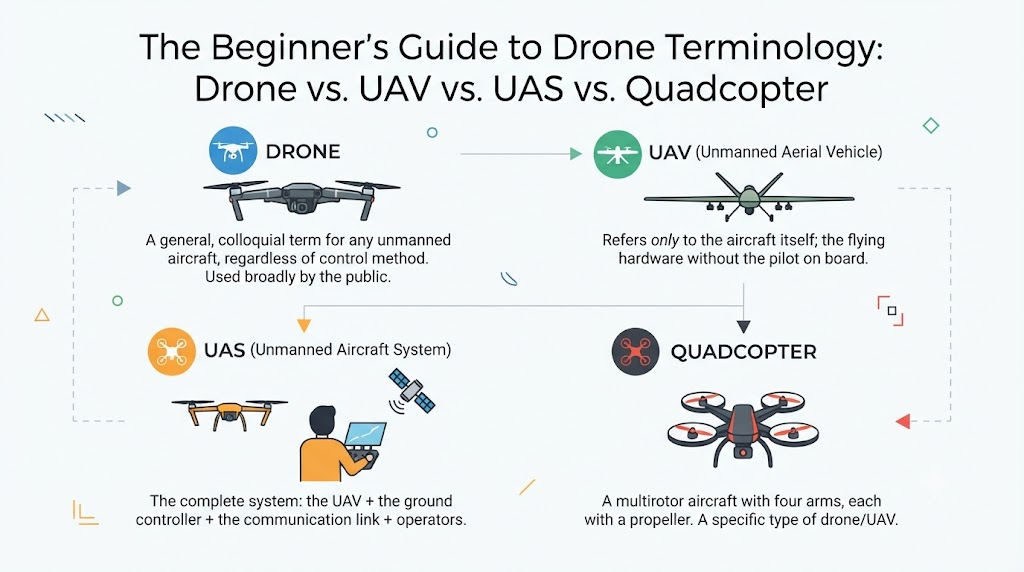
At its core, a drone is a broad and commonly used term for any machine that flies or operates without a pilot sitting inside it. While drones can travel on land, underwater, or in the air, this article focuses entirely on aerial drones. Drones rely on remote control or automated flight paths to complete tasks. They often feature cameras, sensors, and specialized software. Today, people use drones for everything from capturing wedding photography and inspecting bridge infrastructure to delivering packages and monitoring farm crops. The word “drone” serves as an umbrella term. It covers many different shapes, sizes, and designs, ranging from tiny pocket-sized toys to large commercial aircraft.
Common Types of Drones
Because drones come in many designs, it helps to understand the most common configurations you will encounter.
Multirotor Drones
Multirotor drones use multiple spinning blades to lift off the ground, hover in place, and move through the air. They are popular because they can take off and land vertically, making them easy to fly in tight spaces.
Quadcopter
A quadcopter is a specific type of multirotor drone that features exactly four rotors. It represents the most common design for both consumer photography drones and beginner racing models.
Hexacopter
A hexacopter features six rotors. This extra design provides more lifting power and added safety. If one motor fails during flight, a hexacopter often has enough stability to land safely.
Octocopter
An octocopter uses eight rotors. Professionals use these heavy-duty machines to carry large, expensive cinema cameras and heavy professional sensors.
Fixed-Wing Drones
Unlike multirotor drones, fixed-wing drones look and fly more like traditional airplanes. They use wings and forward motion to generate lift rather than spinning rotors. They fly much faster and cover larger areas, making them ideal for mapping large stretches of land.
Hybrid Drones
Hybrid drones combine features from different aircraft designs. They might use rotors to take off vertically like a helicopter, and then switch to a fixed-wing layout to fly efficiently over long distances like an airplane.
What Does UAV Mean?
UAV stands for Unmanned Aerial Vehicle.
- Unmanned: Operates without a human pilot on board.
- Aerial: Operates in the air.
- Vehicle: Refers to the physical machine or aircraft.
When people use the term UAV, they are specifically talking about the flying aircraft itself. If a drone is sitting in a field without its controller, computer tablet, or ground equipment, that flying machine is the UAV.
UAV is a more technical and precise term than the everyday word “drone.” You will often find it used in research papers, engineering discussions, and defense contexts.
What Does UAS Mean?
UAS stands for Unmanned Aircraft System.
While a UAV refers only to the flying aircraft, a UAS refers to the entire system required to make that aircraft fly successfully. A complete UAS includes several interconnected parts:
- The Aircraft (UAV): The flying machine itself.
- Ground Control Station: The remote controller, computer, or tablet used by the pilot.
- Communication Link: The radio signals or data connection that transmit commands from the ground to the aircraft and video back to the pilot.
- The Operator or Pilot: The person controlling the flight or monitoring the automated system.
- Supporting Equipment: Batteries, chargers, landing pads, and transport cases.
- Software: Flight planning apps, mapping software, and telemetry displays.
Think of it this way: the UAV is just the physical machine in the air, while the UAS is the complete ecosystem that keeps it working.
What Is a Quadcopter?
A quadcopter is a type of multirotor aircraft that uses four independent motors and propellers to achieve flight.
The standard design of a quadcopter includes:
- Four Motors: Electric motors that spin at high speeds.
- Four Propellers: Blades attached to the motors that push air downward to create lift.
- Flight Controller: The onboard computer brain that processes sensor data and balances the aircraft.
- Battery: The power source that runs the motors and electronics.
- Frame: The central chassis that holds all the parts together.
- Sensors: Gyroscopes, accelerometers, and compasses that track movement and orientation.
By changing the speed of individual motors, a quadcopter can lift, descend, and tilt in any direction.
How Does a Quadcopter Work?
Understanding how a quadcopter flies helps clarify why its design is so popular.
- Motors and Propellers: The four motors spin their attached propellers rapidly. This action pushes air downward, generating the lift needed to push the aircraft off the ground.
- Flight Controller Monitoring: The onboard flight controller continuously monitors the aircraft’s position hundreds of times per second.
- Adjusting Motor Speeds: To move forward, the rear motors spin faster than the front motors, tilting the quadcopter slightly forward. To turn left or right, pairs of diagonal motors adjust their speeds to rotate the frame.
- Maintaining Stability: Onboard sensors help the quadcopter fight wind gusts and stay completely level when the pilot lets go of the controls.
This direct mechanical control makes quadcopters stable, responsive, and easy to maneuver for beginners and professionals alike.
Drone vs UAV
While people often use these terms interchangeably, they carry different levels of formality.
| Feature | Drone | UAV |
|---|---|---|
| Meaning | Broad everyday term for any uncrewed machine | Technical term for an uncrewed flying aircraft |
| Scope | Includes aerial, ground, and water machines | Strictly covers flying vehicles |
| Example | A camera quadcopter flying in your backyard | A winged aircraft monitoring highway traffic |
| Audience | General public, media, hobbyists | Engineers, researchers, aviation professionals |
“Drone” is a casual, everyday word, whereas UAV is a more specific and technical label. However, they both point directly to the physical vehicle itself.
UAV vs UAS
The difference between a UAV and a UAS comes down to the scope of what is included.
| Feature | UAV | UAS |
|---|---|---|
| Full Form | Unmanned Aerial Vehicle | Unmanned Aircraft System |
| Refers To | The flying aircraft only | The complete setup |
| Aircraft Included | Yes | Yes |
| Ground System Included | No | Yes (Controllers, screens) |
| Operator Included | No | Yes (The pilot and ground crew) |
| Communication System | No | Yes (Radio links, data feeds) |
If your aircraft is resting on the ground, that physical machine is the UAV. When you power on your remote controller, connect your tablet, launch your flight software, and have a pilot ready to fly, you are operating a complete UAS.
Drone vs Quadcopter
The relationship between a drone and a quadcopter is straightforward: a quadcopter is a specific type of drone.
- Drone: A broad category covering all uncrewed aircraft designs.
- Quadcopter: A specific design featuring four rotors.
Not all drones are quadcopters. For example, a fixed-wing delivery aircraft is a drone, but it is not a quadcopter because it has wings instead of four spinning rotors.
UAS vs Quadcopter
These two terms describe completely different aspects of the technology.
- Quadcopter describes the physical design of the aircraft (it has four rotors).
- UAS describes the broader operating system (the aircraft plus the controller, pilot, and software).
For example, you might use a quadcopter as the aircraft portion of your professional UAS setup. One term tells you how the aircraft is built, while the other tells you how it is operated as a complete system.
Drone vs UAV vs UAS vs Quadcopter
| Feature | Drone | UAV | UAS | Quadcopter |
|---|---|---|---|---|
| Basic Meaning | Casual umbrella term | Technical vehicle name | Complete operating system | Four-rotor aircraft design |
| Refers To | Any uncrewed machine | The aircraft itself | Aircraft + ground support + pilot | Physical motor layout |
| Number of Rotors | Any number (or fixed wing) | Any number (or fixed wing) | Any number (or fixed wing) | Exactly four rotors |
| Operator Required | Assumed | Assumed | Included in system definition | Assumed |
| Common Usage | Everyday conversation | Technical writing | Aviation and commercial planning | Hobby and consumer discussions |
The key takeaway is that these terms are not competing names for different technologies. Instead, they describe different layers or parts of the same overall technology.
A Simple Example of All Four Terms
Imagine a real estate photographer preparing to shoot aerial photos of a new housing development:
- The photographer packs a flying machine equipped with four spinning rotors. Its physical design makes it a quadcopter.
- While it flies through the air, the machine itself is functioning as a UAV.
- Neighbors watching from the street casually refer to the flying machine as a drone.
- The photographer relies on a handheld remote controller, a display tablet, radio communication links, and flight planning software alongside the aircraft. Together, this entire setup forms a UAS.
This single flight demonstrates how all four terms describe the exact same piece of equipment from different perspectives.
Why Do People Use Different Drone Terms?
Terminology changes depending on who is talking and where they are working:
- Everyday Conversation: People prefer “drone” because it is simple and universally understood.
- Aviation and Regulation: Authorities prefer “UAS” because safety rules apply to the entire operating system, not just the flying vehicle.
- Engineering and Manufacturing: Designers focus on terms like “UAV” or “quadcopter” when discussing mechanics, aerodynamics, and motor layouts.
- Commercial Business: Companies talk about deploying “drones” for marketing, but use “UAS” in operational safety manuals.
Drone, UAV, and UAS in Business
Businesses across many industries rely on these technologies every day.
- Mapping and Surveying: Companies use fixed-wing or multirotor drones to map large construction sites and agricultural fields quickly.
- Infrastructure Inspection: Engineers use quadcopters to inspect wind turbines, cell towers, and bridges without putting workers in danger.
- Agriculture: Farmers use specialized sensor-equipped UAVs to check crop health and manage irrigation.
When businesses plan these operations, they often talk about purchasing a “drone” for marketing purposes, but refer to the technology as a “UAS” when writing safety protocols and training manuals.
How Aviation Rules May Use These Terms
Aviation authorities around the world establish rules to keep the skies safe for everyone. When reading official aviation documents, you will often see terms like UAS or UAV used instead of the word drone.
Because safety guidelines, registration requirements, and flight permissions vary widely by country, city, and local aviation authority, always check the official government aviation website for your specific location before flying any aircraft.
Common Misunderstandings About Drone Terms
Misunderstanding 1: “All drones are quadcopters.”
Reality: Quadcopters are just one popular design. Drones can also feature six rotors, eight rotors, traditional airplane wings, or hybrid designs.
Misunderstanding 2: “UAV and UAS mean exactly the same thing.”
Reality: A UAV is just the flying aircraft. A UAS includes the aircraft along with the ground controller, communication links, software, and the pilot operating it.
Misunderstanding 3: “Drone is a technical name for one specific aircraft.”
Reality: Drone is a broad, casual umbrella term used to describe many types of uncrewed machines.
Misunderstanding 4: “A quadcopter is the same as a UAS.”
Reality: A quadcopter describes how an aircraft is built physically, while a UAS describes the broader operating system used to fly it.
Misunderstanding 5: “UAV always means military aircraft.”
Reality: While military forces use advanced UAVs, the term applies equally to civilian, commercial, and recreational flying machines.
Why Understanding These Terms Matters
Knowing the difference between these terms helps you in several ways:
- Reading Manuals: Technical documentation and user guides use precise terms like UAS and UAV to describe specific parts of your equipment.
- Following Industry News: Staying informed about aviation updates requires understanding how regulators classify different systems.
- Talking to Professionals: Using the correct terminology helps you communicate clearly with commercial operators, instructors, and technicians.
- Choosing Equipment: Understanding motor layouts like quadcopters helps you select the right aircraft for your specific needs.
An Easy Way to Remember Drone, UAV, UAS, and Quadcopter
If you ever mix up these four terms, use this quick memory guide:
- Drone: The everyday nickname for any uncrewed machine.
- UAV: The flying vehicle itself in the air.
- UAS: The complete system (aircraft + controller + pilot).
- Quadcopter: An aircraft built with four rotors.
Frequently Asked Questions
1. What is the difference between a drone and a UAV? A drone is a broad, casual everyday term for any uncrewed machine, while a UAV (Unmanned Aerial Vehicle) is a more technical term specifically describing the flying aircraft.
2. What does UAV stand for? UAV stands for Unmanned Aerial Vehicle.
3. What does UAS stand for? UAS stands for Unmanned Aircraft System.
4. Is a quadcopter a drone? Yes. A quadcopter is a specific type of drone that uses four rotors to fly.
5. Is every drone a quadcopter? No. Drones come in many designs, including fixed-wing planes, hexacopters with six rotors, and octocopters with eight rotors.
6. What is the difference between UAV and UAS? A UAV refers only to the flying aircraft, whereas a UAS includes the UAV along with the ground control station, communication links, software, and the pilot.
7. Can a quadcopter be part of a UAS? Yes. A quadcopter often serves as the aircraft component within a complete UAS operation.
8. What is the difference between a drone and a UAS? A drone is a casual name for the flying machine, while a UAS is the complete operational ecosystem required to fly and manage that machine safely.
9. Why do technical documents use the term UAV? Technical and engineering documents use UAV because it provides a precise and professional description of the uncrewed aircraft.
10. What is the easiest way to remember these drone terms? Remember that a drone is the casual name, a UAV is the flying aircraft, a UAS is the complete operating system, and a quadcopter is a four-rotor design.
Conclusion
Understanding drone terminology does not have to be complicated. While people use many different words, the main concepts are easy to separate. Think of drone as the broad, common term everyone uses. The UAV is the physical aircraft flying through the air. The UAS represents the entire system, including the aircraft, remote controller, software, and pilot. Finally, a quadcopter describes an aircraft designed with four rotors. These terms overlap naturally in daily conversation. The same machine can be casually called a drone, technically classified as a UAV, built as a quadcopter, and operated as part of a UAS. Here at Dronesbee.com, we want to help you make sense of this technology so you can explore the skies with confidence.
