Introduction
Unboxing a brand-new quadcopter and seeing it lift off the ground for the very first time is an exciting moment. Many new owners believe that buying a capable aircraft means they are instantly ready to capture cinematic footage or explore the skies effortlessly. However, learning to control a flying camera safely takes patience, coordination, and practice. During those first few flights, many beginners make simple mistakes. Excitement can overshadow preparation, unfamiliar controls can create confusion, and unexpected environmental conditions can turn a fun session into a stressful experience. Some of these early missteps lead to broken propellers, scuffed drone bodies, or even lost aircraft. Others result in poor battery performance or awkward encounters in public spaces.
Understanding the Most Common Beginner Drone Mistakes
Flying a modern quadcopter involves much more than simply pushing joysticks. Mistakes can happen across multiple categories, including equipment preparation, flying technique, safety awareness, battery care, weather judgment, regulatory compliance, and overconfidence. When beginners understand why these errors happen and what problems they cause, they can approach each session with greater confidence and control.
Mistake 1: Flying Without Reading the Drone Manual
It is tempting to charge the battery, snap on the propellers, and rush outside immediately. Unfortunately, skipping the manufacturer’s manual is one of the quickest ways to run into trouble.
Why Beginners Skip the Manual
Manuals can look dense, technical, or boring compared to the excitement of flying. Many people assume modern drones are completely intuitive and that operating them requires no prior study.
Problems It Causes
Every drone model features a unique controller layout, specific battery behavior, distinct flight modes, and particular warning indicators. Without reading the documentation, a pilot might not know how to activate emergency motor shutdown, how to calibrate the compass, or what specific warning lights mean on the LED status indicators.
What to Do Instead
Take twenty minutes to read the essential sections of the manual. Pay close attention to controller buttons, charging instructions, Return-to-Home settings, and model-specific safety guidelines. Knowing your equipment before takeoff prevents costly confusion in the field.
Mistake 2: Skipping the Pre-Flight Check
A successful flight begins on the ground. Many beginners place their aircraft on the pavement and take off instantly without performing a basic visual inspection.
Why Beginners Skip Pre-Flight Checks
Eagerness to get airborne makes pre-flight inspections feel like an unnecessary chore rather than a vital safety step.
Problems It Causes
Loose screws, hairline cracks in propellers, uncharged controller batteries, or unseated memory cards can cause unexpected failure mid-flight. A slightly damaged propeller can shatter under load, leading to an immediate crash.
What to Do Instead
Adopt a simple pre-flight routine every single time you fly. Review the quick checklist below to ensure your equipment is ready.
| Check Item | What to Look For | Why It Matters |
| Propellers | Cracks, chips, dirt, or loose screws | Damaged blades cause severe vibration and loss of control. |
| Batteries | Secure latching, full charge, no swelling | Ensures sufficient flight time and prevents sudden power loss. |
| Sensors | Clean camera lens, unobstructed obstacle sensors | Allows proper positioning, stabilization, and clear footage. |
| Environment | Clear takeoff zone, safe weather, clear airspace | Prevents immediate collisions with unseen ground obstacles. |
Mistake 3: Choosing a Bad Flying Location
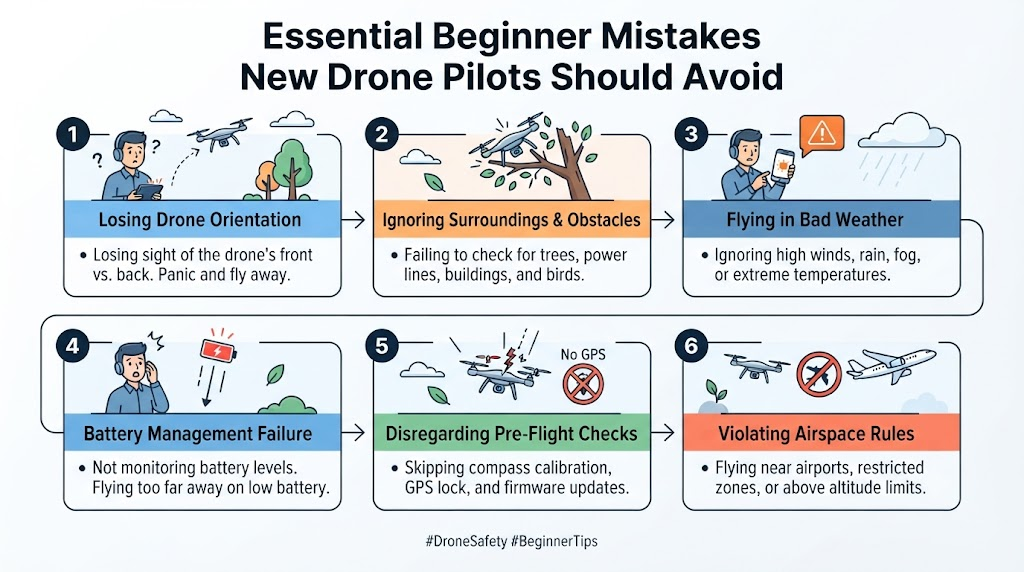
Selecting an inappropriate environment is a primary cause of beginner crashes. Backyards surrounded by tall trees, narrow urban streets, and crowded parks are terrible choices for early practice.
Why Beginners Choose Poor Locations
Convenience often dictates location choice. Flying right outside the front door or in the nearest neighborhood park seems easiest.
Problems It Causes
Trees, overhead power lines, streetlamps, and residential roofs present invisible or hard-to-gauge collision hazards. Furthermore, flying in confined areas increases the risk of disturbing people or colliding with moving vehicles.
What to Do Instead
Find a wide-open, flat space—such as an empty sports field, rural meadow, or designated open park—far away from people, buildings, power lines, and busy roads. Open spaces give you plenty of reaction time if the aircraft drifts unexpectedly.
Mistake 4: Ignoring Weather Conditions
Weather is one of the most powerful external forces acting on a flying aircraft, yet beginners frequently overlook subtle atmospheric shifts.
Why Beginners Ignore Weather
A sunny day at ground level can feel calm, leading pilots to assume conditions aloft are identical.
Problems It Causes
Wind speeds increase significantly as altitude increases. A lightweight entry-level drone can easily be overpowered by moderate gusts, making it difficult to return against the wind. Fog, light mist, and high humidity can also damage electronics or coat camera lenses with moisture.
What to Do Instead
Always check local weather forecasts and wind speeds before heading out. Respect your drone manufacturer’s recommended wind resistance limits. If the aircraft struggles to hold a steady hover near the ground, conditions aloft are likely too strong for a beginner.
Mistake 5: Trying to Fly Too Far Too Soon
After successfully hovering a few feet off the ground, excitement often drives new pilots to push the throttle forward and send the aircraft as far away as possible.
Why Beginners Overextend
The temptation to explore distant horizons or capture sweeping landscape views is powerful during early flight sessions.
Problems It Causes
When a drone flies too far away, visual orientation becomes extremely difficult. Radio signal interference can degrade transmission quality, and battery reserves can deplete faster than anticipated during the return journey.
What to Do Instead
Keep your aircraft close during early sessions. Practice maintaining a comfortable visual range where you can easily determine the front and back of the aircraft without relying entirely on the phone screen.
Mistake 6: Losing Orientation
Orientation confusion is a classic rite of passage for new pilots. It happens when the aircraft rotates so that its front end points toward the pilot instead of away from them.
Why Orientation Becomes Confusing
When the drone faces you, pressing the right control stick forward causes the aircraft to fly toward you, while pressing it left makes the drone move to your right (which is the drone’s left). This reversal breaks natural hand-eye coordination.
Problems It Causes
Panic sets in when the controls seem inverted. In an effort to correct the movement, beginners often push sticks in the wrong direction, leading directly into a wall, tree, or ground obstacle.
What to Do Instead
Practice basic hovering and slow square patterns while keeping the drone facing away from you. Once comfortable, practice slow 360-degree rotations, consciously reminding yourself how control directions shift as the aircraft’s heading changes.
Mistake 7: Depending Too Much on GPS and Automatic Features
Modern quadcopters feature impressive automated helpers, including GPS stabilization, obstacle sensing, and intelligent flight modes.
Why Beginners Over-Rely on Automation
It is easy to believe that advanced sensors make a drone completely crash-proof, removing the need for careful manual piloting.
Problems It Causes
Sensors have notable limitations. Transparent glass, thin tree branches, power lines, and reflective surfaces often go undetected by infrared or optical collision systems. If GPS signal drops due to tall buildings or heavy interference, attitude stabilization can change abruptly.
What to Do Instead
Treat automated features as helpful safety backups rather than infallible shields. Always maintain manual situational awareness and be prepared to take immediate corrective action if automation behaves unexpectedly.
Mistake 8: Ignoring Battery Condition and Battery Warnings
Lithium-polymer (LiPo) batteries power modern consumer drones, delivering high energy output in a lightweight package. They also demand careful handling and strict respect.
Why Beginners Mishandle Batteries
New pilots often extend flight times right down to the final percentage, or store batteries improperly in hot environments without maintaining proper charge levels.
Problems It Causes
Pushing a battery to critically low levels triggers forced landings in inconvenient locations. Furthermore, physically damaged, dropped, or swollen batteries can fail catastrophically, creating fire hazards or unexpected mid-flight power failure.
What to Do Instead
Always follow your manufacturer’s instructions for charging, discharging, and storage. Head back to your landing zone when the battery reaches thirty percent, ensuring you have ample reserve power for a safe, unhurried landing.
Mistake 9: Trying Advanced Moves Too Early
Cinematic banking turns, high-speed ascents, rapid sports-mode flying, and complex automated cinematic shots look incredible in promotional videos.
Why Beginners Rush Progression
Seeing experienced pilots perform agile maneuvers makes beginners eager to skip foundational practice and jump straight into advanced flying.
Problems It Causes
High-speed maneuvers drastically reduce reaction time. Without muscle memory built on gentle, deliberate inputs, beginners quickly lose control when the aircraft moves faster than expected.
What to Do Instead
Master the fundamentals first. Spend multiple sessions practicing smooth takeoffs, steady hovering, gentle forward and backward travel, smooth yaw turns, and controlled landings before attempting anything fast or complex.
Mistake 10: Watching the Phone More Than the Drone
When a crisp live video feed streams directly to a smartphone or tablet screen, it is natural for beginners to fixate entirely on that display.
Why Pilots Screen-Fixate
The view from the onboard camera is immersive, engaging, and feels like playing an advanced video game.
Problems It Causes
Staring exclusively at the screen creates tunnel vision. You lose awareness of surrounding birds, overhead branches, wind shifts, or people approaching your flying space from the side.
What to Do Instead
Maintain a balanced scanning habit. Look up at the physical aircraft in the sky frequently to judge its actual distance, orientation, and surroundings, using the screen only for framing shots and checking telemetry data.
Mistake 11: Ignoring Warning Messages
Flight controller apps display various caution messages, audio alerts, and warning pop-ups when something requires attention.
Why Beginners Dismiss Warnings
Pop-up alerts can feel intrusive or annoying when you are focused on flying, leading pilots to swipe them away without reading.
Problems It Causes
Warnings flag critical situations such as high wind resistance, compass calibration errors, low signal strength, or sensor overheating. Ignoring them invites sudden equipment failure or erratic flight behavior.
What to Do Instead
Pause immediately when a warning appears. Land safely, consult your manual, and resolve the underlying issue before attempting another takeoff.
Mistake 12: Forgetting Local Drone Rules
Operating an unmanned aircraft involves legal responsibilities that vary significantly across different regions, countries, and local jurisdictions.
Why Beginners Overlook Regulations
Many hobbyists assume that because a small camera drone is light and classified as a consumer toy, standard aviation and local municipal rules do not apply.
Problems It Causes
Operating in unauthorized airspace, flying too high near airports, or filming in restricted public zones can lead to severe fines, equipment confiscation, or legal action.
What to Do Instead
Always research and verify current local regulations before flying. For instance, if you are flying in India, you must verify current DGCA (Directorate General of Civil Aviation) and Digital Sky platform requirements, ensure your drone type is properly registered where required, and obey local altitude and airspace limits. Regulations change frequently, so always consult official government aviation sources for up-to-date compliance guidance.
Mistake 13: Flying Near People, Roads, or Property Without Proper Care
It is easy to underestimate how much noise a quadcopter makes and how unsettling it can feel for people nearby to have a flying camera hovering overhead.
Why Beginners Misjudge Surroundings
When focused entirely on the controls, pilots often fail to notice how close their aircraft is drifting toward pedestrians, parked vehicles, or private yards.
Problems It Causes
Low-altitude flights near people create safety risks if a motor fails. They also invade personal privacy and generate justified complaints that damage the public reputation of responsible drone operators.
What to Do Instead
Keep a wide buffer zone between your aircraft and any people, animals, buildings, or roadways. Fly in dedicated open spaces where your presence disturbs no one.
Mistange 14: Forgetting to Check Propellers
Propellers are the spinning aerodynamic blades that lift your aircraft into the air at thousands of RPM.
Why Beginners Neglect Propellers
Because propellers look simple and durable, beginners rarely inspect them closely for microscopic damage after minor bumps or rough landings.
Problems It Causes
Even a tiny nick or slight bend in one blade disrupts aerodynamic balance, causing violent vibrations, motor strain, and potential loss of flight control.
What to Do Instead
Inspect every propeller blade before every flight. Run your fingers gently along the edges to feel for rough spots or cracks, and replace damaged blades immediately using the manufacturer’s approved spare parts and tools.
Mistake 15: Taking Off Without a Basic Flight Plan
Heading out to an open field and launching into the air without any clear objective often leads to aimless drifting and poor battery management.
Why Beginners Skip Planning
Spontaneous flying feels fun and liberating, making structured planning seem unnecessary for a casual hobbyist.
Problems It Causes
Without a plan, pilots often lose track of battery levels, drift beyond comfortable visual range, or find themselves struggling against unexpected obstacles as daylight or weather conditions change.
What to Do Instead
Take one minute before takeoff to decide what you want to achieve. Outline your flying zone, note potential hazards, set a clear battery return threshold, and establish your maximum planned altitude.
Mistake 16: Becoming Overconfident After a Few Good Flights
Success during the first three or four flights can create a false sense of mastery, tempting beginners to abandon careful habits.
Why Overconfidence Develops
Quickly learning how to lift off, hover, and land smoothly makes flying feel deceptively easy.
Problems It Causes
Overconfidence leads to rushed pre-flight checks, risky low-altitude maneuvers between trees, and flying in marginal weather conditions that catch the pilot off-guard.
What to Do Instead
Acknowledge that early success reflects good initial conditions and basic automation rather than expert skill. Let your confidence grow slowly alongside genuine experience and stick to your established safety routines.
Mistake 17: Practicing in Crowded or Difficult Areas
Busy public parks, narrow backstreets, residential driveways, and event spaces are challenging environments filled with unpredictable movement.
Why Beginners Choose Difficult Areas
Proximity and convenience often draw new pilots to local parks filled with joggers, children, dogs, and cyclists.
Problems ItCauses
Unpredictable movement from people and animals makes safe flight management nearly impossible. A sudden distraction can easily cause a collision or public disturbance.
What to Do Instead
Seek out quiet, low-traffic practice zones during off-peak hours. Empty sports fields on weekday mornings offer excellent space with minimal foot traffic.
Mistake 18: Ignoring Privacy and Responsible Flying
Equipping a flying aircraft with a high-definition camera introduces important social and ethical responsibilities regarding privacy.
Why Beginners Overlook Privacy
Beginners are naturally fascinated by aerial perspectives and often point cameras downward without thinking about what is captured in private yards or windows.
Problems It Causes
Filming people without their consent or peering into private residential spaces creates friction, triggers complaints, and can violate local privacy laws.
What to Do Instead
Focus your camera on landscapes, nature, architecture, and approved subjects. Respect people’s personal privacy just as you would when walking around with a handheld camera on the ground.
Beginner Mistakes vs. Better Habits Table
To help you review quickly, the comparison table below outlines common beginner mistakes, why they create problems, and the better habits you should adopt instead.
| Common Mistake | Why It Can Cause Problems | Better Beginner Habit |
| Skipping the Manual | Leaves you unprepared for emergency controls and warning lights. | Read essential manual sections covering battery care and flight modes. |
| No Pre-Flight Inspection | Unchecked props or low batteries lead to sudden mid-air crashes. | Perform a 60-second check of propellers, sensors, and battery latching. |
| Flying in Tight Spaces | Trees, power lines, and walls present high collision risks. | Practice exclusively in wide-open fields far away from obstacles. |
| Ignoring Weather Shifts | Strong winds aloft can overpower lightweight entry-level drones. | Check local wind forecasts and respect manufacturer weather limits. |
| Pushing Maximum Range | Visual orientation loss and signal degradation cause lost drones. | Keep your aircraft close during early flights to build visual confidence. |
| Screen Fixation | Tunnel vision on the phone screen causes missed ground obstacles. | Scan constantly between the physical aircraft in the sky and the screen. |
| Ignoring Low Battery | Triggers forced emergency landings in inconvenient locations. | Plan return flights when the battery reaches thirty percent reserve. |
| Rushing Advanced Moves | Fast turns and sports mode reduce reaction time and cause crashes. | Master slow, deliberate hovering, turning, and landing first. |
First-Flight Practice Plan
Building confidence safely requires a structured, gradual approach. Use this simple progressive practice plan during your first few sessions:
- Session 1: Ground Checks and Hovering
- Perform your pre-flight inspection.
- Take off and hover the drone roughly three feet off the ground directly in front of you for one minute.
- Practice a smooth, controlled landing. Repeat five times.
- Session 2: Basic Directional Movement
- Lift off and hover at eye level.
- Practice gentle forward, backward, left, and right movements over short distances.
- Land smoothly and check your battery percentage.
- Session 3: Square Patterns and Turns
- Practice flying the aircraft in a slow square pattern while keeping the nose pointed forward.
- Practice gentle 90-degree yaw turns while maintaining a stable hover position.
- Session 4: Altitude and Return Practice
- Ascend to a moderate, safe altitude (ten to fifteen feet).
- Practice slow forward travel and return.
- Test your drone’s Return-to-Home feature in an open area to understand how it behaves.
Simple Pre-Flight Routine
Before every single flight, run through this quick, reliable routine to ensure a smooth session:
- Inspect Equipment: Check propellers for cracks, ensure the camera lens is clean, and verify that all arms and sensors are secure.
- Check Power: Verify that both the aircraft battery and the controller battery are fully charged and securely locked in place.
- Evaluate Weather: Check wind speed, visibility, and temperature. Ensure conditions match your drone’s operational limits.
- Scan Surroundings: Look up for power lines and overhead branches; look around for people, animals, and vehicles.
- Verify Airspace & Rules: Confirm you are flying in legal, unrestricted airspace and following local aviation guidelines.
What to Do When Something Goes Wrong
Even with careful preparation, unexpected situations can happen in the field. Staying calm is your most valuable asset:
- Unexpected Wind: If strong gusts push your drone off course, turn the nose into the wind and fly back smoothly at a slightly higher speed setting. Do not panic or cut throttle.
- Low Battery Warning: Acknowledge the warning immediately, turn the aircraft around, and fly straight back to your landing zone.
- Loss of Orientation: If you lose track of which way the drone is facing, stop moving, hover in place, and use your camera feed or automated Return-to-Home feature to regain your bearings.
- Connection Glitch: If the video feed stutters or signal weakens, turn the aircraft slowly toward your home point and reduce distance. Always follow your specific drone manufacturer’s emergency loss-of-signal procedures.
How to Build Good Drone Flying Habits
Safe and enjoyable drone operation is built on consistent habits rather than occasional luck. Make thorough preparation, careful observation, slow and deliberate practice, regular battery care, weather awareness, and respect for local rules part of your routine. When safety becomes second nature, every flight is more relaxing and rewarding.
Common Beginner Questions About Drone Flying
Q: Do I need a license to fly a small hobby drone?
A: Regulations vary widely depending on your country, local jurisdiction, and the weight of your aircraft. Always check official government aviation requirements in your region before your first flight.
Q: What should I do if my drone starts drifting in the wind?
A: Turn the aircraft into the wind and fly back toward your landing zone at a steady, moderate pace. Avoid sudden jerky stick movements that can destabilize the aircraft.
Q: How high can I legally fly a beginner drone?
A: Maximum altitude limits are set by local aviation authorities and vary by country. Consult your local regulatory body for specific altitude ceilings in your operating area.
Q: Can I fly my drone inside my house?
A: Flying indoors is possible with micro drones designed for indoor use, but GPS stabilization is usually unavailable indoors, making precise manual throttle and stick control essential to avoid crashing into furniture or walls.
Q: How often should I inspect my drone propellers?
A: You should inspect your propellers before every single flight. Look closely for hairline cracks, chips, dirt, or loose screws.
Q: What is Visual Line of Sight?
A: Visual Line of Sight means you must be able to see your aircraft directly with your own eyes without relying on binoculars, FPV goggles, or your smartphone screen.
Q: What causes a drone to lose GPS signal?
A: Tall concrete buildings, dense urban canyons, heavy metal structures, and dense overhead tree cover can block satellite signals, causing the drone to switch from GPS mode to attitude mode.
Q: How do I know when my drone battery is getting too low?
A: Your controller app will display low-battery warnings and battery percentage indicators. Always plan to land while you still have at least thirty percent charge remaining.
Q: Is it safe to fly in light rain or fog?
A: Most consumer hobby drones are not waterproof. Moisture can enter electronic components, short-circuit internal circuits, and blur camera lenses, so flying in rain or heavy fog should be avoided.
Q: How can I practice orientation without crashing?
A: Start by hovering your drone low and close, keeping the tail pointed toward you. Practice slow yaw turns and basic movements in a wide-open field where you have plenty of room to recover from mistakes.
Conclusion
Learning to fly a drone is an exciting journey that opens up incredible creative perspectives. By understanding common beginner mistakes—such as skipping the manual, ignoring weather conditions, overextending flight range, and neglecting pre-flight checks—you can avoid unnecessary crashes and equipment damage. Embrace preparation, practice slowly in open spaces, respect your equipment and local regulations, and let your flying skills grow steadily over time. Continue exploring DronesBee for more practical guides, safety tips, and educational resources designed to help you become a confident, safe drone pilot.
