Introduction
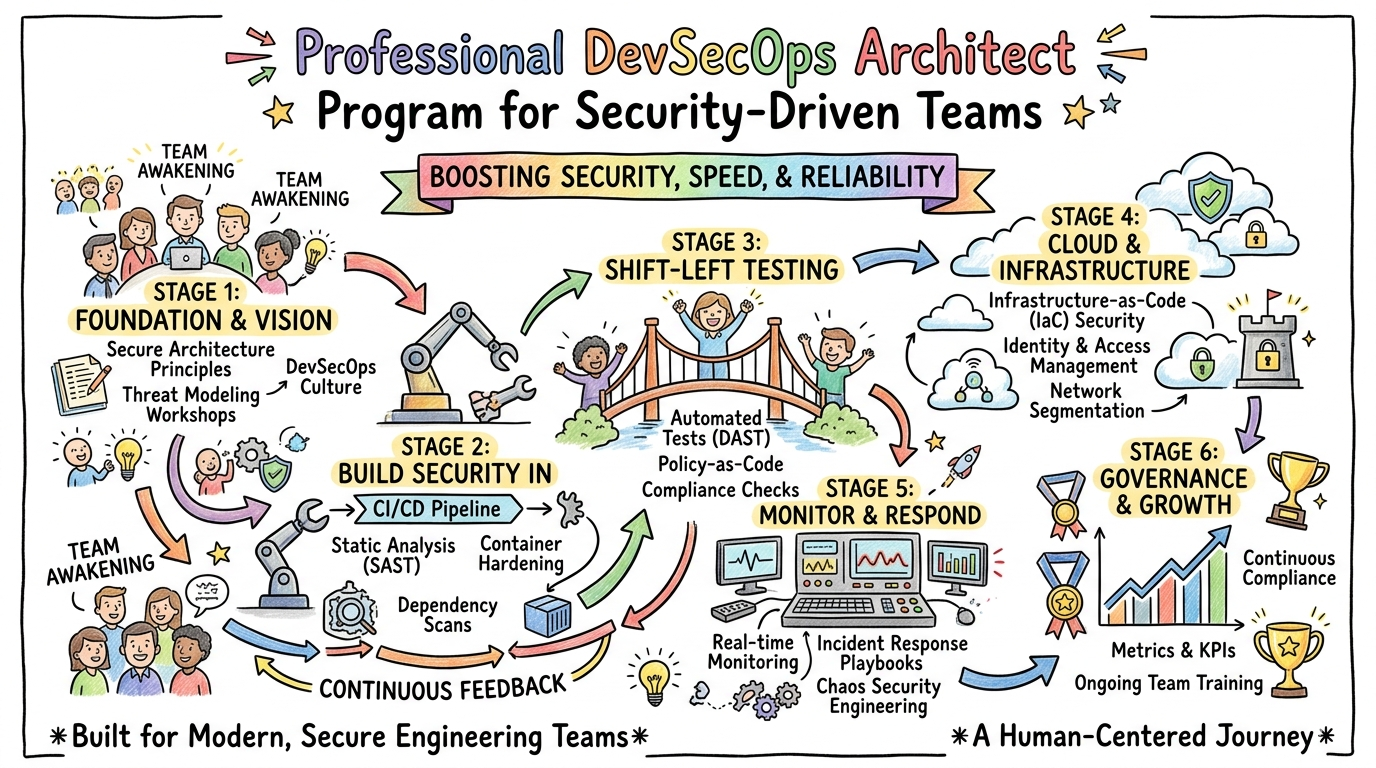
In the current software ecosystem, the bridge between robust development, agile operations, and ironclad security is where the most impactful engineers live. The Certified DevSecOps Architect program is designed to help professionals navigate this critical intersection, turning security from a bottleneck into a competitive advantage. Whether you are operating within the [devopsschool] environment or leveraging the data-driven insights from [aiopsschool], this guide provides the roadmap to professional excellence. By mastering the principles of secure architecture, you gain the ability to design pipelines that are not only fast but inherently resilient. This path is intended to sharpen your technical decision-making and solidify your standing as a key architect in any modern engineering organization.
What is the Certified DevSecOps Architect?
The Certified DevSecOps Architect is a professional designation for those who design the blueprints for secure, automated, and scalable software delivery. It moves beyond the basics of security scanning to address the complex architectural choices that determine a system’s long-term viability and safety. This program is rooted in real-world, production-focused engineering, prioritizing the “how” and “why” of security implementation in complex cloud-native environments. It covers the full lifecycle of a service, ensuring that every architectural decision accounts for threats, compliance, and operational efficiency. By aligning security practices with modern enterprise workflows, it ensures that engineers can deliver software that meets the highest standards of safety without sacrificing speed.
Who Should Pursue Certified DevSecOps Architect?
This certification is essential for engineers who are ready to take ownership of end-to-end delivery and security architecture. It is tailor-made for DevOps, SRE, and platform engineers who need to integrate security into every layer of the infrastructure stack. Security professionals who want to pivot toward an operational and architectural role will also find this curriculum incredibly valuable. Engineering managers and tech leads, who must balance the demands of innovation with the necessity of risk management, will benefit from the strategic depth this program offers. Regardless of your region, from India to international markets, the ability to architect secure software is a fundamental skill for anyone climbing the ladder in the engineering world.
Why Certified DevSecOps Architect
The value of this certification lies in its focus on enduring architectural principles rather than temporary trends. In an industry where tools shift rapidly, the ability to design secure, resilient systems remains a constant requirement, making this a long-term investment in your professional relevance. By earning this certification, you prove that you can handle the complexities of enterprise-grade software delivery, which drastically increases your impact within a team. The return on investment is found in your increased ability to solve mission-critical problems, avoid costly architectural pitfalls, and drive the adoption of security-first cultures. It is a credential that signals to peers and employers alike that you are capable of leading high-stakes engineering projects.
Certified DevSecOps Architect Certification Overview
Delivered through the Certified DevSecOps Architect program and hosted on [devopsschool], this certification provides a structured path for career advancement. The program assessment is built on practical, scenario-based evaluations that test your ability to build secure pipelines and solve real-world architectural challenges. It is designed to be rigorous, requiring candidates to demonstrate mastery of secure design patterns, policy-as-code, and incident automation. Ownership of this certification indicates that a professional has successfully navigated both the theoretical frameworks and the hands-on complexities of modern secure software delivery, proving their readiness to handle enterprise-scale responsibilities.
Certified DevSecOps Architect Certification Tracks & Levels
The certification framework is designed to match different stages of your career growth. The foundation level focuses on core security concepts and the integration of basic security tools. The professional level expands into advanced pipeline architecture, threat modeling, and automated governance. Finally, the advanced level focuses on designing complex, multi-cloud architectures that remain secure under heavy load and evolving threat landscapes. Each track is curated to ensure that your skills progress logically, allowing you to build a comprehensive toolbox that includes everything from basic vulnerability scanning to sophisticated compliance-as-code strategies.
Complete Certified DevSecOps Architect Certification Table
| Track | Level | Who it’s for | Prerequisites | Skills Covered | Recommended Order |
| Security Foundations | Foundation | Junior DevOps | Basic Linux, CI/CD | Scanning, Pipeline Safety | First |
| Secure Delivery | Professional | Mid-level Engineer | IaC, Cloud Concepts | Policy-as-Code, Secrets | Second |
| Systems Architecture | Advanced | Senior Architect | Full-stack Ops | Threat Modeling, Governance | Third |
| Strategic Security | Expert | Lead Engineer | Cloud/Security | Incident Response, Strategy | Fourth |
Detailed Guide for Each Certified DevSecOps Architect Certification
Certified DevSecOps Architect – Foundation Level
What it is
This certification validates the foundational skills required to embed security into the standard software development lifecycle.
Who should take it
Aspiring engineers and junior DevOps practitioners looking to formalize their security skill set.
Skills you’ll gain
- Understanding the core principles of DevSecOps culture.
- Installing and configuring basic security plugins in pipelines.
- Identifying vulnerabilities in container images and dependencies.
Real-world projects you should be able to do
- Create a simple pipeline that stops on critical security failures.
- Automate the audit of basic cloud resource configurations.
Preparation plan
- 7-14 days: Master the basics of security-first coding and tool installation.
- 30 days: Build and test three distinct automated security integration projects.
- 60 days: Conduct mock security audits on personal or small team environments.
Common mistakes
Relying on manual security checks instead of fully automating the feedback loop for developers.
Best next certification after this
- Same-track option: Certified DevSecOps Architect Professional.
- Cross-track option: Certified SRE Practitioner.
- Leadership option: Cloud Infrastructure Management.
Choose Your Learning Path
DevOps Path
The DevOps path focuses on the automation of the entire delivery process, ensuring that security is a seamless part of the workflow. It highlights the importance of fast feedback loops and the removal of manual security bottlenecks that hinder release velocity.
DevSecOps Path
The DevSecOps path is the core journey for those specializing in secure architecture. It emphasizes the integration of security controls, automated threat hunting, and the consistent enforcement of security policies across all delivery stages.
SRE Path
The SRE path is focused on the stability and security of production services. It covers how to maintain uptime while applying security patches, managing site reliability, and implementing observability to detect threats before they impact the end user.
AIOps / MLOps Path
This path investigates the intersection of machine learning and security operations. It covers the use of intelligent systems to detect anomalies in logs, predict potential system failures, and automate the remediation of common security configuration errors.
DataOps Path
The DataOps path focuses on the security of data pipelines and storage. It emphasizes the importance of data classification, encryption, and the secure management of data lifecycle events in distributed systems and cloud databases.
FinOps Path
The FinOps path teaches you how to balance security requirements with cloud costs. It covers the optimization of security tooling spend and ensures that high-security standards are maintained without inflating the cloud bill.
Role → Recommended Certified DevSecOps Architect Certifications
| Role | Recommended Certifications |
| DevOps Engineer | Certified DevSecOps Architect Foundation |
| SRE | Certified DevSecOps Architect Professional + SRE Expert |
| Platform Engineer | Certified DevSecOps Architect Advanced |
| Cloud Engineer | Certified DevSecOps Architect Professional |
| Security Engineer | Certified DevSecOps Architect Advanced |
| Data Engineer | Certified DevSecOps Architect Data Specialization |
| FinOps Practitioner | Certified DevSecOps Architect FinOps Specialization |
| Engineering Manager | Certified DevSecOps Architect Strategy |
Next Certifications to Take After Certified DevSecOps Architect
Same Track Progression
Deepen your expertise by tackling advanced certification levels that deal with complex incident management, forensic analysis, and the architectural design of global-scale security policies.
Cross-Track Expansion
Broaden your skill set by moving into SRE or cloud platform certifications. Gaining an understanding of the infrastructure at its core allows you to design better security controls that don’t negatively impact system performance.
Leadership & Management Track
For those looking to lead, focus on certifications that emphasize governance, security risk management, and the business impact of DevSecOps practices within large organizations.
Training & Certification Support Providers for Certified DevSecOps Architect
DevOpsSchool is a top-tier provider that offers highly structured, lab-based training designed to prepare engineers for the complexities of real-world secure architecture transitions.
Cotocus delivers expert-led training programs that are focused on helping professionals achieve their certification goals while applying what they learn to enterprise-scale projects.
Scmgalaxy provides foundational training that ensures your technical base is strong enough to support the advanced security practices taught at the architectural level.
BestDevOps provides comprehensive learning paths and certification support, helping you gain the skills needed to remain at the forefront of the secure cloud evolution.
devsecopsschool specializes in the security aspects of the delivery lifecycle, offering specific programs that are deeply aligned with the Certified DevSecOps Architect requirements.
sreschool provides targeted education for those who want to excel in SRE while maintaining the rigorous security posture required by cloud-native organizations.
aiopsschool offers programs that teach how to leverage intelligence and automation in operations, which is critical for scaling modern security architectures.
dataopsschool focuses on the intersection of data management and security, providing training for those who handle complex data pipelines and storage solutions.
finopsschool delivers insights into the financial aspects of security, helping engineers understand how to manage costs while securing enterprise cloud assets.
Frequently Asked Questions (General)
- What is the difficulty level of this certification?The difficulty is geared toward experienced professionals, requiring a blend of deep technical knowledge and architectural foresight.
- How much time is required to prepare?We recommend an intensive study and practice period of 30 to 60 days to fully grasp the concepts and pass the practical assessments.
- What are the prerequisites for this path?Applicants should have a firm grounding in cloud concepts, Linux, and standard CI/CD practices before attempting this certification.
- Is this certification globally recognized?Yes, it is highly valued by organizations globally as a mark of a professional capable of high-level secure architecture design.
- Does the certification expire?Certifications typically need to be refreshed periodically to ensure your knowledge stays current with the fast-moving security landscape.
- How does this improve my salary potential?Architectural-level skills are highly compensated, as they directly reduce business risk and improve the stability of high-revenue production systems.
- Can beginners pursue this certification?It is generally better suited for those with a few years of experience, but motivated beginners can succeed with enough hands-on lab practice.
- Are there any lab requirements?Practical lab work is a central part of the certification, testing your ability to implement security tools in a realistic environment.
- How is the exam structured?The exam combines conceptual understanding with a hands-on project that proves you can build and secure actual pipelines.
- What is the return on investment for this cert?You gain the ability to lead security transformations, which translates to career growth, higher project ownership, and increased professional impact.
- How should I sequence my certifications?Build a solid foundation first, then pursue the Architect level, followed by specializations that match your daily work focus.
- Is it better to do this or a cloud vendor cert?Vendor certifications cover specific platform tools, whereas this program teaches you the universal, vendor-neutral principles of secure architecture.
FAQs on Certified DevSecOps Architect
- Does this certification help with incident response?Yes, it teaches how to automate the detection and containment of threats within the pipeline, which is a major part of incident response.
- Is this training purely theory or practical?It is primarily focused on practical labs, ensuring that you can execute secure architecture in a real-world enterprise setting.
- How does it differ from a pure security cert?This certification emphasizes the “Ops” and “Dev” parts of the title, focusing on how security integrates into delivery speeds.
- Will this help me move into an SRE role?Absolutely, the expertise in building stable and secure systems is exactly what SRE teams look for when hiring for architects.
- How do I choose my specialization track?Choose the track that aligns with your professional strengths or the specific technical challenge you are currently trying to solve.
- Are the skills directly applicable to my job?Yes, the program uses production-focused outcomes that you can immediately implement in your current CI/CD environment.
- Can I use this to lead security transformations?The knowledge you gain provides the strategic framework needed to drive security changes from the top down in your organization.
- What specific tools are covered in this architect certification?The curriculum focuses on industry-standard tool classes, such as IaC scanners and secret managers, which are applicable anywhere.
Final Thoughts: Is Certified DevSecOps Architect Worth It?
In my experience, the engineers who stand out are those who don’t just use tools, but who understand the architectural “why” behind them. The Certified DevSecOps Architect path is designed for those who want to be the leaders in their field, not just followers of instructions. It is a demanding, rigorous process, but it is precisely that level of difficulty that makes the certification valuable. If you want to move beyond the surface level of security and become an engineer who designs for safety and resilience by default, this path is for you. It requires a significant commitment of time and effort, but the long-term professional rewards—in terms of both impact and career trajectory—are undeniable.
