Introduction
The modern software engineering landscape is moving at breakneck speed. Organizations across the globe are abandoning slow, siloed development pipelines and transitioning toward unified, automated environments. As a result, roles in DevOps, DevSecOps, Site Reliability Engineering (SRE), Cloud Architecture, Container Orchestration, and Machine Learning Operations (MLOps) have surged in demand. However, this explosion of specialized domains has created massive confusion for professionals looking to step into the field or advance their careers. With hundreds of credentials available, choosing the best DevOps certification tailored to your specific career path is essential for standing out in an ultra-competitive job market.
A strategic certification path serves as a definitive career roadmap, steering you away from aimless tutorial loops and pointing you toward structured, market-validated expertise. Navigating this ecosystem requires clear insights into which certifications offer genuine hands-on validation versus those that merely test theoretical knowledge. This guide delivers an exhaustive breakdown of the top 20 certifications offered by the BestDevOps Certification Portal, providing an actionable blueprint to help freshers, software engineers, systems administrators, and IT managers secure high-paying, future-proof roles.
What is a DevOps Certification?
A DevOps certification is an industry-recognized credential that formally validates a professional’s theoretical knowledge and practical proficiency across software development lifecycle (SDLC) automation, cloud infrastructure management, and cross-functional collaboration. Unlike generic IT diplomas, modern DevOps certifications focus on structured learning paths that merge development methodologies with operational reliability. They ensure you can treat infrastructure as code (IaC), establish robust continuous integration and continuous deployment (CI/CD) pipelines, and enforce shifting-left security principles natively within the release lifecycle.
The true value of an elite certification lies in its rigorous, hands-on evaluation format. Leading programs require candidates to build, troubleshoot, and optimize production-grade environments within timed, live-lab conditions rather than merely answering multiple-choice questions. This rigorous process bridges the gap between conceptual understanding and real-world execution. By earning a specialized credential, you demonstrate to global enterprises that you possess the technical maturity to minimize system downtime, accelerate product delivery velocity, and maintain scalable, resilient architectures under heavy traffic patterns.
Why DevOps Certifications Matter
In the contemporary enterprise tech space, unstructured learning can often lead to fragmented skill sets. Certifications act as an architectural blueprint for your engineering career, filtering out the noise and forcing you to master the exact toolsets and methodologies used by high-performing engineering teams. Beyond personal technical enrichment, certifications play a critical role in clearing human resources (HR) filtering algorithms, giving certified candidates a distinct competitive advantage during competitive hiring cycles.
Step-by-Step Impact Process:
- Navigating Automated HR Screenings: Corporate recruitment engines utilize Applicant Tracking Systems (ATS) to filter thousands of resumes. Possessing a premium certification instantly satisfies strict keyword filters, escalating your resume directly to hiring managers.
- Validating Hands-On Deployment Skills: Certification preparations force you out of your comfort zone, requiring you to construct real-world systems, debug configuration drift, and solve complex networking anomalies.
- Establishing Standardized Team Frameworks: When an engineering group aligns on a certification standard (such as AWS, Azure, or Kubernetes), it establishes a shared architectural vocabulary, minimizing cross-team friction and standardizing production workflows.
- Unlocking Premium Compensations and Career Growth: Certified professionals systematically secure higher tier salary packages, fast-track promotions to Principal or Lead roles, and gain access to high-impact architecture decisions.
Who Should Take DevOps Certifications?
DevOps is no longer a niche, isolated job description; it is a critical organizational philosophy spanning across all modern software delivery frameworks. Consequently, a diverse spectrum of technology professionals can leverage these specialized credentials to pivot, upskill, or scale their production authority.
- Students and Freshers: Aspiring engineers looking to break into the tech sector with market-ready, enterprise-validated infrastructure and automation competencies.
- Software Engineers & QA Professionals: Developers wanting to eliminate the “works on my machine” paradigm by mastering containerization, automated testing, and CI/CD pipelines.
- Systems Administrators & Network Engineers: Infrastructure professionals moving away from manual configurations, shell scripting, and physical racking toward automated, API-driven cloud environments.
- Cloud, Platform, & SRE Professionals: Active practitioners looking to formalize their production exposure, master advanced service meshes, and build resilient, auto-scaling enterprise systems.
- Data and ML Engineers: Data professionals intending to bridge the gap between model training and real-world system inference by mastering stable MLOps pipelines.
- IT Managers & Solution Architects: Technology leaders who require a deep structural understanding of modern automation and cloud patterns to manage large engineering teams and control operational expenditures.
Core Skills Covered in Modern DevOps Certifications
Earning a modern DevOps credential exposes you to a comprehensive matrix of engineering capabilities. These skills form the foundational pillar of any robust enterprise platform engineering strategy.
- Source Code Management & CI/CD Automation: Learning how to manage complex Git branching strategies, configure automated pipelines, and execute secure, zero-downtime application deployments.
- Infrastructure as Code (IaC): Transitioning from manual console clicks to declarative infrastructure configurations, allowing multi-region platforms to be stood up programmatically via code.
- Containerization & Enterprise Orchestration: Packaging applications into isolated, portable runtime units and coordinating them across massively distributed container ecosystems.
- Advanced Cloud Architecture: Designing fault-tolerant, highly available systems utilizing native cloud services across computing, storage, networking, and serverless compute paradigms.
- Enterprise Security Integration (Shift-Left): Embedding automated vulnerability scanners, static analysis tools, and secrets management tools directly into the initial stages of development.
- Full-Stack Observability & SRE Metrics: Instrumenting production systems with distributed tracing, log aggregation, and real-time metric dashboards to measure exact availability and error budgets.
Comprehensive Overview of the Best DevOps Certifications
The table below outlines the 20 premier certifications available through the BestDevOps Certification Directory, mapping each program to its primary engineering focus, target skill level, and direct career trajectory.
Table 1: Global DevOps and Automation Certifications Matrix
| Certification Name | Best For | Skill Level | Career Direction |
| DevOps Certified Professional (DCP) | Core DevOps Frameworks & 20+ Primary Toolsets | Beginner to Intermediate | DevOps Engineer, Systems Agility Lead |
| DevSecOps Certified Professional (DSOCP) | Shifting-Left Security, Automated Compliance | Intermediate to Advanced | DevSecOps Specialist, Cloud Security Engineer |
| Site Reliability Engineering (SRE) Certified Professional | System Availability, Latency, and Error Budgets | Intermediate to Advanced | SRE, Infrastructure Reliability Engineer |
| Master in DevOps Engineering (MDE) | Advanced CI/CD Engineering and Architecture | Intermediate to Advanced | Principal DevOps Engineer, Platform Architect |
| Master in Azure DevOps | Microsoft Cloud Ecosystem (AZ-900, AZ-104, AZ-400) | Intermediate to Advanced | Azure Cloud Engineer, DevOps Specialist |
| AWS Certified DevOps Professional | Amazon Web Services Automation & Systems Delivery | Advanced | AWS Solutions Architect, Cloud DevOps Lead |
| Master in Python Programming | Infrastructure Scripting, Automation, and APIs | Beginner to Advanced | Automation Engineer, Systems Programmer |
| HashiCorp Certified Terraform Associate | Multi-Cloud Declarative Infrastructure as Code (IaC) | Associate | Infrastructure Engineer, Cloud Architect |
| Certified Kubernetes Administrator (CKA) | Production-Grade Container Cluster Orchestration | Intermediate to Advanced | Kubernetes Administrator, Platform Engineer |
| Docker Certified Associate (DCA) | Containerization Essentials and Runtime Workloads | Associate | Container Engineer, Release Manager |
| Envoy Istio Certification Training | Service Mesh Architecture, L7 Traffic Management | Advanced | Cloud Native Architect, Microservices Engineer |
| MLOps Certification Training Course | Machine Learning Lifecycle & Pipeline Automation | Intermediate to Advanced | MLOps Engineer, Data Platform Specialist |
| Google Cloud Professional Cloud DevOps Engineer | Google Cloud Engine Optimization & Site Reliability | Advanced | GCP Devops Engineer, Site Reliability Engineer |
| Master in Machine Learning | Algorithmic Engineering, Statistical Modeling | Intermediate to Advanced | ML Scientist, Quantitative Data Analyst |
| Master in Artificial Intelligence | Deep Learning, Neural Network System Design | Advanced | AI Research Engineer, Cognitive System Specialist |
| Master in AppDynamics | Application Performance Monitoring (APM) & Metrics | Intermediate | Observability Engineer, Performance Engineer |
| Master in Data Science | Advanced Statistical Mining, Enterprise Data Pipelines | Intermediate to Advanced | Big Data Architect, Data Scientist |
| Master in Deep Learning | Complex Neural Network Architectures, Computer Vision | Advanced | Computer Vision Engineer, NLP Specialist |
| Prometheus with Grafana | Cloud-Native Metrics Gathering and Visualization | Intermediate | Monitoring Specialist, SRE Dashboard Architect |
| GitOps Certified Professional (GOCP) | Declarative Git-Driven Continuous Cluster Delivery | Intermediate to Advanced | GitOps Engineer, Cloud Native Specialist |
Certification Deep Dive: Unified Blueprint
To maximize the value of this guide, we have consolidated the core structural parameters across all major professional certifications. This blueprint details the exact skills, expectations, and production scenarios you will encounter throughout your automated engineering career journey.
Real-World Use Case
Imagine a high-traffic e-commerce multi-region cluster experiencing unpredictable traffic spikes during black-swan promotional events. A standard manually provisioned system suffers fatal outages due to configuration drift, hardcoded secrets, and delayed scaling alerts. Applying advanced platform methodologies completely transforms this landscape: infrastructure is instantly provisioned across multi-cloud regions using declarative Terraform scripts, applications are securely containerized inside isolated Docker environments, and workloads are dynamically scheduled across an auto-scaling Kubernetes cluster.
Simultaneously, GitOps agents continuously reconcile cluster states with centralized Git repositories, automated DevSecOps pipelines dynamically audit application containers for zero-day vulnerabilities, and Prometheus metrics trigger automated Grafana alerts before resource degradation compromises user checkouts.
Skills You Will Learn
- Infrastructure Automation: Synthesizing declarative models to manage state files and prevent physical environments from falling prey to manual configuration drift.
- Orchestration Engineering: Managing complex container clusters, setting up software-defined networking overlays, defining persistent storage claims, and handling cluster troubleshooting.
- Advanced Pipeline Hardening: Embedding automated static code testing, dependency scanning, and dynamic image scanning directly into early build cycles.
- Observability Design: Architecting multi-dimensional monitoring frameworks parsing real-time application performance metrics, system resource logs, and distributed trace maps.
- Automated Git Reconciliation: Enforcing Git as the absolute single source of truth for all operational states, letting webhooks safely manage deployments.
Career Scope
The market valuation for certified cloud automation professionals remains at an all-time high. Organizations across high-compliance banking, massive streaming platforms, healthcare, and global SaaS sectors are actively hiring engineers who can eliminate operational inefficiencies. Attaining these advanced credentials positions you for high-impact roles, such as Platform Engineer, Infrastructure Architect, Lead Site Reliability Engineer, or Chief Cloud Security Officer, with premium starting packages across worldwide tech hubs.
Difficulty Level
- Foundational/Associate Paths (e.g., Terraform Associate, Master in Python): Moderate difficulty; requires strong conceptual understanding and basic command-line navigation.
- Professional/Administrator Paths (e.g., CKA, AWS DevOps Professional, SRE, DSOCP): High to Expert difficulty; features performance-based, live production environments requiring deep analytical execution under strict constraints.
Best Career Fit / Who Should Take It
This curriculum is precision-engineered for systems engineers tired of manually resolving repeating middle-of-the-night alerts, developers who want absolute control over how their code behaves at massive production scales, and security engineers striving to eliminate bureaucratic post-development audit bottlenecks by establishing automated, continuous compliance.
Hands-On Projects
- Multi-Region Multi-Cloud High-Availability Topology: Designing an automated Terraform blueprint deploying cross-cloud networking layers across separate physical regions with zero human interaction.
- Zero-Trust Hardened GitOps CI/CD Pipeline: Constructing a comprehensive pipeline that automatically checks source code for secrets, builds isolated images, scans for container exploits, and pushes declarations to a Kubernetes cluster via automated Git reconciliation hooks.
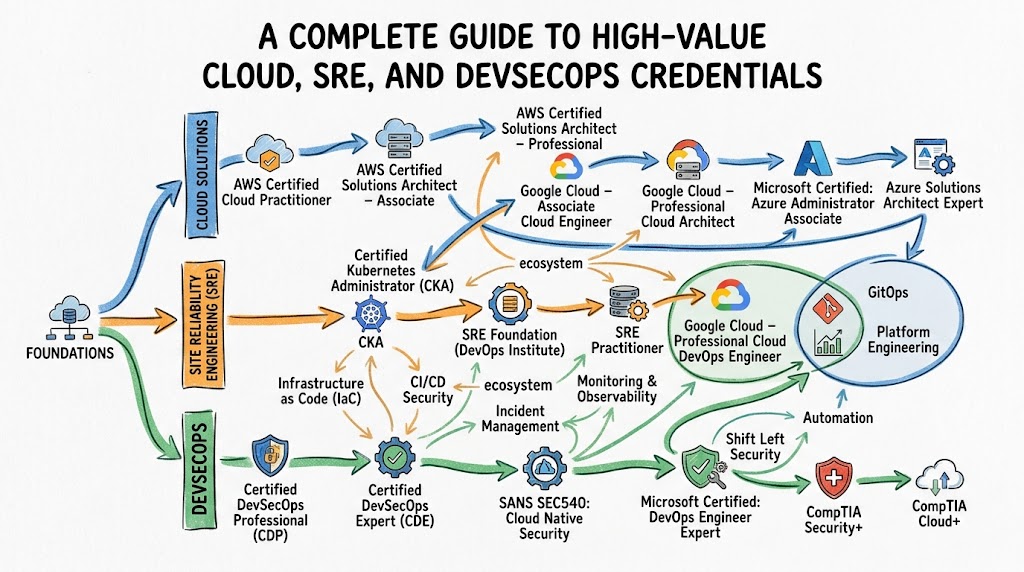
The Strategic DevOps Certification Roadmap
Embarking on your certification journey without a clear path can result in redundant efforts and mismatched skill sets. It is vital to align your study roadmap directly with your long-term daily engineering goals.
Table 2: Role-Based Certification Alignment and Progression
| Career Goal | Recommended Certification Path | Why It Fits |
| Enterprise Cloud DevOps Engineer | DCP ➔ CKA ➔ AWS/Azure DevOps Professional | Forms a comprehensive trajectory starting from fundamental tools to complex container management and native enterprise cloud delivery. |
| Cloud-Native Platform Engineer | Master in Python ➔ Terraform Associate ➔ CKA ➔ GitOps (GOCP) | Establishes total proficiency across infrastructure management, programmatic scripting, orchestration, and continuous state delivery. |
| DevSecOps Compliance Architect | DCP ➔ DevSecOps Certified Professional (DSOCP) ➔ CKA | Infuses deep security analysis, policy-as-code automation, and compliance directly into containerized build pipelines. |
| High-Scale Site Reliability Engineer (SRE) | SRE Certified Professional ➔ Prometheus with Grafana ➔ AppDynamics | Focuses entirely on high system availability, deep production monitoring analytics, telemetry graphing, and incident prevention. |
| MLOps / AI Infrastructure Engineer | Master in Python ➔ MLOps Certification ➔ Master in AI/ML | Connects deep analytical data modeling pipelines directly with automated cloud infrastructure deployment workflows. |
Types of DevOps Certifications & Paths by Role
Understanding how certifications are categorially organized ensures you can pick the right credential for your specific professional specialization.
                  ┌──────────────────────────────┐
                  │    Core Foundations (DCP)    │
                  └──────────────┬───────────────┘
                                 │
         ┌───────────────────────┼───────────────────────┐
         ▼                       ▼                       ▼
┌─────────────────┐     ┌─────────────────┐     ┌─────────────────┐
│  Cloud Native   │     │   Operations    │     │ Data/AI Pipelines│
│ (CKA, GitOps)   │     │  (SRE, Metrics) │     │ (MLOps, Python) │
└─────────────────┘     └─────────────────┘     └─────────────────┘
1. Broad Foundation and Tool-Specific Certifications
These credentials focus entirely on mastering core tools and common automation methodologies. They validate that an engineer can use toolsets like Ansible, Git, Docker, and Terraform cleanly without being tied down to a single cloud vendor’s unique ecosystem.
2. Cloud Vendor-Specific Certifications
Programs offered by tech giants like AWS, Microsoft Azure, and Google Cloud Platform. These validate that you understand how to navigate provider-specific architectures, optimize resource spend, manage complex IAM permissions policies, and configure serverless computing services.
3. Advanced Cloud-Native & Niche Certifications
Tailored for highly specialized enterprise engineering setups. This includes advanced performance-driven tracks like the Certified Kubernetes Administrator (CKA), Envoy Istio service mesh implementations, GitOps cluster configurations, and MLOps management for enterprise artificial intelligence pipelines.
Common Mistakes to Avoid When Pursuing Certifications
- Relying Exclusively on Exam Dumps: Memorizing static multiple-choice questions will leave you completely unable to resolve real-world cluster infrastructure failure cycles.
- Ignoring Basic Linux and Networking Foundations: You cannot build an advanced Kubernetes container configuration if you do not understand basic IP routing tables, DNS records, or Linux file system permissions.
- Collecting Certifications Without Coding: Possessing five high-level certificates but being completely unable to write a basic, clean Python automation script or clean Terraform module degrades engineering credibility.
- Overlooking the “Culture” Aspect of DevOps: Forgetting that DevOps is fundamentally about breaking down communication walls between humans, not just writing code and stringing together orchestration tools.
- Failing to Maintain and Update Your Certifications: Tech stacks age rapidly. Allowing your credentials to expire shows a lack of engagement with the latest evolutions in the field.
Real-Life Enterprise Examples
- Global Fintech Migration: A international banking organization utilized a fully certified DevSecOps Certified Professional (DSOCP) team to migrate 400 legacy microservices to a public cloud, cutting compliance audit friction by 70% using automated container scanners.
- Streaming Platform Scale Optimization: A massive entertainment streaming platform brought in CKA and SRE Certified Professionals to redesign their traffic handling systems, dropping global service degradation by 40% during record-breaking live events.
- E-Commerce Pipeline Acceleration: A fashion retail platform leveraged GitOps Certified Professionals (GOCP) to automate their application deployments, accelerating engineering release cycles from twice a week to over twenty times a day with zero production rollbacks.
- Automated Healthcare Diagnostics: An enterprise healthcare diagnostic provider utilized MLOps Certification graduates to build stable pipelines that securely package, test, and deploy automated medical imaging analysis models with full HIPAA tracking compliance.
- SaaS Infrastructure Modernization: A high-growth B2B SaaS startup used a HashiCorp Certified Terraform Associate to standardize their environments into clean code templates, reducing new environment provisioning times from four days to under twelve minutes.
Frequently Asked Questions (FAQs)
Q1: Which is the best DevOps certification for absolute beginners?
The DevOps Certified Professional (DCP) path is an exceptional entry point. It covers over 20 essential core toolsets across the modern engineering spectrum, establishing a comprehensive operational foundation before you dive into advanced vendor-specific ecosystems.
Q2: Can I get a high-paying DevOps job purely by holding certifications?
Certifications open doors by getting your resume past automated filters, but your performance during technical deep-dive interviews is what secures the job. Pair your certifications with custom hands-on GitHub projects to prove your practical capability.
Q3: Is code development scripting required for a career in DevOps?
Yes, basic programmatic scripting is a core requirement for automation. You do not need to be a competitive software developer, but mastering foundational scripting via certifications like the Master in Python Programming is essential for automating modern cloud systems.
Q4: What makes the Certified Kubernetes Administrator (CKA) exam unique?
The CKA is a 100% performance-based practical exam. Candidates do not answer simple multiple-choice questions; instead, they are dropped into a live terminal environment to resolve cluster failures, build ingress networks, and fix live infrastructure issues.
Q5: How does GitOps differ from standard traditional CI/CD pipelines?
Traditional CI/CD pipelines push applications out to clusters manually via scripts. GitOps utilizes pulling agents (like ArgoCD) that constantly watch a Git repository and automatically pull updates down to the cluster, treating Git as the single source of operational truth.
Q6: Why should an IT organization focus on DevSecOps certifications?
Traditional security practices often act as a final bottleneck right before software releases. DevSecOps teaches teams to automate security scanning and check compliance rules on every single code commit, identifying bugs early and saving massive operational costs.
Q7: What is the primary focus of an SRE certification pathway?
Site Reliability Engineering focuses on applying software engineering principles directly to systems operations tasks. It prioritizes system uptime, building scalable auto-recovery mechanisms, managing latency, and tracking error budgets.
Q8: How long does it typically take to prepare for a professional DevOps certification?
For foundational tracks, expect 4 to 6 weeks of consistent study. For advanced, practical tracks like the CKA or AWS DevOps Professional, plan for 3 to 5 months of hands-on, live-lab environment configuration practice.
Q9: Are multi-cloud certifications better than focusing on a single cloud vendor?
It depends on your target market. If you are targeting a specific enterprise that uses one cloud vendor, go deep with that provider. However, certifications like the HashiCorp Terraform Associate give you cross-platform flexibility across all cloud providers.
Q10: What is the core value of an MLOps certification?
MLOps bridges the gap between data science model training and production cloud systems architecture. It ensures that machine learning models can scale seamlessly, track data drift, and handle live application traffic reliably.
Conclusion
Building a successful career across the modern DevOps, SRE, and Cloud infrastructure space requires continuous, structured upskilling. Rather than trying to patch together unverified internet tutorials, pursuing a professional, role-based certification path provides a structured learning environment backed by real-world labs. Whether you begin with the foundational DevOps Certified Professional path, master complex orchestrations with the CKA, or secure production builds through DevSecOps methodologies, these certifications ensure your skills remain relevant to enterprise engineering standards.
True technical mastery is built by combining conceptual frameworks with consistent hands-on muscle memory. Align your certifications with your day-to-day career goals, avoid relying on simple brain dumps, and continuously validate your knowledge by building and breaking systems in your own labs. Take the first step toward future-proofing your career today by exploring the BestDevOps Certification Hub to map out your personalized, step-by-step path to cloud engineering excellence.
Call to Action
Do not let analysis paralysis stall your professional career growth. Review the engineering roadmaps outlined in this guide, select the specific role path that aligns with your technical interests, and dive into structured learning. Commit to building one new automation script, declarative code block, or container pipeline every week. Explore the elite training frameworks available at the BestDevOps Certification Directory today, choose your next target credential, and start building the scalable production platforms of tomorrow!
