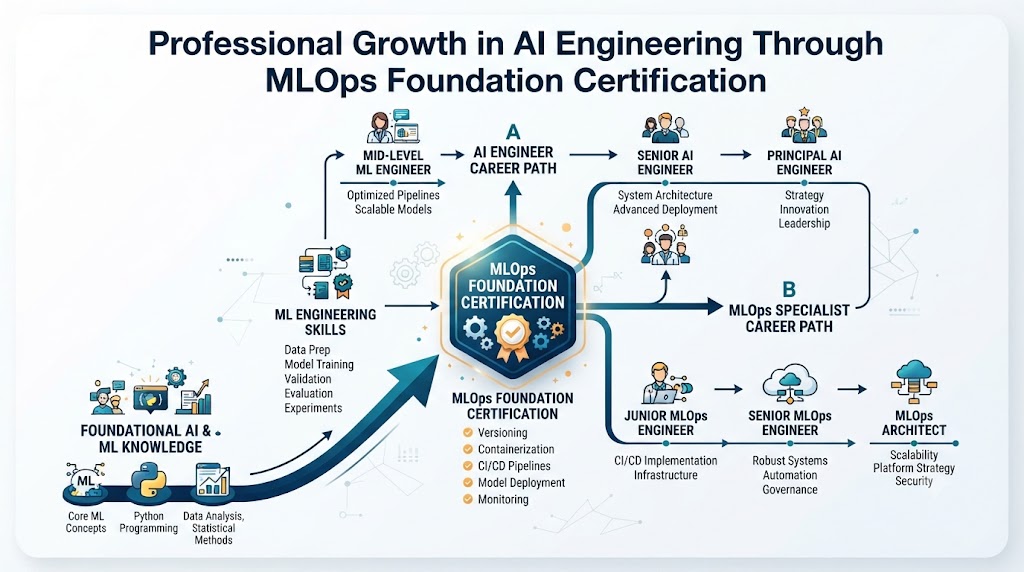
Introduction
The tech landscape has shifted dramatically, and traditional silos between software development, infrastructure, and data science are quickly vanishing. As organizations scramble to move intelligent models out of research environments and into live production, a massive operational gap has emerged. The MLOps Foundation Certification provides a direct, practical pathway for engineers who want to specialize in this highly valued domain. If you are ready to explore the complete curriculum and understand the exact evaluation criteria, you can dive straight into the official MLOps Foundation Certification program specifications. For engineering teams looking to coordinate a broad, organization-wide training initiative or explore adjacent technical paths, visiting the central hub at aiopsschool.com will give you a clear overview of available enterprise resources.
What is the MLOps Foundation Certification?
At its core, the MLOps Foundation Certification is an industry-aligned validation program designed to test an engineer’s ability to build, automate, and maintain machine learning pipelines. Rather than focusing on complex mathematical models or data science theories, this program targets the operational lifecycle of software systems. It exists to solve a real-world problem: ensuring that data-driven applications are just as reliable, testable, and secure as traditional web applications.
By prioritizing production-ready workflows over academic concepts, the certification teaches engineers how to manage infrastructure dependencies, track code versions, and automate deployments. It bridges the gap between raw data manipulation and enterprise-grade software delivery. For professionals working in modern technical environments, it provides a standardized, practical framework for handling the unique challenges of continuous integration and continuous deployment when data is a core variable.
Who Should Pursue MLOps Foundation Certification?
This certification is built specifically for technology practitioners who sit at the crossroads of system operations, software development, and cloud data architecture. Traditional DevOps engineers, site reliability specialists, and system administrators will find it incredibly useful for expanding their existing automation skill sets into the world of intelligent pipelines. Similarly, data analysts and engineers can use this baseline to gain a deep understanding of the infrastructure constraints their code must operate within.
The curriculum is equally valuable for technical project managers and engineering leaders who need to design efficient workflows for cross-functional teams. It helps managers understand the concrete resource requirements and architectural challenges their teams face daily. This validation holds immense value globally, serving as a critical benchmark for enterprise tech firms in Western markets as well as the rapidly expanding cloud infrastructure sectors across India.
Why MLOps Foundation Certification
As companies shift away from manual software testing and ad-hoc scripts, the ability to build automated, self-healing delivery pipelines has become a non-negotiable requirement. This certification offers long-term career stability by teaching core architectural habits that remain completely relevant even when specific software tools or vendor platforms change. It proves to employers that you know how to design sustainable systems rather than short-term fixes.
Earning this credential provides an excellent return on your time investment by placing you at the center of modern platform engineering discussions. It gives you the authority to lead automation projects, reduce system downtime, and accelerate how quickly your team ships new features. By mastering these fundamental deployment patterns, you position yourself as a crucial technical asset capable of navigating complex infrastructure modernizations with absolute confidence.
MLOps Foundation Certification Overview
This specialized training program is delivered directly through the official educational portal and is hosted entirely on the primary digital platform. The assessment methodology is thoroughly practical, moving away from simple memorization to test how you actually solve infrastructure bottlenecks. It forces candidates to think like real-world operators, evaluating their ability to troubleshoot pipeline failures and maintain continuous service availability.
The entire learning structure is optimized for working professionals, allowing you to master complex operational concepts without pausing your daily career commitments. The program is managed and continuously updated by seasoned infrastructure experts who understand the realities of running large-scale automated environments. Passing the exam rewards you with a highly respected industry credential that confirms your readiness to tackle modern software lifecycle challenges.
MLOps Foundation Certification Tracks & Levels
The certification framework uses a highly structured, step-by-step progression plan designed to support your professional journey from initial discovery up to enterprise architecture. The first phase focuses on mastering basic automation mechanics, version tracking, and environment isolation. As you advance through the higher tiers, the focus shifts toward designing massive multi-region delivery pipelines, orchestrating cloud clusters, and implementing strict security guardrails.
Embedded within this structure are clear specialization paths that allow you to align your studies with your specific career goals, whether you focus on pure infrastructure, data systems, or cost management. This layered architecture ensures that your credentials grow alongside your daily professional responsibilities. Each tier serves as a clear, verified milestone that demonstrates your capacity to handle increasingly complex enterprise workloads.
Complete MLOps Foundation Certification Table
| Track | Level | Who it’s for | Prerequisites | Skills Covered | Recommended Order |
| Core Systems | Foundation | IT Associates, Systems Operators | Basic terminal & Git fluency | Pipeline logic, code versioning, environment baselines | First |
| Automation Engineering | Professional | DevOps Practitioners, SREs | Foundation validation, scripting | Automated testing, cluster orchestration, telemetry | Second |
| Enterprise Strategy | Advanced | Solutions Architects, Tech Leads | Professional validation, cloud design | Multi-cloud governance, system security, cost strategy | Third |
Detailed Guide for Each MLOps Foundation Certification Certification
MLOps Foundation Certification – Foundation Level
What it is
This introductory credential certifies that an engineer thoroughly understands the baseline components of automated delivery pipelines, artifact registries, and environment tracking. It proves you have the core knowledge required to support automated software deployment teams.
Who should take it
This track is ideal for junior developers, system support specialists, and aspiring cloud engineers who want to establish a clean, structured entry point into automated infrastructure management.
Skills you’ll gain
- Clear understanding of artifact tracking and code version control mechanics.
- Ability to write fundamental scripts for continuous integration pipelines.
- Mastery of basic container builds and structured cloud storage configurations.
Real-world projects you should be able to do
- Set up a version-controlled code repository that automatically runs validation scripts upon every submission.
- Build a functional local container image that packages an application along with all its required software dependencies.
Preparation plan
- 7–14 Days: Focus on mastering basic vocabulary, studying artifact lifecycle documentation, and practicing everyday Git repository workflows.
- 30 Days: Build simple automation routines on your local machine, experiment with container environments, and learn the phases of standard deployment pipelines.
- 60 Days: Take multiple full-length practice exams, study common pipeline configuration errors, and review cloud bucket access policies.
Common mistakes
- Getting distracted by advanced statistical mathematics instead of focusing on build tools and automation infrastructure.
- Overlooking the importance of basic command-line navigation and fundamental version control concepts.
Best next certification after this
- Same-track option: MLOps Foundation Certification – Professional Level
- Cross-track option: Associate Cloud Infrastructure Engineer
- Leadership option: Technical Team Optimization Basics
Choose Your Learning Path
DevOps Path
This pathway is designed for professionals who want to extend traditional software delivery workflows to include complex data packages and system configurations. You will learn to build resilient continuous integration pipelines that treat system dependencies with the exact same rigor as application code. The focus centers on automated testing boundaries, container consistency, and seamless release coordination. This helps release teams ensure that updates move smoothly from local testing environments out to public infrastructure without sudden configuration conflicts.
DevSecOps Path
This track teaches security-minded engineers how to embed automated vulnerability scans, policy checks, and identity management rules directly into your delivery lifecycles. It emphasizes the importance of preserving code integrity, protecting exposed application endpoints, and maintaining clear access logs across all infrastructure layers. Practitioners learn to stop security vulnerabilities before they hit production, allowing development teams to maintain a fast pace while keeping enterprise data fully locked down.
SRE Path
Focused entirely on system reliability, this path shows operations engineers how to configure deep system telemetry, establish clear alerting boundaries, and manage error budgets effectively. You will dive into root-cause analysis for live system degradation, cluster auto-scaling logic, and high-availability configuration management under heavy traffic spikes. This training ensures that you can keep complex, distributed application environments highly performant and predictable no matter how volatile the user demand becomes.
AIOps Path
Engineers following this path learn to implement automated analytics tools to monitor, optimize, and protect complex enterprise infrastructure environments. The training centers on parsing massive volumes of system log data, identifying hidden operational patterns, and configuring automated self-healing triggers to resolve issues without manual intervention. By mastering these concepts, you can transform traditional, reactive server monitoring setups into intelligent, proactive platform operations.
DataOps Path
This focus area targets the continuous delivery, quality validation, and predictable orchestration of data streams across enterprise infrastructure networks. Practitioners learn to version large datasets, track data lineage, and enforce strict quality validation rules within automated pipelines to prevent downstream application errors. It is an excellent choice for data engineers who want to bring the predictability and structure of modern software engineering to complex data processing workflows.
FinOps Path
This financial tracking specialization teaches cloud professionals how to monitor, analyze, and optimize infrastructure spending across large automation networks. You will explore automated scaling strategies, cost-allocation frameworks, and resource tagging systems to ensure that massive computing jobs do not lead to budget overruns. This path allows you to strike a perfect balance between high system performance and strict corporate fiscal discipline.
Role → Recommended MLOps Foundation Certification Certifications
| Role | Recommended Certifications |
| DevOps Engineer | MLOps Foundation Certification – Professional Level |
| SRE | MLOps Foundation Certification – Professional Level |
| Platform Engineer | MLOps Foundation Certification – Advanced Level |
| Cloud Engineer | MLOps Foundation Certification – Foundation Level |
| Security Engineer | DevSecOps Advanced Strategy Validation |
| Data Engineer | DataOps System Optimization Specialist |
| FinOps Practitioner | Cloud Cost Management Practitioner |
| Engineering Manager | MLOps Enterprise Management Architecture |
Next Certifications to Take After MLOps Foundation Certification
Same Track Progression
Staying on this specialized track means moving directly into advanced platform architecture, multi-cluster scaling, and hybrid-cloud automation setups. You will learn how to design highly resilient, distributed environments that handle immense user activity without suffering from configuration drift or unexpected system outages. This deeper dive prepares you to take on the most complex infrastructure challenges that enterprise organizations encounter.
Cross-Track Expansion
Broadening your technical boundaries involves earning credentials in advanced cloud security protocols, globally distributed database management, or container cluster orchestration. This well-rounded approach ensures you become a versatile technical expert who can easily connect the dots between platform infrastructure, application code, and security requirements. It keeps your career exciting and prevents you from being pigeonholed into a single toolset.
Leadership & Management Track
Moving toward tech leadership requires shifting your focus toward strategic infrastructure management, corporate technology governance, and modern team delivery frameworks. This path is designed to prepare senior individual contributors to guide cross-functional teams, manage technology budgets, and align engineering work with broader business goals. It teaches you how to step back from manual configuration and focus on building high-performing engineering cultures.
Training & Certification Support Providers for MLOps Foundation Certification
DevOpsSchool offers deep, expert-led training courses that focus on building practical, day-to-day deployment skills through hands-on labs and real enterprise case studies.
Cotocus provides fast-paced, highly intensive corporate bootcamps structured to get engineering teams fully up to speed on modern automated pipeline patterns quickly.
Scmgalaxy maintains an impressive, community-driven collection of technical tutorials, troubleshooting guides, and practice challenges designed to help you master code version control systems.
BestDevOps specializes in delivering clear, flexible, and self-paced online courses built specifically to accommodate the busy schedules of active technology professionals.
devsecopsschool focuses entirely on teaching engineers how to integrate automated security scanning, compliance audits, and secret management tools into modern release systems.
sreschool provides deeply technical learning tracks centered around cluster observability, high-availability architecture design, and systematic post-mortem incident investigation.
aiopsschool stands out as a dedicated learning environment for engineers focused on mastering automated infrastructure monitoring and predictive platform operations.
dataopsschool offers highly focused training programs that show you how to manage large-scale data lifecycles, build reliable data pipelines, and maintain data storage integrity.
finopsschool delivers clear, practical courses that teach tech professionals how to measure, control, and optimize cloud infrastructure costs across multiple vendor platforms.
Frequently Asked Questions (General)
- What makes this certification different from standard cloud platform credentials?It focuses explicitly on the continuous automation, lifecycle management, and architectural patterns needed to sustain complex data pipelines, rather than general server hosting.
- Can someone working full-time complete the preparation within a month?Yes, dedicating roughly an hour or two every evening allows most active IT professionals to cover the entire curriculum comfortably within 30 to 45 days.
- Are there programming language exams included in this baseline evaluation?No, you won’t be forced to write complex software code; the exam focuses heavily on configuration files, pipeline logic, and infrastructure assembly.
- Is the information taught here applicable to private data centers or only public clouds?The core engineering principles are completely vendor-neutral and apply seamlessly to private infrastructure, public clouds, or hybrid enterprise setups.
- What happens if I fail the initial certification assessment?The program offers straightforward retake options, allowing you to review your weak areas and schedule a second attempt after a brief study period.
- How does this training help a project manager or Scrum Master?It gives technical leaders the exact vocabulary and structural context needed to estimate project timelines accurately and remove blockers for deployment teams.
- How frequently does the certification board update the tested tools?The exam blueprint is evaluated every year to phase out legacy methodologies and introduce current, production-proven architectural standards.
- Is there a digital badge provided upon passing the final exam?Yes, successful candidates receive a verified digital credential that can be shared instantly on professional networking sites and resumes.
- What is the primary format used for the evaluation questions?The test relies on practical, scenario-driven multiple-choice questions where you must choose the best architectural solution for a specific problem.
- Do the support providers offer community forums for student collaboration?Yes, most of the approved training partners maintain active discord or slack communities where students can share study tips and troubleshoot labs together.
- Does this certification cover data privacy regulations like GDPR or HIPAA?It introduces the core infrastructure practices needed to enforce data security, though it does not serve as a legal compliance certification.
- Are there enterprise discounts available for corporate team training?Yes, most hosting providers offer volume-based pricing for organizations looking to certify their entire engineering department at once.
FAQs on MLOps Foundation Certification
- What specific pipeline tools should I be familiar with before scheduling the MLOps Foundation Certification exam?You should understand the basic mechanics of automated build systems, container packaging tools, repository triggers, and centralized logging dashboards.
- Will I need to memorize complex statistical equations to clear this operational certification?Not at all; the evaluation leaves mathematical modeling to data scientists and focuses entirely on infrastructure reliability and release automation.
- How does the MLOps Foundation Certification prepare me to handle system performance drops?It teaches you how to configure automated health checks, interpret system performance metrics, and set up alert rules to catch errors early.
- Can an infrastructure engineer use this credential to pivot away from manual server configurations?Yes, this program acts as an ideal bridge into modern platform engineering by teaching you how to manage complex application lifecycles programmatically.
- Are container orchestration principles heavily featured in the foundational test material?The foundation level focuses on basic container building and isolation, while advanced multi-container scheduling patterns are saved for the higher tiers.
- How does completing this training help reduce deployment errors in a live environment?It provides you with a blueprint for replacing manual server tasks with immutable code configurations that pass through automated validation gates first.
- Is tracking data versions considered a core requirement for passing this assessment?Yes, knowing how to link specific data snapshots with corresponding code versions is a fundamental topic covered in the entry-level curriculum.
- Why are companies looking for this certification over traditional systems engineering tracks?Because traditional tracks often ignore the unique computing demands, storage bottlenecks, and continuous monitoring requirements that automated data workflows introduce.
Final Thoughts: Is MLOps Foundation Certification Worth It?
When you look past the standard industry hype, the MLOps Foundation Certification stands out as an incredibly sound, career-focused investment. It doesn’t waste your time with temporary software trends; instead, it installs the core engineering habits required to manage complex software lifecycles at scale.
For individual engineers, it offers an undeniable edge in a crowded job market by proving you can handle modern, automated release environments. For companies, it ensures that your teams speak the exact same technical language and build infrastructure that lasts. If you want to future-proof your career in platform operations, taking this track is a remarkably practical move.
