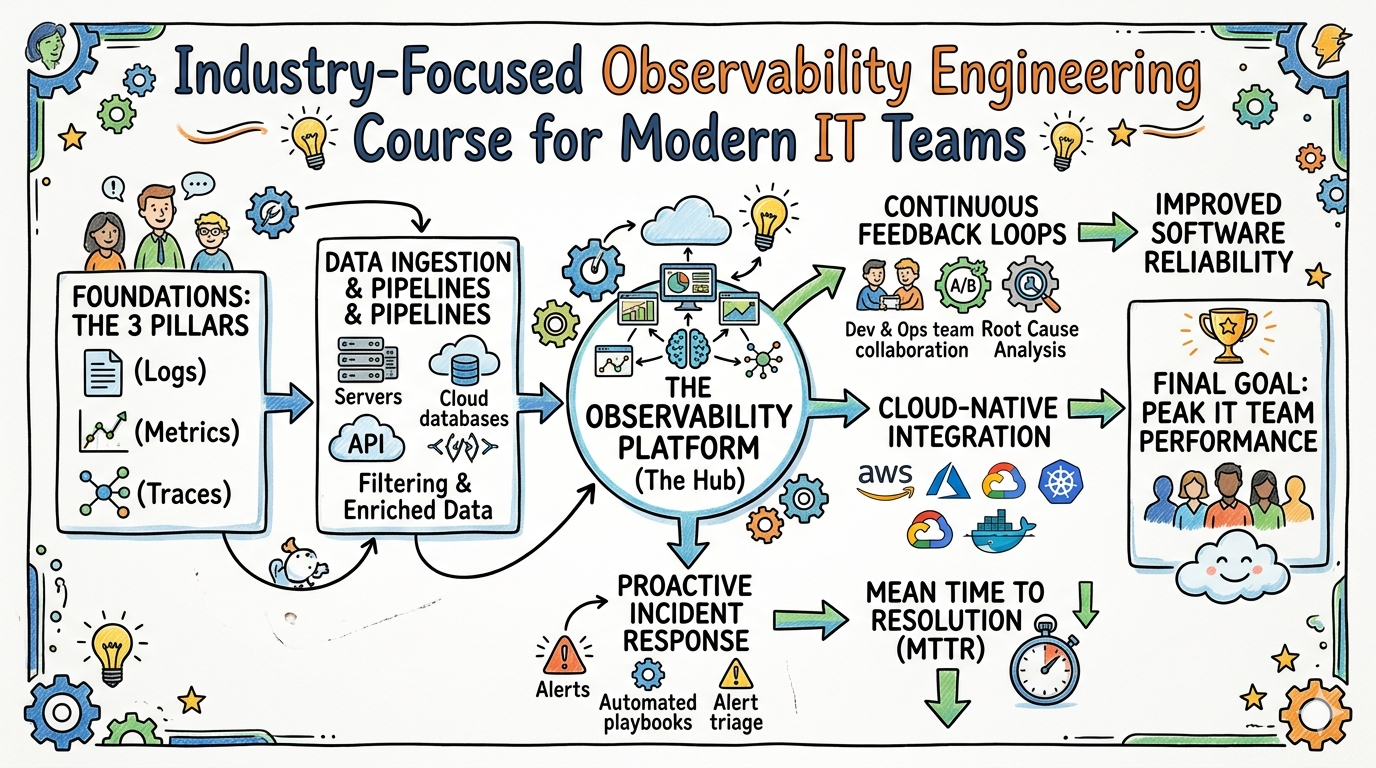
The modern software landscape has shifted from simple application monitoring to complex, data-driven observability. As systems grow in scale and distribution, the ability to understand internal states through external outputs is no longer optional—it is a critical requirement for every engineer. This guide is designed for developers, SREs, and platform architects looking to formalize their expertise and navigate the professional landscape of observability. By exploring the Master in Observability Engineering (MOE) program, you will gain the clarity needed to choose a learning path that aligns with your career goals and technical aspirations. Whether you are transitioning from traditional monitoring or aiming to integrate advanced telemetry into your pipeline, this resource serves as your roadmap for navigating the devopsschool ecosystem and specialized learning hubs like aiopsschool.
What is the Master in Observability Engineering?
Master in Observability Engineering represents a holistic framework for mastering the pillars of telemetry: logs, metrics, and traces. It moves beyond basic dashboarding, focusing instead on high-cardinality data analysis, distributed tracing, and automated incident response. This program exists to bridge the gap between reactive monitoring and proactive engineering, providing practitioners with the hands-on skills required to maintain reliability in cloud-native environments. It emphasizes production-grade implementation, ensuring that learners are not just following theoretical tutorials, but are actually building resilient, observable systems that stand up to real-world traffic and complexity.
Who Should Pursue Master in Observability Engineering?
This certification is designed for a broad spectrum of technical professionals, including DevOps engineers, SREs, and platform engineers tasked with system reliability. It is equally valuable for security engineers looking to monitor threats through behavioral patterns and data engineers who need to ensure data pipeline integrity. Beginners will find a structured entry point into the world of telemetry, while experienced engineers will find value in the advanced patterns of distributed tracing and observability-driven development. For professionals in India and globally, this credential serves as a standard measure of competency in a market that increasingly prioritizes system transparency and operational excellence.
Why Master in Observability Engineering
In the current industry climate, the ability to debug distributed systems is one of the most sought-after skills, ensuring long-term relevance for any engineer. As tools and vendors change, the underlying principles of observability—understanding system health through data—remain constant, providing a durable foundation for your career. This certification program offers a high return on investment by focusing on transferable skills that work across any cloud provider or technology stack. By validating your expertise, you position yourself as a problem solver capable of reducing MTTR (Mean Time to Resolution) and improving overall developer experience, which are essential metrics for modern engineering organizations.
Master in Observability Engineering Certification Overview
The program is structured to deliver deep, practical knowledge through a curriculum hosted on devopsschool. It utilizes a combination of guided study, hands-on lab work, and rigorous assessments to ensure that candidates possess the practical acumen required in production environments. Certification levels are designed to accommodate different stages of professional development, from those just starting their journey to senior architects requiring deep specialization. Ownership of the certification rests with the industry-recognized standards set by the program organizers, ensuring that your credential is respected by peers and hiring managers alike.
Master in Observability Engineering Certification Tracks & Levels
The certification tracks are divided into foundational, professional, and advanced levels to cater to diverse career stages. Foundational levels focus on tool proficiency and basic telemetry concepts, while professional levels emphasize integration, configuration, and best practices. Advanced levels are reserved for those designing complex observability platforms, integrating machine learning for anomaly detection, and implementing service-level objectives at scale. Regardless of your specialization, the progression path allows you to build a stacked skill set that grows in depth as you advance through the different tiers.
Complete Master in Observability Engineering Certification Table
| Track | Level | Who it’s for | Prerequisites | Skills Covered | Recommended Order |
| Observability Fundamentals | Foundation | Beginners | Basic Linux/Cloud | Logs, Metrics, UI | 1 |
| Distributed Tracing | Professional | SRE/DevOps | Foundation | Instrumentation, Spans | 2 |
| Observability at Scale | Advanced | Architect | Professional | High Cardinality, ML | 3 |
Detailed Guide for Each Master in Observability Engineering Certification
Master in Observability Engineering – Foundation Level
What it is
This certification validates your understanding of basic observability pillars including logging, monitoring, and fundamental alerting strategies.
Who should take it
Ideal for junior engineers, fresh graduates, and system administrators looking to modernize their monitoring skills.
Skills you’ll gain
- Understanding telemetry data collection.
- Setting up basic dashboarding and visualization.
- Configuring standard threshold-based alerts.
Real-world projects you should be able to do
- Build a standard dashboard for a web application.
- Configure log aggregation for a microservice environment.
- Implement simple uptime monitoring.
Preparation plan
- 7 days: Focus on documentation and tool architecture.
- 14 days: Execute lab exercises focused on data ingestion.
- 30 days: Review case studies and prepare for assessment.
Common mistakes
Ignoring the importance of structured logging and over-reliance on basic threshold alerts.
Best next certification after this
- Same-track: Professional Level Tracing
- Cross-track: SRE Fundamentals
- Leadership: Engineering Management Basics
Choose Your Learning Path
DevOps Path
The DevOps path focuses on integrating observability directly into CI/CD pipelines. This ensures that every deployment is measured for performance regressions from the moment it goes live. You will learn how to automate the provisioning of monitoring tools and ensure that infrastructure remains observable throughout its lifecycle.
DevSecOps Path
In this track, observability serves as a security layer, tracking unusual patterns that may indicate a breach. You will learn how to correlate system performance data with security logs to identify anomalies that traditional security tools might miss. It is essential for those securing distributed, cloud-native applications.
SRE Path
The SRE path is centered on reliability and SLO-driven engineering. You will master the art of using observability to define and measure error budgets, ensuring that your system performance aligns with business requirements. This path is crucial for those working on mission-critical, high-availability platforms.
AIOps Path
This path explores how machine learning can be applied to observability data to predict failures before they happen. You will learn about automated root cause analysis, noise reduction in alerts, and capacity planning using historical telemetry data. It is for engineers aiming to build self-healing systems.
MLOps Path
The MLOps track focuses on monitoring the health of machine learning models in production. You will learn to track data drift, model latency, and prediction accuracy, ensuring that your ML systems remain reliable and accurate as real-world data evolves over time.
DataOps Path
The DataOps path focuses on the observability of data pipelines. You will learn how to monitor data quality, latency, and lineage as information moves through your infrastructure. This is critical for data-heavy organizations where data integrity is as important as system uptime.
FinOps Path
The FinOps path uses observability data to track cloud expenditure in relation to performance. You will learn to identify resource waste, right-size your infrastructure, and correlate costs with system usage metrics, helping organizations maintain cost-efficiency without sacrificing quality.
Role → Recommended Master in Observability Engineering Certifications
| Role | Recommended Certifications |
| DevOps Engineer | Foundation, CI/CD Integration |
| SRE | Professional, Advanced SLOs |
| Platform Engineer | Advanced Infrastructure Monitoring |
| Cloud Engineer | Foundation, Multi-Cloud Telemetry |
| Security Engineer | DevSecOps Observability |
| Data Engineer | DataOps Observability |
| FinOps Practitioner | FinOps Telemetry |
| Engineering Manager | Observability Strategy |
Next Certifications to Take After Master in Observability Engineering
Same Track Progression
Deepen your expertise by pursuing advanced certifications in specific toolsets such as Prometheus, Grafana, or OpenTelemetry. This specialization ensures you are the go-to expert for technical implementation within your organization.
Cross-Track Expansion
Expand your skill set by moving into security or data engineering paths. Understanding how observability integrates with these fields makes you a versatile engineer capable of handling complex, cross-functional challenges.
Leadership & Management Track
Transition to leadership by focusing on observability strategy and governance. Learn how to define organizational standards, manage reliability budgets, and influence engineering culture to prioritize transparency and proactive health monitoring.
Training & Certification Support Providers for Master in Observability Engineering
DevOpsSchool provides comprehensive training modules and hands-on laboratory environments specifically tailored for the Master in Observability Engineering program, ensuring learners gain practical experience.
Cotocus offers specialized workshops and professional guidance to help candidates navigate the certification requirements and master complex observability concepts through expert-led mentorship.
Scmgalaxy focuses on the integration aspects of observability, providing resources that help engineers bridge the gap between development, deployment, and operational monitoring.
BestDevOps delivers curated content and practice assessments that are essential for candidates aiming to achieve high scores and demonstrate deep technical understanding.
devsecopsschool offers a dedicated curriculum for integrating security observability, helping professionals protect their infrastructure by detecting anomalies through telemetry data.
sreschool provides in-depth training on site reliability engineering principles, focusing on how observability is used to maintain system health and meet service-level objectives.
aiopsschool focuses on the application of artificial intelligence in observability, guiding engineers on how to automate incident management and predict system failures.
dataopsschool specializes in training for data pipeline observability, ensuring that engineers can monitor the flow and quality of data in complex systems.
finopsschool delivers insights into managing cloud costs through observability, teaching practitioners how to link system usage data with financial efficiency.
Frequently Asked Questions
- What is the difficulty level of this certification?The difficulty is intermediate to advanced, designed to challenge experienced professionals while remaining accessible to those with a solid foundational background.
- How much time is required for preparation?Preparation usually ranges from 30 to 60 days depending on your prior hands-on experience with monitoring tools and your current role.
- Are there any specific prerequisites?A strong understanding of Linux, cloud platforms, and basic application architecture is required to get the most out of the training.
- What is the return on investment for this certification?The ROI is high, as it significantly improves your ability to debug systems, reduces downtime, and makes you a more valuable asset in any SRE or DevOps team.
- Is this program recognized internationally?Yes, the certification is recognized globally by organizations that value standardized skills in cloud-native observability and engineering practices.
- Can I take the exam multiple times if I fail?Most certification programs allow for retakes, though it is highly recommended to complete the lab exercises thoroughly to pass on the first attempt.
- How does this differ from standard monitoring certifications?This program focuses on high-cardinality data and system transparency rather than just simple up/down status checks, providing a more modern skill set.
- Is this suitable for someone in a management position?Absolutely, as managers need to understand the strategic value of observability to guide team priorities and ensure system reliability.
- What is the best way to practice for the lab portion?The best approach is to build personal projects, experiment with open-source observability tools, and actively troubleshoot your own deployments.
- Does the certification expire?Certifications typically require periodic updates or renewal to ensure your knowledge remains current with the rapidly evolving observability landscape.
- Can I choose a specialization track later?Yes, the foundational certification provides a platform that allows you to easily pivot into specialized areas like AIOps, FinOps, or Security.
- What language are the exams conducted in?The exams are conducted in English, reflecting the global standard of technical communication in the DevOps and engineering community.
FAQs on Master in Observability Engineering
- How does this certification help with troubleshooting?It provides techniques to move from symptoms to root causes using distributed tracing and event correlation.
- Is programming knowledge necessary?Basic scripting or programming knowledge is essential to implement instrumentation and automate telemetry data collection.
- Does it cover specific tools?It covers foundational concepts that apply to all major tools, though practical labs often use industry-standard stacks.
- Is it helpful for remote-first teams?Yes, robust observability is critical for distributed teams to maintain system health without needing physical access.
- How does it impact my salary potential?Demonstrating specialized observability skills often leads to higher demand and better compensation in SRE and DevOps roles.
- What is the focus of the advanced level?The advanced level focuses on architectural decisions, managing scale, and using data for automated decision-making.
- Can I apply this to legacy systems?Yes, many of the principles of observability can be adapted to improve the monitoring of legacy environments.
- Where can I find study resources?Official resources are provided through the host platform upon registration, including lab guides and documentation.
Final Thoughts: Is Master in Observability Engineering Worth It?
If you are serious about advancing your career in modern engineering, this certification is a worthwhile investment. It forces you to move beyond basic monitoring and adopt a mindset centered on system transparency and reliability. The real value lies not in the certificate itself, but in the disciplined practice of instrumentation and data analysis that you will cultivate during the process. Approach this not as a shortcut, but as a commitment to mastery. With the right focus and hands-on effort, it will undoubtedly elevate your professional capabilities and set you apart in a competitive industry.
