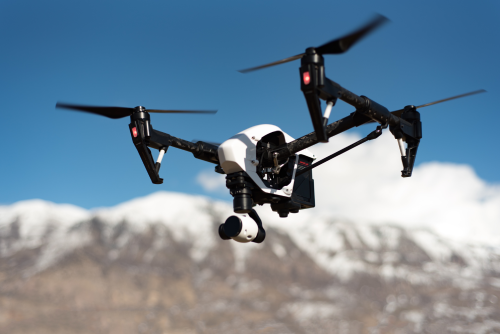
The DJI Inspire 3 is DJI’s flagship professional cinema multirotor, built for film crews that need a serious aerial camera platform rather than a casual creator drone. It matters because it combines a dedicated cinema workflow, an integrated gimbal camera system, and repeatable flight tools in one active product line. For buyers comparing high-end aerial filmmaking systems, the Inspire 3 sits firmly in the premium, production-first category.
What makes it especially relevant is that there are not many aircraft left in this exact niche. At the lower end, compact folding drones now handle a huge amount of creator, corporate, and lightweight commercial work. At the higher end, custom heavy-lift rigs serve productions that want to fly third-party cinema bodies and specialized payloads. The Inspire 3 lives in the middle of those worlds: more serious than a prosumer camera drone, but far more integrated and streamlined than a custom cinema aircraft.
That positioning is why the Inspire 3 continues to attract attention from production companies, drone departments, rental houses, and aerial DPs. For teams that need image quality, predictable flight behavior, and set-friendly repeatability, it is one of the clearest purpose-built options on the market.
Quick Summary Box
- Drone Name: DJI Inspire 3
- Brand: DJI
- Model: Inspire 3
- Category: Professional cinema
- Best For: Film crews, aerial cinematographers, production houses, and high-end commercial video teams
- Price Range: Not publicly confirmed in supplied data
- Launch Year: 2023
- Availability: Active; regional stock and dealer availability should be verified
- Current Status: Active
- Overall Rating: Not rated due to limited confirmed data
- Our Verdict: A purpose-built cinema drone for serious productions, with clear strengths in image quality and repeatable workflow, but too specialized and expensive for most casual buyers
Introduction
The DJI Inspire 3 is an active professional cinema drone from DJI, a Chinese manufacturer best known for camera drones and gimbal systems. Unlike creator-focused folding drones, this model is aimed at production environments where image quality, camera movement precision, and crew workflow matter more than portability. Readers should care about it because the Inspire line has long represented DJI’s top integrated aerial filmmaking platform, and the Inspire 3 continues that role in the current market.
That distinction matters more than it may seem at first glance. Many drones can shoot attractive footage in good light. Far fewer are designed around the way real productions actually work. On a film set or high-end commercial shoot, the drone is not just expected to capture a pretty shot. It must match a schedule, coordinate with ground cameras, integrate into post-production, repeat paths when needed, and deliver footage that can sit alongside footage from dedicated cinema cameras without feeling obviously lesser.
The Inspire 3 is therefore best understood not as a luxury version of a consumer drone, but as a specialized tool built around professional expectations. It is meant for environments where producers want reliability, camera operators need control, directors want confidence in repeat takes, and post teams care about image latitude and media workflow. That makes it a much more serious purchase decision than a travel-friendly aerial camera for social media or solo content creation.
Another reason the platform matters is market continuity. Buyers in the professional segment often care less about novelty and more about whether a system is actively supported, easy to source, and compatible with a broader working ecosystem. Because the Inspire 3 comes from DJI’s established product family, it benefits from stronger market recognition than many niche alternatives. For commercial operators, that can translate into easier training, easier resale logic, better rental acceptance, and less uncertainty for clients who already know the DJI name.
Overview
What kind of drone is it?
The Inspire 3 is a multirotor aerial cinema platform designed for professional video production. In practical terms, that means it is built around a high-end stabilized camera system, advanced flight and positioning tools, and a workflow that suits commercial shoots, film sets, and specialist operators.
The “cinema platform” label is important. A lot of drones are judged mainly by top-line specs such as flight time or range. Those numbers matter, but they are not the whole story here. What defines a cinema drone is the combination of image quality, controllable camera movement, lens options, monitoring, positioning accuracy, and consistency across multiple takes. The Inspire 3 is built to serve those needs rather than simply maximize consumer-friendly convenience.
It also sits in a class where the aircraft is part of a larger working system. You are not just buying the drone body. You are buying into batteries, storage, lenses, controllers, transport, service, and on-set operating practices. In that sense, the Inspire 3 behaves more like professional camera equipment than like a typical consumer gadget.
Who should buy it?
This drone is best suited to:
- Professional cinematographers
- Drone operators working on commercial shoots
- Production companies
- Rental fleets serving film and TV clients
- Teams that need repeatable aerial moves for VFX or multi-take shooting
It is not primarily designed for hobby flying, beginner training, or low-cost content production.
A useful rule of thumb is this: if aerials are central to your paid workflow rather than occasional extras, the Inspire 3 starts to make sense. If your business depends on matching footage to larger camera packages, delivering to agencies or studios, or recreating exact flight paths on demand, the platform’s strengths are much easier to justify. If you mostly shoot occasional promotional clips, travel videos, or social content, the value proposition becomes much weaker.
It is also a good fit for teams rather than individuals. While a skilled solo operator can certainly fly a professional drone, the Inspire 3 is most at home when it is part of a crewed production environment with planning, roles, safety checks, and clear shot requirements. The more structured your workflow, the more the platform’s design pays off.
What makes it different?
What separates the Inspire 3 from many other drones is its cinema-first design. It is not just a drone with a good camera attached. It is an integrated production platform that combines a professional camera system, interchangeable-lens workflow, stabilized movement, and repeatable route tools that matter on set. That makes it very different from compact prosumer drones and also different from heavy-lift custom rigs that require more setup and integration work.
This distinction becomes obvious when you think about the operator experience. Compact drones are optimized for portability, quick deployment, and broad ease of use. Heavy-lift systems are optimized for payload flexibility and can be built around many different third-party cameras, but they usually involve more complexity. The Inspire 3 aims for a middle ground that is unusually attractive for professional crews: premium image capture without the friction of building and tuning a custom aircraft for every job.
The result is a platform that emphasizes consistency. Lens behavior, gimbal performance, transmission, monitoring, route planning, and camera integration are meant to work together out of the box. For productions under schedule pressure, that kind of integration is a real advantage. Less setup friction can mean more takes, fewer surprises, and faster turnaround from prep to flight.
Key Features
The Inspire 3’s feature list looks impressive on paper, but the more important question is what those features mean in real production use. Below are the headline capabilities most associated with the aircraft, along with why they matter to the intended buyer.
-
Professional cinema-focused multirotor platform
Built from the ground up for high-end aerial imaging rather than casual content capture. -
Active DJI model positioned for high-end aerial filmmaking
That means buyers are looking at a current product rather than a legacy platform already sliding into the used-only market. -
Integrated full-frame Zenmuse X9-8K Air camera system in official product materials
Full-frame capture is one of the defining reasons the Inspire 3 stands out in the integrated drone market. -
Up to 8K video capture
This supports demanding post workflows, reframing flexibility, and high-end delivery expectations. -
Interchangeable-lens workflow through DJI’s DL lens ecosystem
Lens choice affects perspective, shot character, and how well aerial footage cuts with ground camera material. -
DJI O3 Pro transmission system
Reliable video transmission matters not only for flying safely but also for directors, camera operators, and spotters working as a team. -
Up to 28 minutes of flight time in official specifications
Real-world times vary, but this gives a sense of the aircraft’s intended operating envelope. -
Integrated RTK support for highly repeatable flight paths
This is especially important for VFX, continuity, surveying-like precision in cinematic movement, and multi-pass shot work. -
Omnidirectional obstacle sensing
This improves situational awareness, though it should never be treated as a substitute for professional planning and piloting. -
Waypoint Pro and other advanced route tools for repeatable shots
Repeatability is one of the clearest dividing lines between a creator drone and a production platform. -
DJI RC Plus controller support
A more serious controller ecosystem better suits extended outdoor work and professional handling. -
Built for professional crews rather than travel-first solo creators
This is the central buying signal: it prioritizes production value over portability.
Taken together, these features suggest a very specific kind of product. The Inspire 3 is less about being the easiest drone to own and more about being the easiest professional cinema drone to integrate into real set workflows. That is a narrower appeal, but for the right users it is exactly the point.
Full Specifications Table
| Specification | Details |
|---|---|
| Brand | DJI |
| Model | Inspire 3 |
| Drone Type | Multirotor professional cinema drone |
| Country of Origin | China |
| Manufacturer | DJI |
| Year Introduced | 2023 |
| Status | Active |
| Use Case | Professional cinema / aerial filmmaking |
| Weight | About 4 kg class in standard filming configuration; exact configured weight should be verified |
| Dimensions (folded/unfolded) | Not foldable in the same way as compact consumer drones; exact dimensions not publicly confirmed in supplied data |
| Max Takeoff Weight | Not publicly confirmed in supplied data |
| Battery Type | Dual DJI TB51 Intelligent Batteries |
| Battery Capacity | 4,280 mAh per battery |
| Flight Time | Up to 28 minutes |
| Charging Time | Not publicly confirmed in supplied data |
| Max Range | Up to 15 km transmission range, region-dependent |
| Transmission System | DJI O3 Pro |
| Top Speed | Up to 94 km/h |
| Wind Resistance | Up to 14 m/s |
| Navigation System | GNSS with integrated RTK support |
| Obstacle Avoidance | Omnidirectional obstacle sensing |
| Camera Resolution | Full-frame Zenmuse X9-8K Air system; exact still-photo resolution not publicly confirmed in supplied data |
| Video Resolution | Up to 8K |
| Frame Rates | High-frame-rate capture supported depending on codec; official platform materials list up to 8K/75fps in supported formats |
| Sensor Size | Full-frame |
| Gimbal | 3-axis stabilized gimbal with cinema-oriented unobstructed movement |
| Zoom | No fixed built-in zoom; depends on lens choice |
| Storage | DJI PROSSD media support |
| Controller Type | DJI RC Plus |
| App Support | DJI Pilot 2 |
| Autonomous Modes | Waypoint Pro, Repeatable Routes, 3D Dolly, Spotlight Pro |
| Payload Capacity | Not publicly confirmed in supplied data |
| Operating Temperature | Not publicly confirmed in supplied data |
| Water Resistance | Not publicly confirmed in supplied data |
| Noise Level | Not publicly confirmed in supplied data |
| Remote ID Support | Not publicly confirmed in supplied data |
| Geo-fencing | DJI geospatial restrictions may apply by region |
| Certifications | Not publicly confirmed in supplied data |
| MSRP / Launch Price | Not publicly confirmed in supplied data |
| Current Price | Not publicly confirmed in supplied data |
Numbers alone do not tell the whole story, but they do show the aircraft’s priorities. The listed speed and wind resistance figures suggest a platform capable of keeping up when a shot requires energy and momentum, while the full-frame camera system and professional media options show that imaging quality sits at the center of the design. Meanwhile, the dual-battery setup and RTK support point to the kind of operational reliability expected in paid environments.
Buyers should still verify configuration-specific details before purchase, especially where regional compliance, firmware variation, or bundled accessories are concerned. In the professional segment, seemingly small differences in supported codecs, dealer packages, media compatibility, and service options can have meaningful effects on real-world ownership.
Design and Build Quality
The Inspire 3 uses the classic Inspire-style professional airframe concept rather than a compact folding consumer layout. That matters in the field because this type of design prioritizes rigidity, stable camera movement, landing gear clearance, and production readiness over backpack convenience.
A few practical points stand out:
- It is a large professional multirotor, not a travel drone
- The layout is designed around unobstructed camera movement
- Its size and category suggest a stronger emphasis on stable outdoor operation than on tight indoor shooting
- Dual-battery architecture is better suited to professional uptime and mission continuity than single-battery hobby platforms
For transport, buyers should think in terms of hard cases, dedicated batteries, charging hubs, and crew handling rather than a light grab-and-go kit. In that sense, the build approach is aligned with film-set use: serious, specialized, and less compromise-driven than smaller creator drones.
Another key part of the design philosophy is that the aircraft needs to support not just flight, but shot execution. On a cinema platform, body shape, arm clearance, gimbal freedom, and landing geometry all affect what camera moves are possible. The Inspire family has historically emphasized a configuration that keeps the camera’s field of view clear and allows more dramatic movement without landing gear constantly intruding into the frame. That matters when you are trying to produce cinematic reveals, orbiting shots, or low-angle moves that would be awkward on more compact designs.
Build quality also has to be understood in professional terms. A professional drone is judged not only by how solid it feels in the hand, but also by how well it tolerates repeated setup cycles, frequent transport, battery swapping, lens changes, and long outdoor days. It should support predictable preflight checks, straightforward maintenance, and quick turnaround between takes. The Inspire 3’s overall concept reflects those needs more than lifestyle convenience.
There is, of course, a tradeoff. A larger, more specialized aircraft is simply less forgiving from a logistics standpoint. It occupies more vehicle space, attracts more attention on location, and usually requires a cleaner takeoff and landing area. That can be a minor issue on open landscapes but a significant one in dense urban locations or tight documentary-style shoots. In other words, its physical design is one of its strengths and one of its operating constraints.
Flight Performance
On paper, the Inspire 3 is built for controlled, confident, outdoor cinema work. Officially listed figures such as up to 28 minutes of flight time, high top speed, RTK positioning, and omnidirectional sensing suggest a drone that is meant to perform stable tracking, reveal, and repeat-pass shots rather than maximize simple endurance.
Based on its size and segment, its likely flight character is:
- More stable and deliberate than a lightweight folding drone
- Better suited to open shooting environments than confined spaces
- Capable of strong pace when a shot needs speed
- More useful for repeatable planned routes than for casual freestyle flying
The listed wind resistance also indicates a platform designed to keep shots usable in real production conditions, though any actual performance depends on payload, flight profile, local weather, and pilot skill. As analysis rather than a new claim, this is the kind of drone that should feel most at home in structured outdoor shoots with a clear safety perimeter and a trained crew.
For professional users, the most important flight-performance question is not usually “How far can it go?” but “How well can it execute a shot?” That includes hover stability, braking behavior, smooth acceleration, positional accuracy, confidence in wind, and the ability to produce repeatable camera movement. A drone can have excellent raw performance and still be frustrating if its movements are too abrupt or inconsistent for cinematic use. The Inspire 3’s specification profile strongly suggests that DJI designed it with shot quality in mind rather than headline recreational speed alone.
The top-speed figure is also worth interpreting carefully. High speed can be valuable for chase scenes, vehicle work, and energetic reveals, but it is not the main point of a cinema aircraft. Most high-end aerial shots rely more on smoothness than outright velocity. In practice, a professional crew will often operate far below the maximum speed in order to preserve composition, timing, and safety margins. What matters is having performance in reserve when the scene demands it.
Flight time, meanwhile, should be treated as a planning tool rather than a promise. The official figure gives a useful benchmark, but real-world duration depends on wind, speed, temperature, lens choice, flight style, takeoff altitude, and how conservative the operator is with reserve power. Production teams do not usually plan around flying to the battery’s limit. They plan around safe return windows, retake capacity, and battery rotation. On a paid shoot, reliability beats squeezing out the last minute.
RTK support deserves special emphasis because it changes what “good flight performance” can mean on a film job. For certain uses, the best aircraft is not the one that feels the most agile; it is the one that can come back and fly the same line again with a high degree of consistency. That kind of repeatable movement is valuable for VFX plates, time-separated takes, and scenes that need continuity across multiple lighting setups or actors’ marks.
Camera / Payload Performance
This is where the Inspire 3 matters most. It is a cinema-led platform, and its value is tied directly to its imaging system and how that system fits professional workflows.
Based on official platform materials, the key strengths include:
- Full-frame imaging
- Up to 8K capture
- Interchangeable-lens support
- Stabilized gimbal footage designed for professional output
- Codec options aimed at serious post-production workflows
In practice, that makes the Inspire 3 relevant for productions that care about color grading, dynamic range, lens choice, and intercutting with other cinema cameras. An integrated cinema drone like this is especially useful when a production wants aerial footage that feels less like “drone footage” and more like part of the main camera package.
It is also important to understand what it is not. The Inspire 3 is not mainly a flexible third-party payload carrier in the way some heavy-lift systems are. Its strength is a tighter, more integrated camera workflow, not broad payload modularity.
The full-frame sensor is one of the defining reasons the platform sits above most compact drones. Larger sensors can contribute to a more cinematic rendering, improved low-light behavior, and a different sense of depth and perspective when paired with suitable lenses. That does not automatically make every shot better, but it gives aerial cinematographers more room to craft an image that sits naturally within a higher-end production.
Lens choice is another major advantage. With an interchangeable-lens workflow, the operator can choose a focal length that serves the scene rather than accept a single built-in perspective. Wider options may support sweeping environmental context, while longer lenses can create a more compressed, dramatic look and allow the aircraft to work farther from a subject. This matters for both aesthetics and safety. Sometimes the best way to capture a shot is not to fly closer, but to choose the right lens and preserve more operational margin.
The phrase “integrated cinema workflow” also includes media handling and post-production relevance. Productions paying for an aircraft at this level usually care about how footage enters editorial, grading, and finishing pipelines. Higher-resolution acquisition, serious recording media, and robust codec support make the Inspire 3 more suitable for these environments than creator-oriented systems whose footage is optimized for convenience over maximum finishing latitude. Buyers should still verify the exact recording formats, storage requirements, and post tools they plan to use, especially if a production depends on a specific editorial or color workflow.
Just as important is stabilization. Professional aerial footage succeeds when it feels intentional rather than merely airborne. A capable 3-axis gimbal helps deliver smoothness, horizon control, and compositional stability that can survive close scrutiny on larger screens. For a production company, that can be the difference between drone footage that looks like a novelty insert and footage that feels fully integrated with the rest of the project.
The payload conversation is therefore very different from that of heavy-lift rigs. If you need to mount unusual sensors, specialized cinema bodies, or highly customized payload packages, the Inspire 3 may not be the most open system. But if your priority is to get a refined, production-grade aerial camera package working quickly and predictably, its integrated design becomes a feature rather than a limitation.
Smart Features and Software
The Inspire 3’s software value is tied to professional repeatability and camera control rather than consumer automation tricks.
Confirmed or widely associated workflow strengths include:
- RTK support for more precise positioning
- Waypoint Pro for repeatable routes
- Repeatable Routes for matching previous takes
- 3D Dolly for controlled camera path planning
- Spotlight Pro for subject-oriented camera behavior
- DJI Pilot 2 support
- O3 Pro transmission for professional monitoring and control
For cinema teams, repeatability is a major selling point. If a director or VFX team needs the same aerial path more than once, tools like RTK-assisted route memory are more important than novelty features. Buyers who need deeper integration with custom production pipelines should still verify any current SDK, API, monitor, or accessory compatibility before purchase.
To understand why this matters, imagine a shoot where the production wants to repeat the same move at sunrise and again at dusk, or capture one pass clean and another with talent or vehicles in frame, or line up a plate that will later be enhanced in post. In those situations, repeatability is not a convenience feature. It is a core production requirement. The Inspire 3’s software suite is valuable because it speaks directly to that requirement.
Waypoint and route tools also help reduce human inconsistency. Even highly skilled pilots vary slightly from take to take, especially under pressure or in difficult conditions. Smart route planning does not remove the need for piloting skill, but it can make complex moves more dependable and easier to brief with the rest of the crew. That can be especially useful when the drone’s movement needs to coordinate with actors, vehicles, cranes, or ground camera operators.
3D Dolly-style planning has particular appeal in cinematic work because it shifts the conversation from “how do we fly this?” to “what camera move do we want?” That is a subtle but important difference. Filmmakers think in terms of blocking, timing, and framing. Software that allows aerial movement to be planned more like a camera move rather than a mere navigation task can make collaboration with directors and DPs much smoother.
Spotlight-style subject tracking tools can also help when a production wants the camera to maintain attention on a moving subject while the aircraft’s path remains flexible. Even then, professionals should treat these modes as assists, not as replacements for shot design and pilot judgment. The Inspire 3’s smart features are best understood as tools that support disciplined operation, not shortcuts that eliminate the need for experience.
Use Cases
The most realistic use cases for the DJI Inspire 3 are high-end visual production jobs where image quality and controlled camera movement justify the cost and operating complexity.
- Feature film and television aerial cinematography
- Commercials and brand films
- Music videos
- High-end tourism, hospitality, and real-estate showcase work
- VFX plates and repeatable aerial passes
- Multi-operator professional drone teams
- Rental-house fleets for production clients
- Large-scale event filming in controlled and legally approved conditions
A feature film or scripted TV production may value the Inspire 3 because it can deliver more polished aerial imagery and greater continuity control than a smaller drone. A commercial production may care less about raw endurance and more about whether the aircraft can produce hero shots that fit alongside footage from high-end ground cameras. A music video may use the drone for bold, flowing camera moves where lens choice and image character matter as much as the movement itself.
The platform can also make sense in premium property, resort, and destination marketing, but only at the top end of that market. Most real-estate and hospitality work does not require a cinema-class drone. However, luxury campaigns, destination films, and agency-led brand pieces sometimes do benefit from the extra image quality and shot discipline an Inspire-class platform brings.
VFX-related applications are among the most convincing use cases. When post teams need clean plates, matched moves, or highly consistent repeat passes, the Inspire 3’s positioning and route tools become much more valuable than they might appear in a basic feature checklist. This is one of the areas where the difference between a creator drone and a cinema platform becomes especially obvious.
Rental fleets are another natural fit because the Inspire 3 serves a recognizable professional need. A rental house does not need a product to appeal to everyone; it needs a product that fills a specific gap in client demand. For productions that want a major-manufacturer aerial cinema system without moving all the way into custom heavy-lift territory, the Inspire 3 is exactly that sort of rentable solution.
Pros and Cons
Like most specialized professional tools, the Inspire 3 is excellent at a narrow set of tasks and less compelling outside them. Its strengths are significant, but they only matter if they line up with the work you actually do.
Pros
- Purpose-built for professional aerial cinema rather than casual content creation
- Integrated full-frame camera workflow is a major advantage for production teams
- Up to 8K capture keeps it relevant for demanding post-production pipelines
- RTK and repeatable route tools are valuable for VFX and multi-take work
- Omnidirectional sensing improves situational awareness in complex shoots
- DJI ecosystem support is typically stronger than many niche cinema-drone brands
These advantages combine into something bigger than any single spec. The biggest “pro” is really workflow confidence. The Inspire 3 gives productions a way to access cinema-grade aerial capture in a package that is more integrated and predictable than many custom alternatives. For the right crew, that can mean fewer operational surprises and better output consistency.
Cons
- Expensive category, with total ownership cost likely extending far beyond the airframe
- Large and less portable than prosumer creator drones
- Requires more planning, space, and operator discipline than smaller camera drones
- Not ideal for beginners, solo travelers, or casual hobby use
- Payload flexibility is less open-ended than some heavy-lift custom rigs
- Several buyer-relevant details such as exact current price and some compliance specifics should be verified regionally
The main weakness is not that the drone underdelivers, but that its value is highly conditional. If your work does not benefit from full-frame aerial imaging, lens choice, route repeatability, and crew-oriented operation, you will pay a large premium for capabilities you may rarely use. In that sense, the Inspire 3 is easy to admire and easy to overbuy.
Comparison With Other Models
When comparing the Inspire 3 to other aircraft, the most useful lens is workflow rather than specs alone. Not every buyer needs the same kind of “best.” Some need the cleanest integrated cinema system. Others need custom payload freedom, lower operating burden, or lower entry cost.
| Model | Price | Flight Time | Camera or Payload | Range | Weight | Best For | Winner |
|---|---|---|---|---|---|---|---|
| DJI Inspire 3 | Not publicly confirmed in supplied data | Up to 28 min | Integrated Zenmuse X9-8K Air full-frame interchangeable-lens cinema system | Up to 15 km | About 4 kg class | Professional aerial cinema | Best integrated cinema workflow |
| Freefly Alta X | Not publicly confirmed in supplied data | Payload-dependent / not publicly confirmed here | Custom heavy-lift payload carrier | Not publicly confirmed in supplied data | Heavy-lift class | Flying custom cinema payloads | Best custom rig flexibility |
| DJI Mavic 3 Pro Cine | Not publicly confirmed in supplied data | Up to 43 min | Compact triple-camera cine-oriented folding drone | Up to 15 km | Under 1 kg class | Portable creator and small-crew work | Best portability and lower operating burden |
| DJI Inspire 2 | Not publicly confirmed in supplied data | Up to 27 min | Older Inspire-generation cinema ecosystem | Up to 7 km | About 3.4 kg class | Older pro workflows and used-market buyers | Best lower-cost legacy entry point |
DJI Inspire 3 vs a close competitor
Against the Freefly Alta X, the Inspire 3 is the cleaner choice for buyers who want an integrated aircraft-camera-transmission workflow with less setup friction. The Alta X makes more sense if your priority is carrying custom cinema payloads and building a more open rig around third-party cameras.
That difference can shape an entire production plan. With an integrated system like the Inspire 3, prep is usually more straightforward, and the aircraft is designed around the camera package it carries. With a heavy-lift platform, you gain flexibility but accept more variables: balancing the payload, confirming integration, accounting for different camera bodies, and often building a more specialized crew workflow around the rig. Neither approach is inherently better. They simply serve different operational priorities.
DJI Inspire 3 vs an alternative in the same segment
Compared with the DJI Mavic 3 Pro Cine, the Inspire 3 is much less portable and almost certainly far more expensive to own and operate. In return, it offers a more serious cinema platform, a stronger on-set workflow, better repeatability tools, and a more production-oriented camera system.
For many businesses, the Mavic-class option is still the more rational purchase. It is lighter, easier to carry, quicker to deploy, and simpler to justify for everyday jobs. The Inspire 3 only becomes the better answer when the job itself is more demanding—when image character, lens options, client expectations, and repeatable shot design outweigh the convenience of a smaller airframe.
DJI Inspire 3 vs an older or previous-generation option
Compared with the Inspire 2, the Inspire 3 is the more modern choice for teams that want current-generation DJI cinema positioning and newer workflow tools. The Inspire 2 can still appeal on the used market, but buyers should be cautious about battery age, long-term parts, and the reality of investing in an older platform.
This is an especially important comparison because the Inspire 2 built a strong reputation and may still be available at a lower entry cost. But lower acquisition cost is not the same as lower operational risk. Legacy batteries, older media, uncertain support horizons, and aging components can reduce the appeal of a used professional aircraft, especially when you need it for client work. Buyers considering the older platform should think beyond purchase price and factor in supportability over the next several seasons.
Manufacturer Details
DJI is both the brand and the manufacturer of the Inspire 3, so there is no separate parent consumer label involved in this case. The company is headquartered in Shenzhen, China, and has been one of the most influential drone makers in the global market since its founding in 2006.
DJI’s major product lines span:
- Consumer camera drones
- Prosumer and creator drones
- FPV products
- Enterprise and industrial systems
- Agricultural platforms
- Handheld gimbals and stabilization tools
Its reputation in the drone industry is built on strong integration between hardware, camera systems, transmission, and software. That background is a major reason the Inspire line has remained important in professional aerial imaging.
For buyers in the cinema segment, manufacturer scale matters. Professional users are not just buying a feature set; they are buying confidence that accessories, replacements, firmware support, and trained operators will exist in the real world. DJI’s broad market presence can make it easier to find technicians, dealer guidance, spare parts, and crew members already familiar with the company’s control logic and software environment.
That does not mean every buyer will have identical support conditions in every region. Local regulations, distributor networks, and political or procurement realities can all affect purchase decisions. Still, compared with many smaller aerial cinema brands, DJI’s market footprint remains a practical advantage. Familiarity reduces friction, and in production environments friction costs time.
Support and Service Providers
Support for the Inspire 3 should be approached as a professional-equipment decision, not a casual gadget purchase.
Buyers should verify:
- Official manufacturer support availability in their country
- Authorized repair center access
- Spare battery and propeller availability
- Lens and storage media availability
- Regional turnaround times for service
- Any official protection or service-plan options available locally
Because this is a cinema-oriented platform, professional dealers and rental houses may also play an important support role. In many markets, those partners can be just as important as the official support portal for training, onboarding, accessories, and replacement logistics.
This is one of the most overlooked parts of a professional drone purchase. A platform can look outstanding on paper and still be the wrong choice if downtime is hard to manage. For commercial operators, the real test is not whether a drone works on a good day, but what happens when a battery fails, a prop is damaged, firmware causes an issue, or a shoot is booked on short notice and a critical accessory is unavailable locally.
Professional dealers often add value beyond simple sales. They may help with initial setup, battery management practices, firmware guidance, accessory selection, training recommendations, and even loaner or rental continuity if your own aircraft is temporarily out of service. For production companies, that relationship can be more important than finding the lowest advertised purchase price.
Where to Buy
The most sensible purchase channels for the Inspire 3 are:
- Official DJI sales channels
- Authorized professional drone dealers
- Cinema and broadcast equipment resellers
- Regional enterprise distributors
- Professional rental houses for short-term access
This is the kind of product that may also be sourced through quote-based professional channels rather than only standard consumer storefronts. If you are buying for commercial work, it is smart to compare not just price, but also service support, local repair coverage, and accessory availability.
Buyers should be especially cautious with gray-market listings or incomplete used bundles. A professional drone package is only truly useful if it includes the right media, battery health, compatible lenses, chargers, and documentation. Missing components can turn an apparently good deal into an expensive delay. In many cases, an authorized dealer package with proper support is worth more than a cheaper listing with uncertain origin.
Renting is also a valid “where to buy” alternative in practice, even though it is not ownership. For teams that only need this class of aircraft a few times per year, short-term rental can provide access without the burden of ongoing maintenance, battery care, and storage. That is often the smartest first step before committing to ownership.
Price and Cost Breakdown
Exact launch and current pricing are not publicly confirmed in the supplied data, so buyers should verify current figures through official sales channels or authorized dealers.
What matters more than headline price is total ownership cost. For the Inspire 3, that can include:
- Aircraft and controller package
- Camera media
- Extra TB51 batteries
- Charging equipment
- Additional lenses
- Cases and transport solutions
- Spare propellers and maintenance items
- Insurance
- Crew training
- Downtime and repair contingencies
For many buyers, the real budget question is not “Can I buy the drone?” but “Can I support the full workflow around it?” If the aircraft is only needed occasionally, renting may be more economical than owning.
This point deserves emphasis because professional drone ownership is often underestimated. The aircraft itself is just the center of the expense profile. Batteries age. Media needs offloading solutions. Cases need to survive transport. Lenses expand capability but also expand cost. Insurance may be essential. Crew time for training, compliance, and maintenance is real cost even if it does not appear on the invoice as “drone hardware.”
There is also the cost of operational readiness. A production company cannot treat a cinema drone like a device that sits untouched until the next shoot. Batteries need care, firmware needs management, accessories need to remain organized, and pilots need regular practice to stay sharp. If the aircraft is not generating enough revenue or strategic value to justify that effort, ownership may not be efficient.
A simple way to think about the financial decision is to compare frequency of use against complexity of need. If you need cinema-grade aerial capability often, ownership can make sense because availability, familiarity, and scheduling control matter. If you only occasionally require this level of aerial work, a rental or specialist subcontractor may be the better business decision.
Regulations and Compliance
The Inspire 3 is a large professional multirotor, so buyers should assume that registration and commercial-use rules will apply in most jurisdictions. It is clearly not in an ultralight hobby class.
Practical points to verify before operating:
- Drone registration requirements
- Pilot certification or commercial licensing rules
- Remote ID requirements in your market
- Airspace authorization for controlled locations
- Local filming and privacy laws
- Set safety procedures for operating near people, vehicles, or structures
- Insurance expectations for commercial shoots
Do not assume global compliance based on the platform alone. Rules vary widely by country, and professional filming often adds another layer of legal and insurance obligations.
Aerial cinematography also creates operational risks that go beyond standard recreational flying. Productions may want to work near roads, sets, talent, buildings, crowds, or temporary lighting rigs. Even where technically legal, those conditions often demand stronger planning, more conservative operating distances, and clearer risk management than a simple open-field flight. The drone’s obstacle sensing should be treated as a support tool, not as permission to work carelessly in tight environments.
Film permitting can also matter. In some jurisdictions, the drone rules are only one part of the compliance picture. Separate permits may be required for commercial filming, municipal property use, road control, park access, or flying in visually sensitive locations. Production insurance requirements may be set by the client, venue, or local authority rather than by aviation law alone.
Because the Inspire 3 is aimed at professional work, buyers should approach compliance as part of the purchase decision from day one. If your local operating environment makes high-end aerial shoots difficult to authorize, that affects the real-world value of the platform just as much as camera quality or flight time.
Who Should Buy This Drone?
Best for
- Professional aerial cinematographers
- Production companies
- Film and TV crews
- Commercial video teams with dedicated drone operators
- Rental fleets serving cinema clients
- Buyers who need repeatable camera routes and full-frame aerial footage
These users are the clearest fit because they can actually exploit what the Inspire 3 offers. If your projects involve planned aerial sequences, client oversight, continuity requirements, and footage that must sit comfortably in a serious post pipeline, the platform’s premium features stop being luxuries and start becoming practical tools.
Not ideal for
- Beginners
- Casual hobby pilots
- Travel-light solo creators
- Buyers on a tight budget
- Indoor operators working in confined spaces
- Users who mainly need industrial payload flexibility rather than a cinema workflow
For these buyers, the Inspire 3 is usually too much machine in the wrong way. It is larger, more demanding, and more expensive than necessary for basic content creation. It is also not the obvious choice if your work centers on custom sensors or non-cinema payloads. In those cases, a smaller creator drone or a different enterprise platform is often the smarter fit.
One more category worth noting is the “aspirational” buyer: the person or small company tempted by flagship performance even though current jobs do not require it. That is understandable, but professional aerial equipment should be purchased for the work you have or are realistically about to win—not for the work you merely hope might appear someday. The Inspire 3 is easiest to justify when its strengths already match real demand.
Final Verdict
The DJI Inspire 3 is a serious professional cinema drone, not a general-purpose flying camera. Its biggest strengths are its integrated full-frame imaging workflow, production-ready flight tools, and repeatable route capability for demanding shoots. Its biggest drawbacks are cost, size, complexity, and the fact that it makes little sense unless aerial cinematography is central to your work.
What ultimately defines the Inspire 3 is balance. It does not try to be the smallest drone, the cheapest drone, or the most open-ended payload carrier. Instead, it tries to be a polished, integrated aerial cinema system that professional crews can deploy with confidence. For productions that value image quality, lens flexibility, route repeatability, and a mature DJI-style ecosystem, that balance is highly appealing.
If you run a production company, specialize in drone cinematography, or need a current high-end aerial camera platform from a major manufacturer, the Inspire 3 deserves real attention. It fills a specific professional role extremely well. It is particularly compelling for teams that want more than a prosumer drone can offer but do not want the complexity of a custom heavy-lift build.
If you are a hobbyist, a budget-conscious creator, or someone who needs maximum portability, this is almost certainly more drone than you need. In that sense, the Inspire 3 is easy to summarize: excellent for the right user, excessive for almost everyone else. That is not a flaw. It is exactly what a flagship cinema drone is supposed to be.
