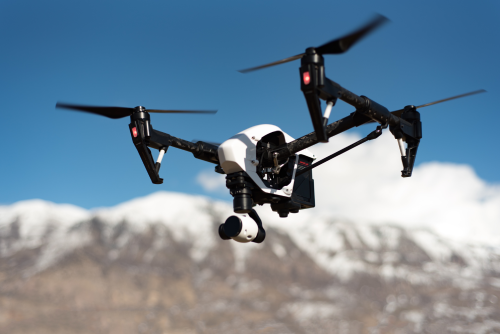
The Martin UAV V-Bat is an active US-built military VTOL fixed-wing drone aimed at operators who need runway-independent launch with longer endurance than a typical multirotor. Based on the supplied public data, it offers up to 8 hours of endurance, a stated range of 563 km, and a top speed of 166 km/h. That makes it most relevant to defense, government, and research readers comparing niche VTOL platforms rather than mainstream consumer drones.
What makes the V-Bat worth attention is not just that it can take off and land vertically, but that it appears to pair that flexibility with performance numbers that move it beyond the “small tactical quadcopter” category. In practical terms, it sits in a part of the market where endurance, deployment flexibility, and mission persistence matter more than cinematic image quality, beginner usability, or app polish. For agencies and teams that operate from ships, isolated sites, temporary field positions, or urban areas with little launch space, that combination can be strategically valuable.
At the same time, this is not a transparent retail product with a neat online checkout page, public accessories list, and fully documented feature sheet. Many of the details ordinary commercial-drone buyers would expect to see up front—payload options, support terms, pricing, software depth, and training pipeline—are either absent from the supplied data or likely handled through direct procurement channels. So the V-Bat is best understood as a serious mission platform with attractive headline figures, but one that requires much deeper buyer diligence than a normal enterprise or prosumer drone.
Quick Summary Box
- Drone Name: Martin UAV V-Bat
- Brand: Martin UAV
- Model: V-Bat
- Category: Military / VTOL fixed-wing
- Best For: Government, defense, and research users needing runway-independent endurance
- Price Range: Not publicly confirmed in supplied data
- Launch Year: Not publicly confirmed in supplied data
- Availability: Not publicly confirmed in supplied data
- Current Status: Active
- Overall Rating: Not rated due to limited confirmed data
- Our Verdict: A specialized VTOL fixed-wing platform with strong published endurance and range figures, but public buyers face major information gaps around payloads, pricing, and support structure.
Introduction
The V-Bat sits in the military/VTOL segment, where the main appeal is combining vertical takeoff and landing with the cruise efficiency of a winged airframe. In plain terms, it is designed for missions where a runway is impractical but endurance still matters. Readers care about it because that combination is harder to achieve than it sounds, and the V-Bat’s published endurance and range figures place it in a more serious class than most small unmanned aircraft.
This category exists to solve a real operational problem. Traditional fixed-wing drones can stay airborne for longer periods and travel farther than most multirotors, but they often need a runway, a launcher, a recovery net, or a well-prepared operating area. Multirotors solve the launch-and-recovery problem, but they usually sacrifice range and endurance. A VTOL fixed-wing aircraft tries to bridge that gap. When it works well, operators get the convenience of vertical launch with the mission reach of a more efficient cruise platform.
That promise is especially relevant for military and government users because real deployments rarely happen from ideal airfields. Small teams may launch from rough terrain, rooftops, ship decks, temporary forward sites, or remote outposts. In those conditions, an aircraft that can self-deploy vertically and then cruise efficiently can reduce equipment burden, shorten setup time, and widen the number of places from which missions can be flown.
The reason the V-Bat stands out in that conversation is not simply its class, but the published numbers attached to it. An 8-hour endurance figure changes the type of missions a drone can support. A 563 km stated range suggests broader-area operations than short-leg tactical scouting. A top speed of 166 km/h indicates the platform is designed for meaningful transit performance rather than just hovering near the launch site. Those numbers do not tell the whole story, but they are strong enough to justify serious comparison by analysts and procurement teams.
Overview
What kind of drone is it?
The Martin UAV V-Bat is a VTOL fixed-wing unmanned aircraft from the USA. That means it is intended to take off and land vertically, then transition into more efficient wing-borne flight for longer-distance work. In the military market, that layout matters because it can reduce dependence on launch rails, catapults, or runways.
That distinction is important because “VTOL drone” is a broad label. Some VTOL aircraft are essentially multirotors with limited forward-flight efficiency. Others are hybrid airframes that use separate lift motors for takeoff and then rely on fixed wings for cruise. The supplied data does not detail the V-Bat’s exact propulsion architecture, so the most careful interpretation is simply that it belongs to the runway-independent fixed-wing class rather than the consumer quadcopter class. The mission implication is clear even if the engineering specifics are not publicly outlined here: it is designed to deploy vertically, travel farther and longer than most hovering drones, and support operations where infrastructure is limited.
Who should buy it?
This is not a normal retail drone for hobby flying, vlogging, or casual aerial photography. The most realistic audience includes:
- Defense and government program evaluators
- Public-sector aviation teams
- Researchers studying long-endurance VTOL systems
- Journalists and analysts comparing tactical unmanned aircraft
- Enterprise readers tracking procurement-class drone platforms
It is worth clarifying why each of those groups might care. A defense evaluator may be looking at the V-Bat as part of a broader tactical UAS shortlist. A government aviation unit may care about whether it can launch from tight spaces without giving up too much endurance. Researchers may be less interested in buying the aircraft immediately and more interested in understanding how modern VTOL fixed-wing systems balance performance, field logistics, autonomy, and mission flexibility. Analysts and journalists, meanwhile, often track platforms like this because they occupy a strategic middle ground between small tactical drones and larger runway-based unmanned systems.
For most ordinary commercial buyers, though, the fit is weak. If your primary needs are routine site inspection, real-estate media, standard mapping, or simple thermal surveys, there are more transparent and accessible platforms with clearer support pathways. The V-Bat becomes relevant when the mission profile is harder, the operating environment is more constrained, or the user organization is built to handle procurement-heavy aviation systems.
What makes it different?
What stands out in the supplied data is the combination of:
- VTOL fixed-wing configuration
- 8-hour endurance
- 563 km published range
- 166 km/h top speed
- Active market status
That mix suggests a platform built around persistence and flexible deployment rather than short-range hovering.
The significance of those figures is easiest to understand in combination rather than isolation. Endurance alone can be impressive, but if a drone is slow or limited in range, that endurance may be spent mostly loitering near the launch point. Speed alone can be useful, but without endurance it may only support quick dashes rather than persistent missions. Range can sound impressive, but if launch and recovery are complex, practical deployment flexibility may still be weak. The V-Bat’s appeal comes from the idea that all three variables—endurance, distance, and runway independence—are being pursued together.
That is why the aircraft is more interesting as a mission system than as a spec-sheet curiosity. If the published figures translate into real operational performance under useful payload loadouts, the V-Bat could offer a strong compromise for users who need tactical flexibility without accepting the short legs of a typical multirotor.
Key Features
- VTOL fixed-wing airframe for vertical launch/recovery plus more efficient forward flight
- Published endurance of 8 hours, suggesting mission persistence well beyond standard small-UAS expectations
- Published maximum range of 563 km, indicating suitability for broader-area operations than short-hop observation tasks
- Published top speed of 166 km/h, which points to meaningful transit capability rather than purely local hover work
- Active platform status, indicating it is not listed here as discontinued or legacy-only
- Military-oriented positioning, making it more relevant for program-level evaluation than consumer comparison
- Runway-independent mission profile as a core benefit of the VTOL fixed-wing category
- Potential value in austere or constrained launch environments, where a runway, launcher, or recovery system may be impractical
- Payload and camera flexibility likely matter heavily, but exact payload options are not publicly confirmed in the supplied data
- Ground control, autonomy, and software stack are not publicly confirmed in the supplied data
- Procurement-class purchase path, meaning buyer experience is likely closer to defense acquisition than retail drone ownership
- Long-endurance operational promise, which may be especially relevant for border, maritime, and remote-site monitoring if supported by suitable sensors
Full Specifications Table
| Specification | Details |
|---|---|
| Brand | Martin UAV |
| Model | V-Bat |
| Drone Type | VTOL fixed-wing |
| Country of Origin | USA |
| Manufacturer | Martin UAV |
| Year Introduced | Not publicly confirmed in supplied data |
| Status | Active |
| Use Case | Military / VTOL |
| Weight | Not publicly confirmed in supplied data |
| Dimensions (folded/unfolded) | Not publicly confirmed in supplied data |
| Max Takeoff Weight | Not publicly confirmed in supplied data |
| Battery Type | Not publicly confirmed in supplied data |
| Battery Capacity | Not publicly confirmed in supplied data |
| Flight Time | 8 hr |
| Charging Time | Not publicly confirmed in supplied data |
| Max Range | 563 km |
| Transmission System | Not publicly confirmed in supplied data |
| Top Speed | 166 km/h |
| Wind Resistance | Not publicly confirmed in supplied data |
| Navigation System | Not publicly confirmed in supplied data |
| Obstacle Avoidance | Not publicly confirmed in supplied data |
| Camera Resolution | Not publicly confirmed in supplied data |
| Video Resolution | Not publicly confirmed in supplied data |
| Frame Rates | Not publicly confirmed in supplied data |
| Sensor Size | Not publicly confirmed in supplied data |
| Gimbal | Not publicly confirmed in supplied data |
| Zoom | Not publicly confirmed in supplied data |
| Storage | Not publicly confirmed in supplied data |
| Controller Type | Not publicly confirmed in supplied data |
| App Support | Not publicly confirmed in supplied data |
| Autonomous Modes | Not publicly confirmed in supplied data |
| Payload Capacity | Not publicly confirmed in supplied data |
| Operating Temperature | Not publicly confirmed in supplied data |
| Water Resistance | Not publicly confirmed in supplied data |
| Noise Level | Not publicly confirmed in supplied data |
| Remote ID Support | Not publicly confirmed in supplied data |
| Geo-fencing | Not publicly confirmed in supplied data |
| Certifications | Not publicly confirmed in supplied data |
| MSRP / Launch Price | Not publicly confirmed in supplied data |
| Current Price | Not publicly confirmed in supplied data |
The table above captures the challenge with evaluating the V-Bat from public information alone: the headline performance numbers are attention-grabbing, but many of the operating details that determine procurement suitability remain undisclosed in the supplied record. For mission buyers, unknowns such as payload class, environmental tolerance, communications architecture, supportability, and configuration options can be as important as flight time itself.
Design and Build Quality
Public detail is limited, so the safest conclusion is that the V-Bat should be viewed first as a mission airframe, not a lifestyle product. Its VTOL fixed-wing classification suggests a design focused on field deployment efficiency: vertical launch and recovery for tight operating areas, paired with a winged cruise phase for endurance.
That matters because “build quality” means something different in this category than it does in consumer drone reviews. For a retail camera drone, buyers often think in terms of compact folding design, cosmetic finish, fit and finish tolerances, or how premium the controller feels in the hand. For a procurement-class military VTOL system, build quality is more about ruggedness, repeatability, service access, transport practicality, and whether the aircraft can be assembled, flown, maintained, and redeployed reliably in austere conditions.
What cannot be confirmed from the supplied data includes:
- Exact dimensions
- Weight
- Foldability
- Materials
- Propulsion layout details
- Field service access points
Those omissions matter more than they might first appear. Dimensions affect shipping footprint, vehicle integration, storage requirements, and shipboard or mobile-team use. Weight influences launch-party workload, recovery handling, maintenance ergonomics, and regulatory treatment during domestic testing. Materials and structural design affect repairability, corrosion resistance, survivability in field handling, and lifecycle cost. Even something as basic as how quickly components can be inspected or swapped in the field can have a major effect on mission tempo.
From an operator perspective, the likely design priority is practicality in constrained environments rather than consumer portability. That does not automatically mean “easy to transport” or “easy to repair,” so buyers should verify packing footprint, spare-part logistics, and maintenance workflow directly with the manufacturer or authorized channel.
A useful way to think about the V-Bat’s design is to ask not whether it looks refined, but whether it is designed around operational friction. How many people are needed to unpack and ready it? How much support equipment travels with it? How exposed are critical parts during transport? How quickly can the aircraft be turned around between sorties? Can sensors be swapped without specialist tools? Does routine maintenance happen at the field level or require depot support? Those are the questions that define practical build quality in this segment.
In short, the V-Bat should be judged as an operational aircraft system, not as a consumer gadget. Until more detailed public design data is available, its build story remains promising but incomplete.
Flight Performance
The most important confirmed performance figure is the 8-hour endurance. For a VTOL platform, that is a meaningful number because vertical takeoff and landing usually add complexity and energy cost compared with pure fixed-wing systems. If the published figure is achievable in mission-relevant configuration, it points to a platform built for persistence rather than quick sorties.
Why does that matter so much? Because endurance changes the shape of a mission. With short-flight multirotors, operators often spend a significant amount of time landing, swapping power sources, relaunching, and repositioning. A longer-endurance aircraft can loiter over an area, transit between multiple task points, support shift-based operations more efficiently, or reduce the number of launches required to maintain coverage. In surveillance, maritime observation, perimeter overwatch, or wide-area search, that kind of persistence can be far more valuable than raw speed alone.
The 166 km/h top speed suggests the V-Bat is not a slow hover-centric craft. Instead, it appears positioned more like an efficient forward-flight system that happens to retain vertical launch and recovery ability. That can matter for covering larger areas, repositioning faster, or reducing transit time.
Top speed, however, should be read carefully. Maximum speed is not always the same as efficient cruise speed, nor does it necessarily reflect the best loiter setting for endurance. A platform can have an impressive top-end number while doing most of its real work at a lower, more economical airspeed. So the meaningful operational question is not just “How fast can it go?” but “At what speed does it deliver its most useful blend of endurance, sensor stability, and mission efficiency?” The supplied data does not answer that, so readers should treat 166 km/h as a useful ceiling figure rather than a complete performance picture.
The 563 km range is also notable, but readers should treat it carefully. In drone marketing and database summaries, “range” can mean different things depending on payload, communications profile, reserve assumptions, and whether the figure reflects maximum one-way transit or broader mission planning. So while the published number is useful for comparison, it should not automatically be treated as a guaranteed real-world operating radius.
That distinction is especially important in government and defense contexts. A practical mission radius can be constrained by more than fuel or energy capacity. It may depend on communications links, relay architecture, regulatory approvals, line-of-sight limits, payload power draw, weather margins, and required reserve assumptions. A long theoretical range does not always translate directly into operational freedom. Still, even allowing for those caveats, a stated 563 km range places the V-Bat in a conversation beyond short-range tactical hover platforms.
A few practical conclusions are still fair:
- This is an outdoor-only platform in realistic use
- It is built for longer-distance missions, not indoor maneuvering
- The VTOL layout likely simplifies launch and recovery versus runway-dependent fixed-wing systems
- Wind handling may be better in forward flight than a small multirotor, but no confirmed wind rating is available in the supplied data
It is also useful to think about the full mission cycle, not just cruise performance. VTOL aircraft gain deployment flexibility, but vertical phases can be some of the most demanding parts of the flight profile. Launch and recovery in gusty conditions, near obstacles, on moving platforms, or from uneven surfaces can place different stresses on the aircraft than stable cruise does. Buyers should ask how transition phases affect operational limits, how recovery accuracy is managed, and whether endurance figures assume ideal launch conditions or realistic repeated field use.
Another issue is payload effect. An aircraft may post strong endurance and range in a baseline configuration, but sensor turrets, communications payloads, environmental kits, or extra integration hardware can materially change performance. Without confirmed payload detail, it is impossible to say how close the supplied figures are to a fully missionized setup. Serious evaluators should therefore treat the published performance as a headline indicator, then request configuration-specific mission profiles before drawing procurement conclusions.
Camera / Payload Performance
The supplied data does not confirm the V-Bat’s camera package, payload class, stabilization system, or sensor options. That is a major limitation for anyone trying to evaluate it as a surveillance, mapping, or special-mission aircraft.
In this segment, payload choice usually defines the mission value more than the airframe alone. For example, a long-endurance VTOL platform can look very different in practice depending on whether it carries:
- Daylight imaging sensors
- Thermal payloads
- Multi-sensor stabilized turrets
- Communications or relay payloads
- Research instrumentation
Because none of those details are confirmed here, the safest conclusion is that the V-Bat should be treated as a platform-level candidate rather than a fully defined camera drone. Buyers should verify payload compatibility, stabilization quality, onboard power availability, and data-link integration before drawing conclusions about mission readiness.
This is one of the most important distinctions in the entire review. A consumer drone is often evaluated primarily by its built-in camera. A military VTOL platform is usually evaluated by what payloads it can support, how well those payloads integrate, and whether the aircraft can still meet endurance and handling expectations once they are installed. In other words, the airframe is only half the story.
For surveillance users, the main questions are likely to be about image quality, thermal capability, zoom performance, stabilization in forward flight, target handoff workflow, and whether the sensor suite is optimized for wide-area search or point inspection. For research users, concerns may include power budgets, mounting flexibility, vibration characteristics, and whether onboard systems allow third-party instrumentation or data capture. For communications roles, buyers may care less about optics and more about antenna placement, electromagnetic compatibility, and sustained orbit behavior.
Payload integration is not just about physical mounting, either. A well-supported mission payload needs clean command interfaces, useful operator controls, reliable downlink behavior, and manageable data-handling workflows. It matters whether the sensor can be controlled from the same interface as the aircraft, whether metadata is embedded cleanly, how video is recorded and exported, and whether operators can switch between mission packages without major reconfiguration overhead.
The lack of public payload detail therefore limits the V-Bat’s assessability more than the lack of consumer-style camera specs might suggest. The aircraft may be highly capable in this area—but from the supplied data alone, that remains unverified.
Smart Features and Software
Public software detail is thin in the supplied record. There is no confirmed information here on:
- Waypoint mission planning
- Return-to-home logic
- Follow-me functions
- AI tracking
- Mapping software
- SDK or API support
- Fleet management tools
- App ecosystem
- Cloud connectivity
That said, it would be unusual for an active military VTOL platform to operate without some form of autopilot, navigation logic, and ground control workflow. The important point is that the specific implementation is not publicly confirmed in the supplied data.
For serious buyers, software questions may be more important than airframe questions. Verify:
- Ground control station type
- Mission planning workflow
- Sensor-control interface
- Data-link architecture
- Contingency and recovery modes
- Training burden for operators and maintainers
In this class, software is often where usable capability either comes together or falls apart. An aircraft may have excellent raw endurance, but if mission planning is cumbersome, operator workload is high, or the interface between flight control and sensor control is awkward, the real mission value may be lower than the airframe numbers suggest. Conversely, a strong software environment can multiply the value of the aircraft by reducing training load, improving situational awareness, and making missions more repeatable.
There are several software-related questions procurement teams should ask even when public documentation is sparse. How are lost-link events handled? What contingency behaviors are configurable? Can geospatial plans be imported from other systems? How is video and telemetry archived? Is cybersecurity posture documented? Can the platform integrate into broader command-and-control workflows? What permissions or role structures exist for multi-user teams? How are software updates delivered, validated, and sustained over time?
For organizations already operating other drones, interoperability may matter just as much as standalone functionality. If the V-Bat requires a separate planning environment, separate training stream, or separate data-management stack, that can increase total ownership complexity. On the other hand, if it integrates well with existing workflows, the burden of introducing a new airframe can be reduced significantly.
So while it is reasonable to assume the V-Bat has meaningful autonomy and mission-planning capability, that assumption should not substitute for direct verification. In procurement settings, software maturity often determines day-to-day usefulness more than the headline airframe statistics do.
Use Cases
Given the confirmed airframe type and performance figures, the most realistic use cases are the following:
- Runway-independent government and defense observation missions
- Long-endurance aerial monitoring from constrained launch areas
- Expeditionary or remote-site UAS operations where runway access is limited
- Program evaluation for VTOL fixed-wing surveillance platforms
- Research and testing around endurance-focused VTOL aircraft concepts
- Training and doctrine development for teams transitioning from multirotor to fixed-wing VTOL systems
Each of those use cases deserves a little more context.
Runway-independent observation missions: This is the most obvious fit. If a team needs to launch from a small field position, temporary checkpoint, coastal site, or maritime-adjacent location, a VTOL system can eliminate some of the infrastructure requirements of conventional fixed-wing operations. That matters for surveillance, overwatch, route monitoring, or reconnaissance where the launch site may be chosen for tactical convenience rather than ideal aviation layout.
Long-endurance monitoring from tight spaces: A platform with 8-hour published endurance can potentially support watchstanding missions more efficiently than short-endurance systems. Instead of constant rotation between multiple batteries and aircraft, operators may be able to sustain coverage with fewer launches. This can help in perimeter observation, environmental monitoring, infrastructure security, or maritime scanning—assuming suitable payloads are available.
Expeditionary or remote-site operations: In austere environments, reducing support equipment matters. A drone that avoids runways and launchers may be attractive to teams that move frequently or operate from improvised sites. The value here is not just flight performance, but logistical simplification.
Program evaluation: Some buyers may never purchase the V-Bat specifically, but may still study it as a benchmark. It represents a case study in how the VTOL fixed-wing category is evolving, especially for users comparing hybrid airframes against rotary-wing or runway-based alternatives.
Research and testing: Universities, labs, and defense research organizations may examine aircraft like this to understand endurance optimization, VTOL transition efficiency, autonomy design, or mission-payload integration in compact tactical systems.
Training and doctrine development: Organizations moving beyond simple multirotors often need to rethink how they plan missions, structure crews, manage airspace, and interpret aircraft capabilities. A platform like the V-Bat can be relevant not only as hardware, but as a training and concept-development tool.
Depending on payload and certification specifics, there could also be adjacent roles in border observation, coastal patrol support, infrastructure corridor awareness, disaster-zone assessment, or communications relay. The key point is that the V-Bat’s value proposition is strongest where operators need both launch flexibility and time on station.
Pros and Cons
Pros
- Strong published endurance at 8 hours
- Long published range of 563 km
- VTOL fixed-wing format offers runway independence with winged cruise efficiency
- Respectable top speed of 166 km/h for a persistence-oriented platform
- Active status suggests current relevance rather than pure legacy interest
- Mission-focused positioning makes it notable in procurement and research comparisons
- Likely useful in constrained operating areas where launch rails or runways would be a burden
- Potentially attractive for austere deployments if support requirements are reasonable
- Relevant as a benchmark platform for anyone studying tactical VTOL fixed-wing systems
Cons
- Public data is limited, especially for payload, dimensions, and weight
- Pricing is not publicly confirmed, which makes budgeting difficult
- Camera and sensor details are not publicly confirmed
- Software and autonomy details are not publicly confirmed
- Support structure may be contract- or region-dependent, not consumer-friendly
- Not a retail-oriented product, so access may be restricted by procurement rules or export controls
- Operational value is highly payload-dependent, but payload specifics are not supplied here
- Real-world mission performance may vary significantly by configuration, which is not detailed in the supplied record
The broad takeaway is simple: the V-Bat’s strengths are compelling on paper, but the unknowns are concentrated in exactly the areas that determine buying confidence.
Comparison With Other Models
The table below is a high-level segment comparison. The V-Bat figures reflect the supplied record for this page. Competitor entries are broad public-market references and can vary by configuration, payload, and program version.
| Model | Price | Flight Time | Camera or Payload | Range | Weight | Best For | Winner |
|---|---|---|---|---|---|---|---|
| Martin UAV V-Bat | Not publicly confirmed in supplied data | 8 hr | Not publicly confirmed in supplied data | 563 km | Not publicly confirmed in supplied data | Runway-independent long-endurance VTOL fixed-wing missions | Strongest confirmed range figure in this table |
| AeroVironment JUMP 20 | Not publicly confirmed in supplied data | Publicly marketed as a 13+ hr class platform; verify exact configuration | Multi-sensor mission payloads depending on configuration | Not directly comparable from the supplied data here | Not publicly confirmed in supplied data | Buyers prioritizing endurance in a tactical VTOL system | Endurance-focused choice |
| Schiebel Camcopter S-100 | Not publicly confirmed in supplied data | Publicly reported around a 6 hr class endurance depending on setup | Modular mission payload options depending on configuration | Not directly comparable from the supplied data here | Not publicly confirmed in supplied data | Operators preferring helicopter-style VTOL behavior | Rotary-wing mission flexibility |
A note of caution: this entire category is hard to compare cleanly from headline specs alone. Payload classes vary, communications assumptions vary, endurance can be configuration-dependent, and mission behavior can differ dramatically between a fixed-wing VTOL aircraft and a rotary-wing system. The right comparison is rarely just about who has the biggest advertised flight-time number.
V-Bat vs a close competitor
Against a close competitor like the AeroVironment JUMP 20, the V-Bat’s appeal is its published balance of VTOL flexibility and strong range. JUMP 20 is often discussed as the longer-endurance benchmark in this class, so buyers who care most about time aloft may compare those two first. If your priority is overall mission persistence, competitor endurance figures deserve close scrutiny.
The more interesting question is what kind of persistence you need. Some programs care about the longest possible orbit time over a fixed area. Others care about transit speed, launch simplicity, or how easily the system deploys with a small field team. If the V-Bat offers a better fit on those operational variables, a competitor with a higher headline endurance number may not automatically be the better choice.
V-Bat vs an alternative in the same segment
Compared with a rotary-wing VTOL alternative like the Schiebel Camcopter S-100, the V-Bat represents a different compromise. Rotary-wing systems can be attractive when hover behavior and helicopter-like operating logic matter most, while a VTOL fixed-wing aircraft usually aims to recover more cruise efficiency once it transitions out of vertical flight.
That difference affects mission style. Rotary-wing systems may be better suited to tasks involving stationary observation, tight maneuvering, or helicopter-like employment concepts. Fixed-wing VTOL systems typically make the strongest case when the aircraft needs to cover distance economically or remain efficient over long patrol patterns. So the choice is often less about which platform is universally better and more about which flight profile matches the mission concept.
V-Bat vs an older or previous-generation option
A clearly defined earlier V-Bat generation is not publicly confirmed in the supplied data for this page. In practical buying terms, the more useful comparison may be against older small tactical UAVs that needed catapult launch, runway access, or more launch equipment. On that axis, the V-Bat’s main differentiator is the VTOL fixed-wing concept itself.
That matters doctrinally as well as technically. Systems that remove launch rails, arresting gear, or prepared strips can change how teams deploy, how quickly they relocate, and what support vehicles they require. Even if the aircraft is not the absolute endurance leader in the category, the operational simplification of VTOL launch and recovery may still be enough to justify serious consideration.
Manufacturer Details
Martin UAV is the manufacturer and brand listed for this model, and the company is based in the USA. In broader market context, Martin UAV became part of Shield AI, so some readers may encounter the V-Bat under Martin UAV naming in older references and Shield AI naming in newer market discussions.
That matters because brand history and current corporate ownership can affect:
- Product naming
- Support channels
- Documentation sources
- Procurement contacts
- Upgrade path visibility
As listed in the supplied record, the brand and manufacturer are the same: Martin UAV. Readers should still verify whether current program support is handled through Martin UAV-branded channels, Shield AI channels, or both.
Corporate context matters more in this market than it does in casual drone buying. When a platform moves under a larger parent company, buyers often want to know whether that change improves long-term sustainment, expands integration options, affects documentation access, or alters procurement pathways. A larger parent can sometimes strengthen resources, software investment, or global support reach. It can also change product naming conventions, account structures, and the way support is delivered.
For analysts and program evaluators, that means the V-Bat should not be viewed only as a static airframe. It also sits within a broader company and product ecosystem that may shape future updates, interoperability, and sustainment strategy.
Support and Service Providers
For a platform in this segment, support is likely to be more structured and contract-led than what buyers see in the consumer drone market. Publicly confirmed details on warranty terms, repair turnaround, spare-part stocking, and regional maintenance centers are not available in the supplied data.
Before committing, buyers should verify:
- Official technical support pathway
- Regional service coverage
- Repair authorization process
- Spare-parts availability
- Training packages for operators and maintainers
- Software update process
- Long-term sustainment commitments
Community support is also likely to be much thinner than for mass-market drones, simply because this is a niche procurement-class platform.
That limited community footprint has practical consequences. With consumer drones, users can often rely on forums, third-party tutorials, broad reseller networks, and unofficial repair channels. With a platform like the V-Bat, support is more likely to be centralized, formal, and tied to purchase agreements. That can be positive if the service structure is strong, but it also means buyers should not assume easy independent troubleshooting or broad third-party accessory availability.
Sustainment deserves special attention. For a long-endurance military-oriented UAS, the critical question is not just whether the aircraft flies well on day one, but whether the supplier can maintain fleet readiness over years of use. That includes access to replacement components, software maintenance, approved training, documentation updates, and configuration management. A capable aircraft without a dependable sustainment model can become expensive and operationally fragile.
For public-sector buyers especially, service-level expectations should be clarified early. Ask whether maintenance is organizational-level, field-level, or depot-level. Ask what training is included. Ask how software revisions are validated. Ask whether spare kits are standardized. Ask how long key components are expected to remain available. In this class, the support model can influence lifecycle success as much as the aircraft itself.
Where to Buy
The V-Bat should not be approached like a standard retail drone purchase. This appears to be a procurement-oriented platform, so acquisition may be handled through:
- Official manufacturer sales channels
- Parent-company enterprise or defense sales teams
- Authorized integrators
- Government-approved distributors
- Region-specific procurement partners
Readers should not assume normal online storefront availability. Depending on country and intended use, access may also be affected by export controls, procurement rules, or end-user restrictions.
In practice, many buyers in this segment begin with a capability inquiry rather than a purchase order. That may involve requesting product documentation, arranging a demonstration, discussing mission requirements, reviewing payload options, and clarifying support expectations before any pricing is shared. Public-sector acquisitions may also require competitive evaluation, standards review, legal vetting, and internal approval steps that are far removed from normal enterprise drone buying.
For non-government research or institutional buyers, the path may still be formal. Even if acquisition is possible, the aircraft may require integration discussions, training commitments, or compliance planning before delivery. So the main advice here is simple: think in terms of vendor engagement and procurement workflow, not “shop cart” availability.
Price and Cost Breakdown
No launch price or current public price is confirmed in the supplied data. For a defense-linked VTOL aircraft, that usually means pricing depends heavily on configuration and contract structure rather than a simple posted MSRP.
Before budgeting, verify the cost of:
- Air vehicle itself
- Ground control equipment
- Sensor or payload package
- Batteries or onboard power components
- Spares and replacement parts
- Training
- Software licensing if applicable
- Maintenance and service agreements
- Shipping, import, and integration costs
In this class, the payload and support package can change the total ownership cost just as much as the airframe.
That last point cannot be overstated. A drone with strong public performance figures can appear attractive until the full system cost is understood. Ground stations, antennas, mission payloads, launch/recovery accessories, maintenance tooling, software support, and training pipelines can all materially affect the final budget. Depending on procurement structure, the aircraft itself may represent only part of the total program cost.
Buyers should also consider lifecycle rather than acquisition cost alone. What is the expected fleet size? How many spare air vehicles are needed for uptime? How often do critical components require replacement? Is there a recurring software fee? Are operator certifications or recurring training events required? Does the aircraft require specialized transport cases or environmental storage? These questions often determine whether a platform is economically sustainable over time.
For some organizations, the lack of public price transparency is not a deal-breaker; defense and government programs are used to configuration-based quotes. For others—especially smaller research groups or enterprise buyers accustomed to clear product catalogs—it can make shortlisting more difficult. The V-Bat is therefore best treated as a program purchase, not a unit-price impulse buy.
Regulations and Compliance
Rules for operating a platform like the V-Bat will depend heavily on country, operator type, and mission category. A few practical points apply almost everywhere:
- Registration requirements may apply even for testing or demonstration flights
- Commercial or governmental operator approvals may be required
- Airspace authorization is essential for any non-recreational operation
- Privacy and data-handling rules still matter when imaging or sensing is involved
- Remote ID support is not publicly confirmed in the supplied data
- Export, import, and restricted-use controls may apply more strongly than with consumer drones
- Military or government use does not automatically remove civil aviation obligations during training, transit, or domestic testing
Always verify local aviation law, end-user restrictions, and any platform-specific approvals before purchase or operation.
Large or long-endurance VTOL aircraft often face additional scrutiny compared with small consumer drones. Beyond basic registration and operator qualification, buyers may need to address issues such as beyond-visual-line-of-sight approvals, frequency or spectrum permissions, operating-area segregation, safety cases for test flights, and internal organizational risk procedures. If the aircraft will be used domestically by public agencies, there may also be procurement compliance, cybersecurity review, and data-governance requirements.
Cross-border acquisition adds another layer. Because the V-Bat is a US-built military-oriented platform, export review and end-user restrictions may be more relevant than they would be for consumer systems. That does not automatically prevent purchase, but it does mean buyers should clarify legal pathways early rather than treating compliance as a final-stage checkbox.
The simplest rule here is that capability should never be evaluated separately from legal operability. A platform can be technically ideal and still be impractical if the user cannot lawfully fly it in the intended environment.
Who Should Buy This Drone?
Best for
- Government and defense teams evaluating VTOL fixed-wing platforms
- Organizations needing runway-independent launch and recovery
- Buyers prioritizing endurance over consumer-friendly features
- Research or program-analysis teams comparing tactical unmanned aircraft
- Operators who can support a procurement-led, service-backed platform
These are the users most likely to extract real value from what the V-Bat appears to offer. They tend to care more about operational flexibility, mission duration, field deployment, and sustainment planning than about consumer polish. They are also more likely to have the internal structure to handle demonstrations, vendor engagement, training, and formal support agreements.
Not ideal for
- Hobbyists and first-time drone pilots
- Retail buyers wanting transparent public pricing
- Content creators looking for a camera-first drone
- Users who need consumer app ecosystems and simple support
- Buyers who require fully public payload, battery, and compliance details before shortlisting
That does not mean the V-Bat is a weak product. It means it is a specialized product. The mismatch happens when buyers approach it with consumer or light-enterprise expectations. If you want a drone that ships quickly, publishes every camera spec, and integrates into a familiar app-driven workflow, this is probably the wrong category entirely.
A practical way to decide fit is to ask whether your organization is solving an aviation problem or buying a drone tool. If you are solving an aviation problem involving launch constraints, endurance, and mission persistence, the V-Bat may deserve attention. If you are buying a tool for standard aerial imaging, there are easier options.
Final Verdict
The Martin UAV V-Bat stands out because the confirmed numbers are genuinely interesting: 8 hours of endurance, 563 km of range, and a VTOL fixed-wing layout in an active platform. Those traits make it a serious aircraft to watch in the military and government VTOL space, especially for buyers who value runway independence without giving up wing-borne efficiency.
Its core appeal is clear. A runway-independent aircraft with meaningful endurance can open up mission profiles that are difficult for both standard fixed-wing drones and ordinary multirotors. That makes the V-Bat relevant for constrained launch environments, expeditionary operations, long-watch tasks, and broader discussions about how tactical UAS design is evolving. On paper, it occupies a strategically useful middle ground between convenience and persistence.
The downside is equally clear: public information is thin where it matters most for a final decision. Payload options, detailed dimensions, software stack, support structure, and price are not publicly confirmed in the supplied data. So this is best understood as a high-potential, procurement-driven platform, not a transparent off-the-shelf drone purchase.
For defense, government, and serious research buyers, that does not automatically diminish the aircraft’s value. Many capable systems in this class are evaluated through demonstrations, direct vendor contact, and configuration-specific proposals rather than public spec dumps. But it does mean the V-Bat should be shortlisted with discipline. Buyers should press for payload details, mission-configured endurance data, software workflow explanations, sustainment terms, and regulatory pathway clarity before treating the headline numbers as procurement proof.
If you are a defense, government, or research buyer comparing long-endurance VTOL systems, the V-Bat deserves attention. If you are a consumer or even a typical enterprise buyer looking for easy pricing and published feature depth, it is probably too specialized and too opaque to be a straightforward fit. In short: the V-Bat looks compelling as a mission platform, but its real value depends on the details still missing from the public record.
